 Add to Chrome
 Add to Firefox
 Add to Edge
Towards a point-to-point CV-QKD system: Implementation challenges and perspectives
Dec 22, 2025
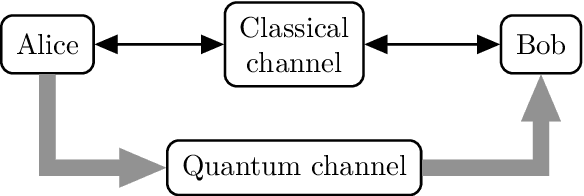
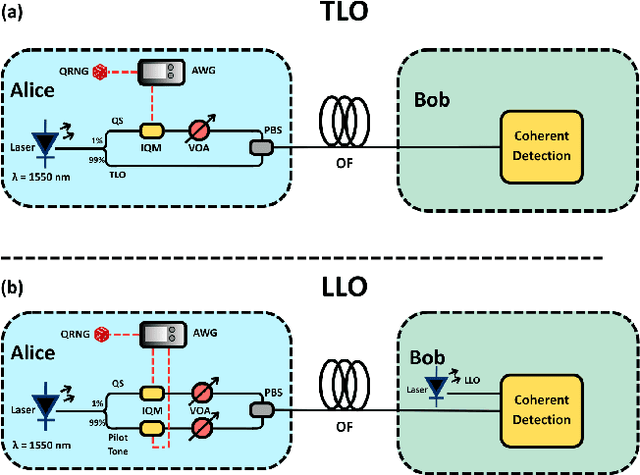
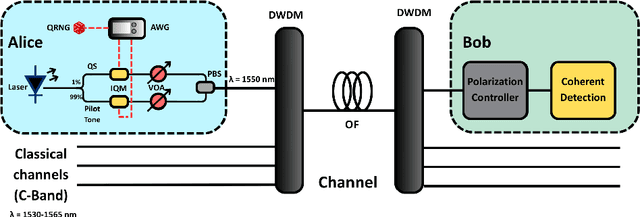
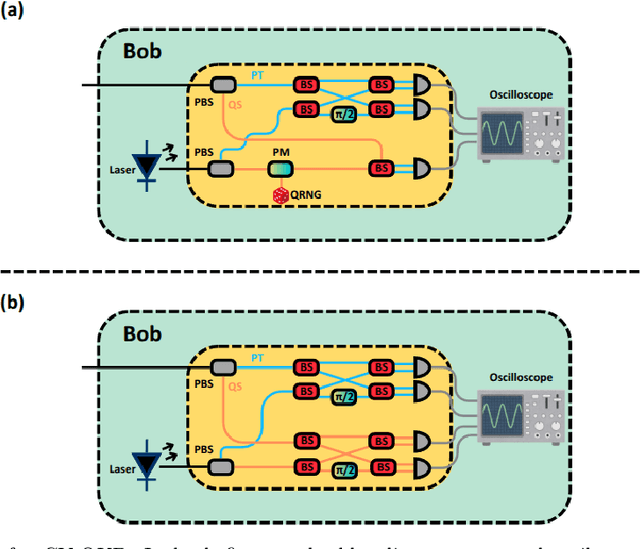
This article presents an analysis of the practical challenges and implementation perspectives of point-to-point continuous-variable quantum key distribution (CV-QKD) systems over optical fiber. The study addresses the physical layer, including the design of transmitters, quantum channels, and receivers, with emphasis on impairments such as attenuation, chromatic dispersion, polarization fluctuations, and coexistence with classical channels. We further examine the role of digital signal processing (DSP) as the bridge between quantum state transmission and classical post-processing, highlighting its impact on excess noise mitigation, covariance matrix estimation, and reconciliation efficiency. The post-processing pipeline is detailed with a focus on parameter estimation in the finite-size regime, information reconciliation using LDPC-based codes optimized for low-SNR conditions, and privacy amplification employing large-block universal hashing. From a hardware perspective, we discuss modular digital architectures that integrate dedicated accelerators with programmable processors, supported by a reference software framework (CV-QKD-ModSim) for algorithm validation and hardware co-design. Finally, we outline perspectives for the deployment of CV-QKD in Brazil, starting from metropolitan testbeds and extending toward hybrid fiber/FSO and space-based infrastructures. The work establishes the foundations for the first point-to-point CV-QKD system in Brazil, while providing a roadmap for scalable and interoperable quantum communication networks.

Exploring Quantum Neural Networks for Demand Forecasting
Oct 19, 2024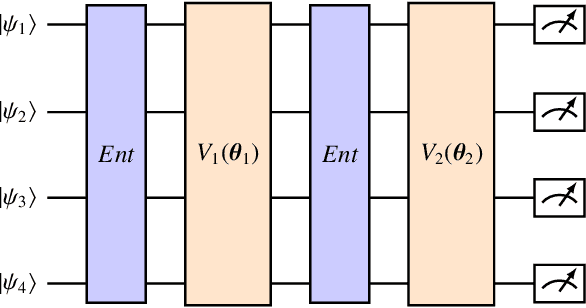
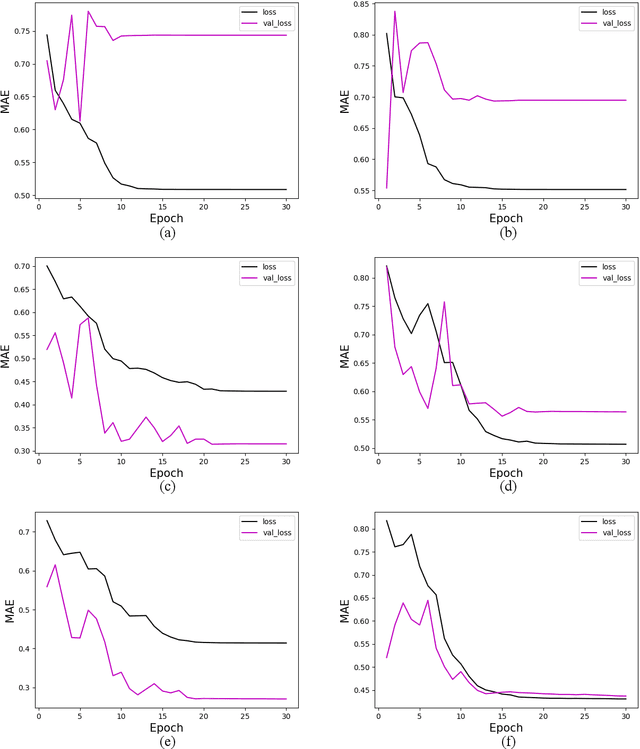
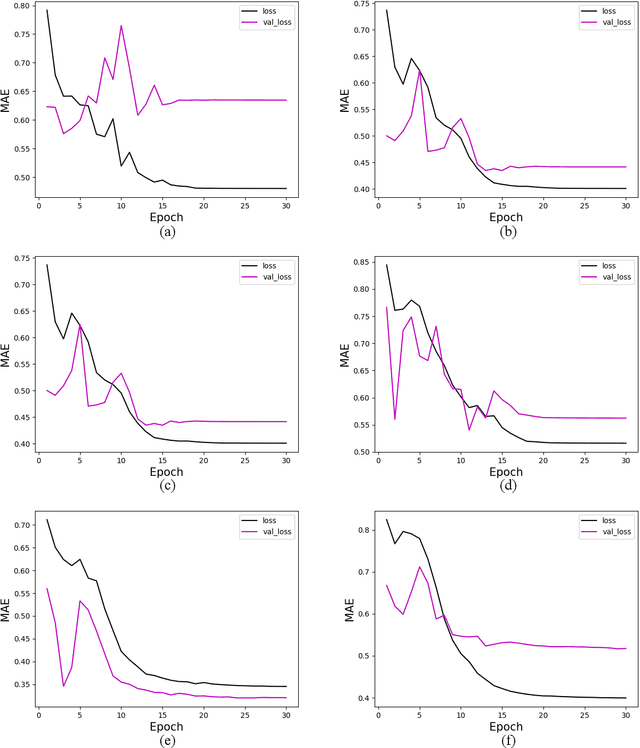
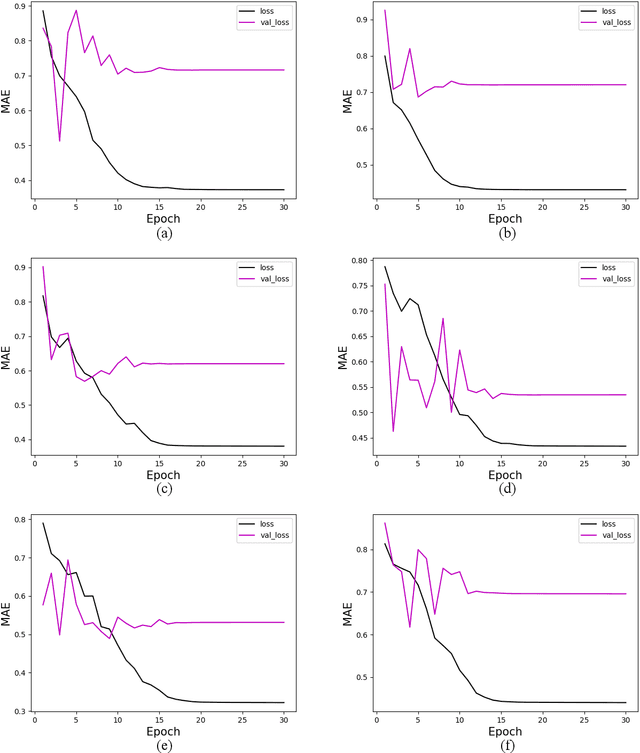
Forecasting demand for assets and services can be addressed in various markets, providing a competitive advantage when the predictive models used demonstrate high accuracy. However, the training of machine learning models incurs high computational costs, which may limit the training of prediction models based on available computational capacity. In this context, this paper presents an approach for training demand prediction models using quantum neural networks. For this purpose, a quantum neural network was used to forecast demand for vehicle financing. A classical recurrent neural network was used to compare the results, and they show a similar predictive capacity between the classical and quantum models, with the advantage of using a lower number of training parameters and also converging in fewer steps. Utilizing quantum computing techniques offers a promising solution to overcome the limitations of traditional machine learning approaches in training predictive models for complex market dynamics.