 Add to Chrome
 Add to Firefox
 Add to Edge
On the Efficiency of Sequentially Aware Recommender Systems: Cotten4Rec
Feb 06, 2026
Sequential recommendation (SR) models predict a user's next interaction by modeling their historical behaviors. Transformer-based SR methods, notably BERT4Rec, effectively capture these patterns but incur significant computational overhead due to extensive intermediate computations associated with Softmax-based attention. We propose Cotten4Rec, a novel SR model utilizing linear-time cosine similarity attention, implemented through a single optimized compute unified device architecture (CUDA) kernel. By minimizing intermediate buffers and kernel-launch overhead, Cotten4Rec substantially reduces resource usage compared to BERT4Rec and the linear-attention baseline, LinRec, especially for datasets with moderate sequence lengths and vocabulary sizes. Evaluations across three benchmark datasets confirm that Cotten4Rec achieves considerable reductions in memory and runtime with minimal compromise in recommendation accuracy, demonstrating Cotten4Rec's viability as an efficient alternative for practical, large-scale sequential recommendation scenarios where computational resources are critical.

An Efficient Attention Mechanism for Sequential Recommendation Tasks: HydraRec
Jan 02, 2025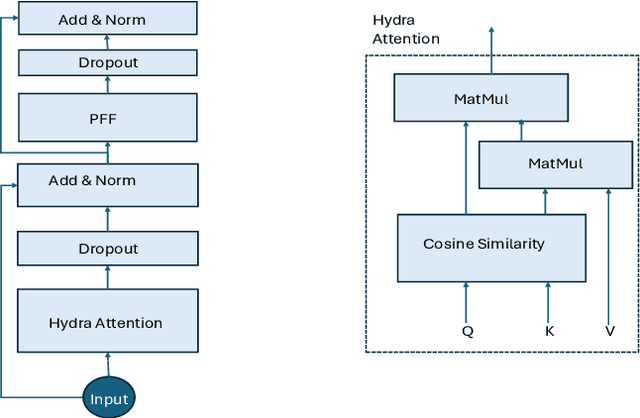
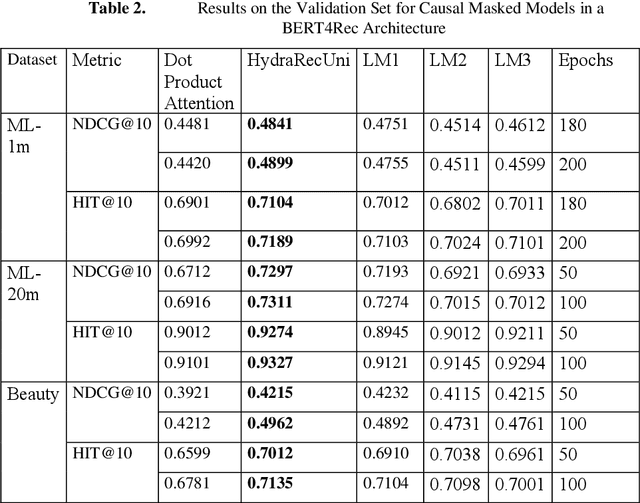
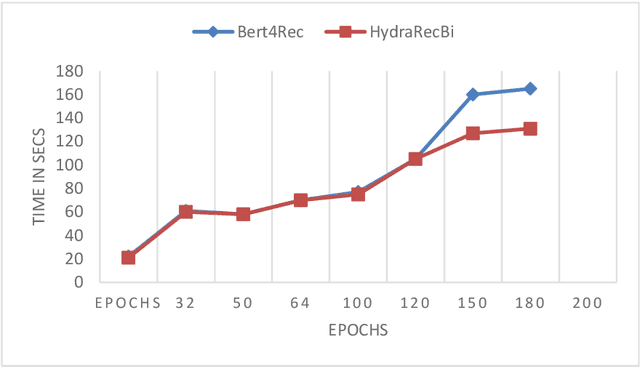
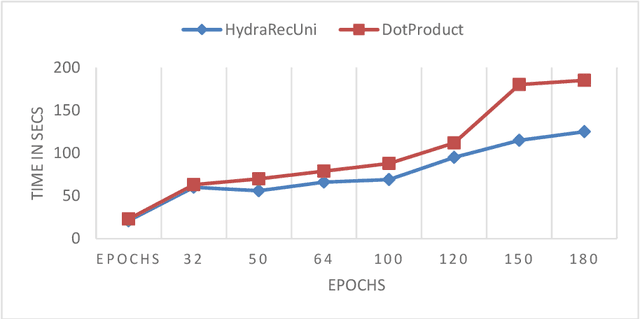
Transformer based models are increasingly being used in various domains including recommender systems (RS). Pretrained transformer models such as BERT have shown good performance at language modelling. With the greater ability to model sequential tasks, variants of Encoder-only models (like BERT4Rec, SASRec etc.) have found success in sequential RS problems. Computing dot-product attention in traditional transformer models has quadratic complexity in sequence length. This is a bigger problem with RS because unlike language models, new items are added to the catalogue every day. User buying history is a dynamic sequence which depends on multiple factors. Recently, various linear attention models have tried to solve this problem by making the model linear in sequence length (token dimensions). Hydra attention is one such linear complexity model proposed for vision transformers which reduces the complexity of attention for both the number of tokens as well as model embedding dimensions. Building on the idea of Hydra attention, we introduce an efficient Transformer based Sequential RS (HydraRec) which significantly improves theoretical complexity of computing attention for longer sequences and bigger datasets while preserving the temporal context. Extensive experiments are conducted to evaluate other linear transformer-based RS models and compared with HydraRec across various evaluation metrics. HydraRec outperforms other linear attention-based models as well as dot-product based attention models when used with causal masking for sequential recommendation next item prediction tasks. For bi-directional models its performance is comparable to the BERT4Rec model with an improvement in running time.