 Add to Chrome
 Add to Firefox
 Add to Edge
Enhancing Generative Information Extraction with Two-step Validation: A Product Attribute Use Case
Jul 29, 2026
The ability of large language models (LLMs) to process and generate text has introduced potential for applications in information extraction (IE). While it's debated whether LLMs outperform smaller fine-tuned models for classification tasks, their strong generalization capability makes them promising for domains with limited labeled data available for fine-tuning. This advantage is particularly relevant for the emerging application of the digital product passport (DPP), where the problem space is broad but domain-specific data remains scarce. Motivated by this use case, we apply generative IE to the product domain, explicitly addressing efficiency, generalizability, and data privacy constraints. We propose a two-step validation method that integrates a PLM block into the generative IE pipeline and thereby leverages LLMs' correction capability. We discover that such a validation task enhances LLM performance, particularly on the extraction of weakly expressed, low-salience entities that appear sparsely throughout the text. For certain entities, the performance of mid-size models can even reach levels comparable to larger models, and the improvement of first-step PLM predictions also enhance the final LLM output. Nevertheless, the effects on the smallest open-source LLMs (e.g., Llama-3.2 3B) is limited. Based on the findings, we develop a demo application for product information extraction that utilizes locally deployed LLMs, targeting further adaptations to real-world DPP use cases.

Transfer learning-based method for automated ewaste recycling in smart cities
Jun 22, 2026Sorting a huge stream of waste accurately within a short period can be done with the support of digitalization, particularly Artificial Intelligence, instead of traditional methods. The overlap of Artificial Intelligence and Circular Economy can flourish many services in the environmental technology domain, in particular smart ewaste recycling, resulting in enabling circular smart cities. We analyse the growing need for automated ewaste recycling as an essential requirement to cope with the fast growing ewaste stream and we shed the light on the impact of Artificial Intelligence in supporting the recycling process through smart classification of devices, where the smartphone is our case study. Our study applies transfer learning as a special technique of Artificial Intelligence by finetuning the output layers of AlexNet as a pretrained model and perform the implementation on a small size dataset that contains 12 classes from 6 smartphone brands. We evaluate the performance of our model by tuning the learning rate, choosing the best optimizer, and augmenting the original dataset to avoid overfitting. We found that the optimizer of Stochastic Gradient Descent with Momentum and 3e-4 as a learning rate brings almost 98% model accuracy with generalization. Our study supports automated ewaste recycling in decreasing the error rate of ewaste sorting and investigates the advantages of applying transfer learning as the best scenario to overcome the rising challenges.
Battery detection of XRay images using transfer learning
Jun 10, 2026The need for detecting and sorting batteries is drastically increasing for many applications. This study proves the potential of transfer learning in predicting whether the image contains a battery or not, the location and identifying three types of batteries, namely: prismatic, pouch, and cylindrical Lithium-Ion Batteries (LIB). Particularly, it focuses on the transfer learning method in two applications: Training a large-scale dataset to detect electronic devices using a pre-trained YOLOv5m, then using these latter trained weights to detect and classify the batteries. The precision of battery detection achieves 94%, which outperforms the pretrained YOLOv5m weights with 5%, in 22 ms inference time.
Don't waste SAM
Jun 09, 2026Meta AI has recently released the Segment Anything Model (SAM), which demonstrates exceptional zero-shot image segmentation performance across various tasks with remarkable accuracy. Despite its inability to provide accurate segmentation across multiple research fields, SAM still serves as a valuable starting point for supporting the segmentation pipeline process, particularly for tasks that require extensive and senior skills annotations. This study aims to evaluate the generalization of SAM and fine-tuning SAM models using three waste segmentation datasets. Although they are captured from real scenes as SAM was pretrained on, these datasets present several challenges, including occlusions, deformable objects, transparency, and objects easily confused with backgrounds. In our findings, the fine-tuned SAM-ViT-H model outperforms the state-ofthe-art Zerowaste, and TACO datasets with a significant increase of +30 in IoU, and it closely approaches performance levels of TrashCan 1.0, with only a -1.44 difference. After evaluating these popular waste datasets, it became evident that fine-tuning SAM as a foundational model is a crucial step for providing better generalization for downstream waste segmentation tasks. Therefore, SAM should not be disregarded or wasted.
A Transfer Learning Evaluation of Deep Neural Networks for Image Classification
May 12, 2026Transfer learning is a machine learning technique that uses previously acquired knowledge from a source domain to enhance learning in a target domain by reusing learned weights. This technique is ubiquitous because of its great advantages in achieving high performance while saving training time, memory, and effort in network design. In this paper, we investigate how to select the best pre-trained model that meets the target domain requirements for image classification tasks. In our study, we refined the output layers and general network parameters to apply the knowledge of eleven image processing models, pre-trained on ImageNet, to five different target domain datasets. We measured the accuracy, accuracy density, training time, and model size to evaluate the pre-trained models both in training sessions in one episode and with ten episodes.
* Published by Machine Learning and Knowledge Extraction Journal
A simple technique for improving multi-class classification with neural networks
Jan 06, 2016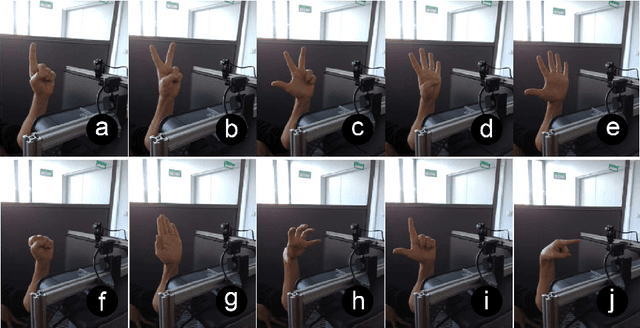



We present a novel method to perform multi-class pattern classification with neural networks and test it on a challenging 3D hand gesture recognition problem. Our method consists of a standard one-against-all (OAA) classification, followed by another network layer classifying the resulting class scores, possibly augmented by the original raw input vector. This allows the network to disambiguate hard-to-separate classes as the distribution of class scores carries considerable information as well, and is in fact often used for assessing the confidence of a decision. We show that by this approach we are able to significantly boost our results, overall as well as for particular difficult cases, on the hard 10-class gesture classification task.
A pragmatic approach to multi-class classification
Jan 06, 2016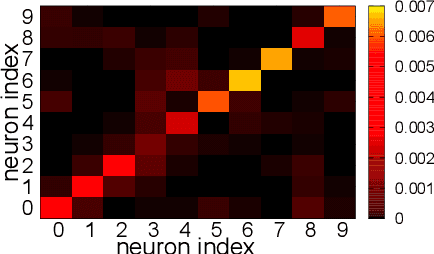
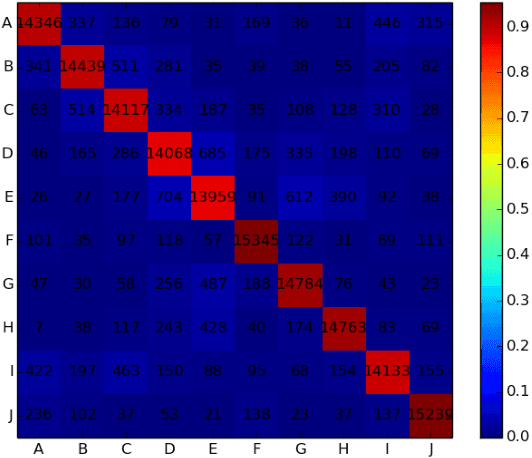
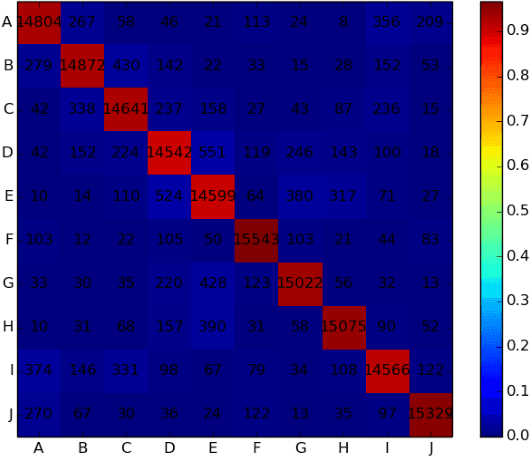
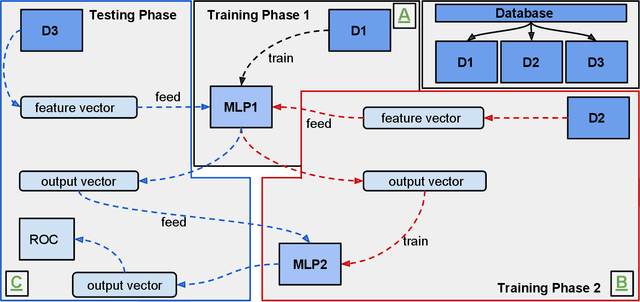
We present a novel hierarchical approach to multi-class classification which is generic in that it can be applied to different classification models (e.g., support vector machines, perceptrons), and makes no explicit assumptions about the probabilistic structure of the problem as it is usually done in multi-class classification. By adding a cascade of additional classifiers, each of which receives the previous classifier's output in addition to regular input data, the approach harnesses unused information that manifests itself in the form of, e.g., correlations between predicted classes. Using multilayer perceptrons as a classification model, we demonstrate the validity of this approach by testing it on a complex ten-class 3D gesture recognition task.