 Add to Chrome
 Add to Firefox
 Add to Edge
Efficient Fairness Testing in Large Language Models: Prioritizing Metamorphic Relations for Bias Detection
May 09, 2025
Large Language Models (LLMs) are increasingly deployed in various applications, raising critical concerns about fairness and potential biases in their outputs. This paper explores the prioritization of metamorphic relations (MRs) in metamorphic testing as a strategy to efficiently detect fairness issues within LLMs. Given the exponential growth of possible test cases, exhaustive testing is impractical; therefore, prioritizing MRs based on their effectiveness in detecting fairness violations is crucial. We apply a sentence diversity-based approach to compute and rank MRs to optimize fault detection. Experimental results demonstrate that our proposed prioritization approach improves fault detection rates by 22% compared to random prioritization and 12% compared to distance-based prioritization, while reducing the time to the first failure by 15% and 8%, respectively. Furthermore, our approach performs within 5% of fault-based prioritization in effectiveness, while significantly reducing the computational cost associated with fault labeling. These results validate the effectiveness of diversity-based MR prioritization in enhancing fairness testing for LLMs.

Metamorphic Relation Prioritization for Effective Regression Testing
Sep 20, 2021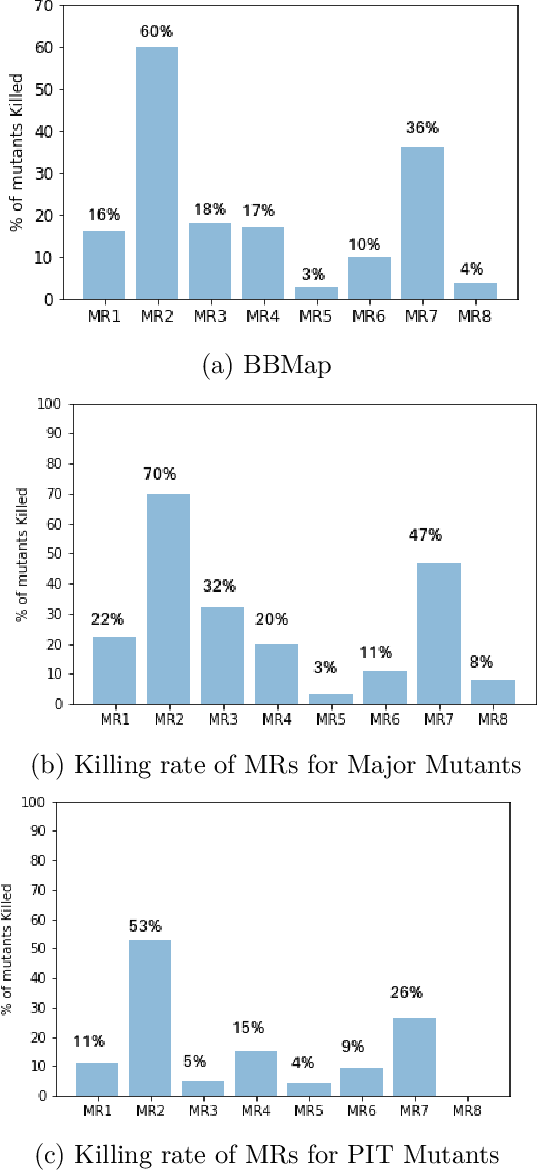
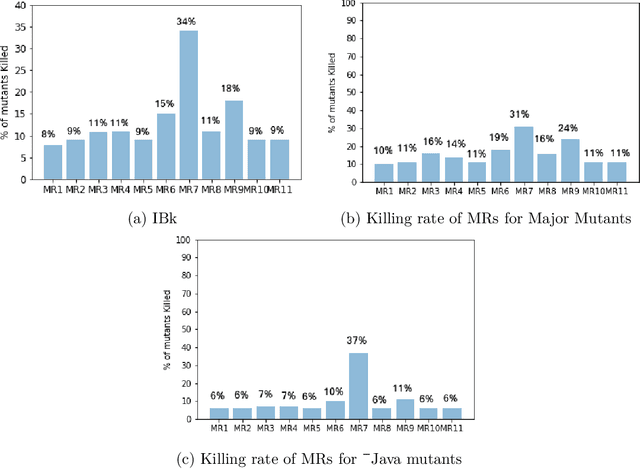
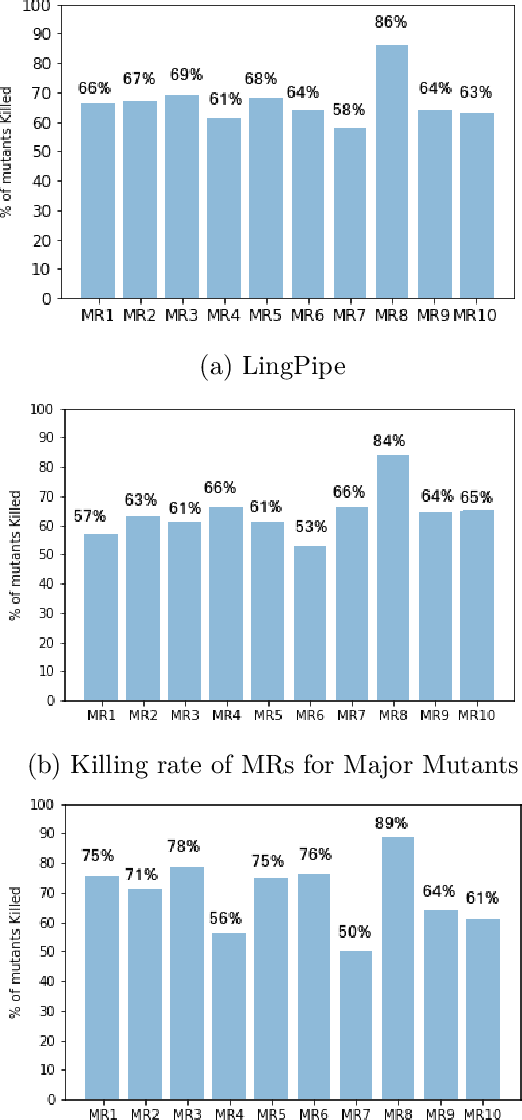
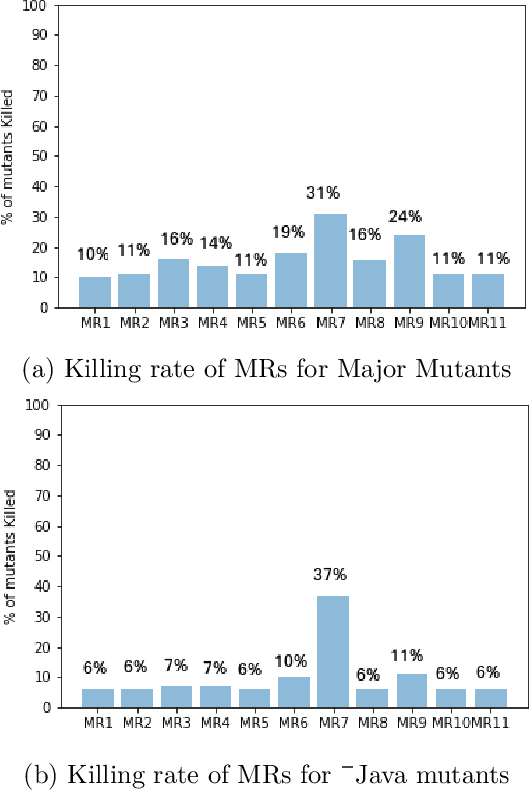
Metamorphic testing (MT) is widely used for testing programs that face the oracle problem. It uses a set of metamorphic relations (MRs), which are relations among multiple inputs and their corresponding outputs to determine whether the program under test is faulty. Typically, MRs vary in their ability to detect faults in the program under test, and some MRs tend to detect the same set of faults. In this paper, we propose approaches to prioritize MRs to improve the efficiency and effectiveness of MT for regression testing. We present two MR prioritization approaches: (1) fault-based and (2) coverage-based. To evaluate these MR prioritization approaches, we conduct experiments on three complex open-source software systems. Our results show that the MR prioritization approaches developed by us significantly outperform the current practice of executing the source and follow-up test cases of the MRs in an ad-hoc manner in terms of fault detection effectiveness. Further, fault-based MR prioritization leads to reducing the number of source and follow-up test cases that needs to be executed as well as reducing the average time taken to detect a fault, which would result in saving time and cost during the testing process.