 Add to Chrome
 Add to Firefox
 Add to Edge
Characterization and Correlation of Robotic Snake Scale Friction and Locomotion Speed
Mar 04, 2026
Snake robots are inspired by the ability of biological snakes to move over rock, grass, leaves, soil, up trees, along pavement and more. Their ability to move in multiple distinct environments is due to their legless locomotion strategy, which combines distinct gaits with a skin that exhibits frictional anisotropy. Designing soft robotic snakes with similar capabilities requires an understanding of how this underlying frictional anisotropy should be created in engineered systems, and how variances in the frictional anisotropy ratio affect locomotion speed and direction on different surfaces. While forward and backward frictional ratios have been characterized for previous scale designs, lateral friction and the associated ratios are often overlooked. In this paper, our contributions include: (i) the development of a novel articulated pseudo-skin design that is modular, easy to construct and has removable or replaceable scales; (ii) experimental measurement of the frictional characteristics of otherwise-identical scales at varying angles of attack (15°, 25°, 35°, 45°) on different surfaces of interest (grass, bark, smooth surface, carpet);(iii) separate measurements of locomotion speed for each angle and surface. Consequently, while we observed some consistent trends between frictional coefficients and scale angle, aligning with literature and intuition, we were not able to consistently identify expected correlations between frictional ratios and locomotion speed. We conclude that either frictional ratios alone are not sufficient to predict the observed speed of a snake robot, or that specific measurement approaches are required to accurately capture these ratios.

Hand Dominance and Congruence for Wrist-worn Haptics using Custom Voice-Coil Actuation
Aug 20, 2023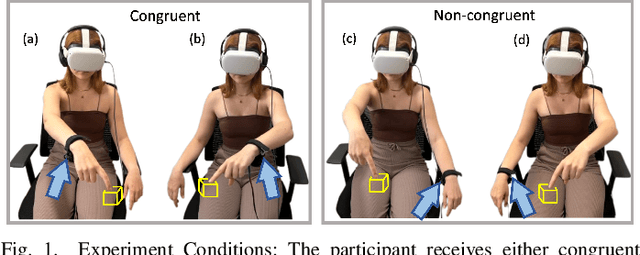
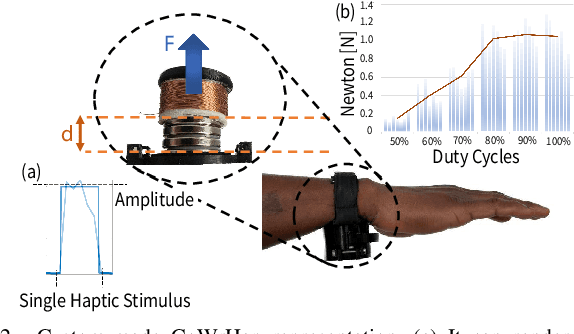
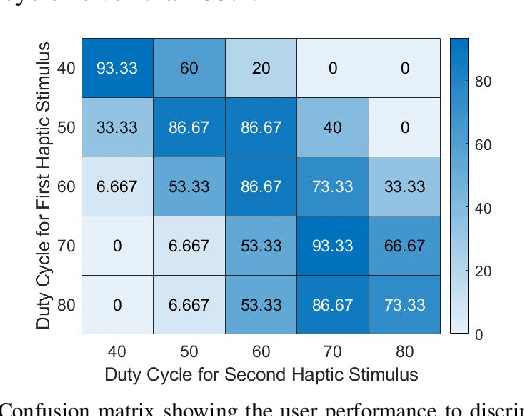
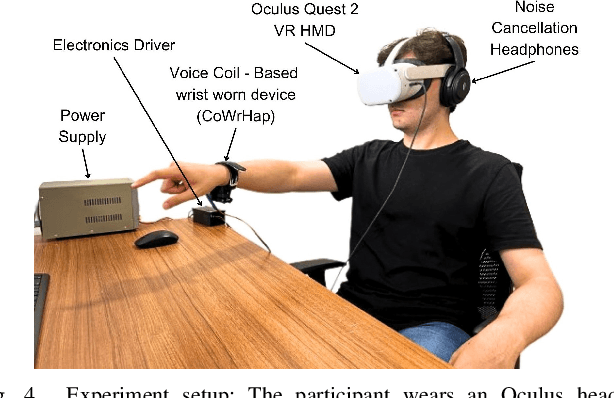
During virtual interactions, rendering haptic feedback on a remote location (like the wrist) instead of the fingertips freeing users' hands from mechanical devices. This allows for real interactions while still providing information regarding the mechanical properties of virtual objects. In this paper, we present CoWrHap -- a novel wrist-worn haptic device with custom-made voice coil actuation to render force feedback. Then, we investigate the impact of asking participants to use their dominant or non-dominant hand for virtual interactions and the best mapping between the active hand and the wrist receiving the haptic feedback, which can be defined as hand-wrist congruence through a user experiment based on a stiffness discrimination task. Our results show that participants performed the tasks (i) better with non-congruent mapping but reported better experiences with congruent mapping, and (ii) with no statistical difference in terms of hand dominance but reported better user experience and enjoyment using their dominant hands. This study indicates that participants can perceive mechanical properties via haptic feedback provided through CoWrHap.