 Add to Chrome
 Add to Firefox
 Add to Edge
Student views in AI Ethics and Social Impact
Mar 19, 2026
An investigation, from a gender perspective, of how students view the ethical implications and societal effects of artificial intelligence is conducted, examining concepts that could have a big influence on how artificial intelligence may be taught in the future. For this, we conducted a survey on a cohort of 230 second year computer science students to reveal their opinions. The results revealed that AI, from the students' perspective, will significantly impact daily life, particularly in areas such as medicine, education, or media. Men are more aware of potential changes in Computer Science, autonomous driving, image and video processing, and chatbot usage, while women mention more the impact on social media. Both men and women perceive potential threats in the same manner, with men more aware of war, AI controlled drones, terrain recognition, and information war. Women seem to have a stronger tendency towards ethical considerations and helping others.

Students' interest in knowledge acquisition in Artificial Intelligence
Nov 26, 2023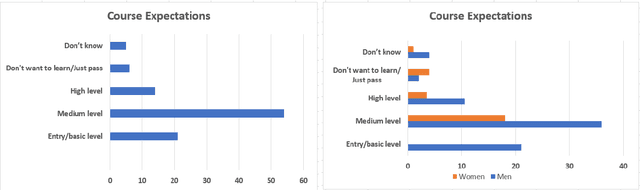
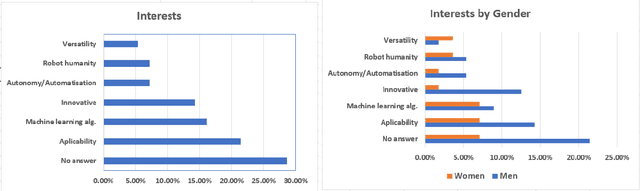
Some students' expectations and points of view related to the Artificial Intelligence course are explored and analyzed in this study. We anonymous collected answers from 58 undergraduate students out of 200 enrolled in the Computer Science specialization. The answers were analysed and interpreted using thematic analysis to find out their interests and attractive and unattractive aspects related to the Artificial Intelligence study topic. We concluded that students are interested in Artificial Intelligence due to its trendiness, applicability, their passion and interest in the subject, the potential for future growth, and high salaries. However, the students' expectations were mainly related to achieving medium knowledge in the Artificial Intelligence field, and men seem to be more interested in acquiring high-level skills than women. The most common part that wasn't enjoyed by the students was the mathematical aspect used in Artificial Intelligence. Some of them (a small group) were also aware of the Artificial Intelligence potential which could be used in an unethical manner for negative purposes. Our study also provides a short comparison to the Databases course, in which students were not that passionate or interested in achieving medium knowledge, their interest was related to DB usage and basic information.