 Add to Chrome
 Add to Firefox
 Add to Edge
Spectral Entropy Collapse as an Empirical Signature of Delayed Generalisation in Grokking
Apr 13, 2026
Grokking -- delayed generalisation long after memorisation -- lacks a predictive mechanistic explanation. We identify the normalised spectral entropy $\tilde{H}(t)$ of the representation covariance as a scalar order parameter for this transition, validated on 1-layer Transformers on group-theoretic tasks. Five contributions: (i) Grokking follows a two-phase pattern: norm expansion then entropy collapse. (ii) $\tilde{H}$ crosses a stable threshold $\tilde{H}^* \approx 0.61$ before generalisation in 100% of runs (mean lead: 1,020 steps). (iii) A causal intervention preventing collapse delays grokking by +5,020 steps ($p=0.044$); a norm-matched control ($n=30$, $p=5\times10^{-5}$) confirms entropy -- not norm -- drives the transition. (iv) A power-law $ΔT = C_1(\tilde{H}-\tilde{H}^*)^γ+C_2$ ($R^2=0.543$) predicts grokking onset with 4.1% error. (v) The mechanism holds across abelian ($\mathbb{Z}/97\mathbb{Z}$) and non-abelian ($S_5$) groups. Crucially, MLPs show entropy collapse without grokking, proving collapse is necessary but not sufficient -- architecture matters. Code: https://anonymous.4open.science/r/grokking-entropy

Detecting Neurovascular Instability from Multimodal Physiological Signals Using Wearable-Compatible Edge AI: A Responsible Computational Framework
Mar 20, 2026We propose Melaguard, a multimodal ML framework (Transformer-lite, 1.2M parameters, 4-head self-attention) for detecting neurovascular instability (NVI) from wearable-compatible physiological signals prior to structural stroke pathology. The model fuses heart rate variability (HRV), peripheral perfusion index, SpO2, and bilateral phase coherence into a composite NVI Score, designed for edge inference (WCET <=4 ms on Cortex-M4). NVI - the pre-structural dysregulation of cerebrovascular autoregulation preceding overt stroke - remains undetectable by existing single-modality wearables. With 12.2 million incident strokes annually, continuous multimodal physiological monitoring offers a practical path to community-scale screening. Three-stage independent validation: (1) synthetic benchmark (n=10,000), AUC=0.88 [0.83-0.92]; (2) clinical cohort PhysioNet CVES (n=172; 84 stroke, 88 control) - Transformer-lite achieves AUC=0.755 [0.630-0.778], outperforming LSTM (0.643), Random Forest (0.665), SVM (0.472); HRV-SDNN discriminates stroke (p=0.011); (3) PPG pipeline PhysioNet BIDMC (n=53) -- pulse rate r=0.748 and HRV surrogate r=0.690 vs. ECG ground truth. Cross-modality validation on PPG-BP (n=219) confirms PPG morphology classifies cerebrovascular disease at AUC=0.923 [0.869-0.968]. Multimodal fusion consistently outperforms single-modality baselines. Code: https://github.com/ClevixLab/Melaguard
Entropy Collapse: A Universal Failure Mode of Intelligent Systems
Dec 13, 2025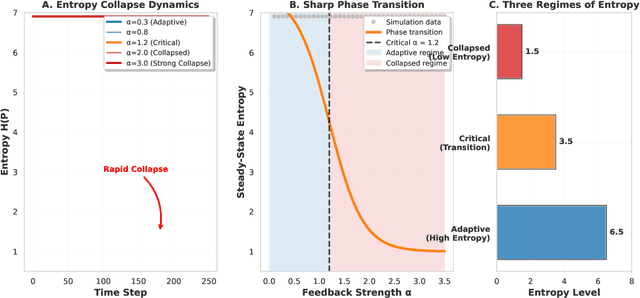
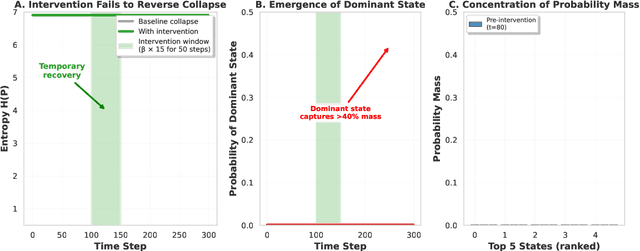
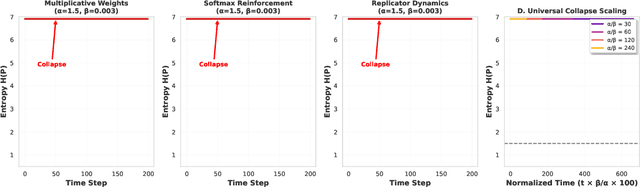
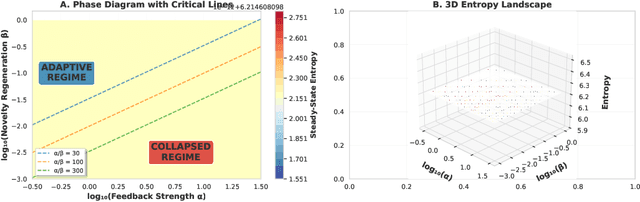
Intelligent systems are widely assumed to improve through learning, coordination, and optimization. However, across domains -- from artificial intelligence to economic institutions and biological evolution -- increasing intelligence often precipitates paradoxical degradation: systems become rigid, lose adaptability, and fail unexpectedly. We identify \emph{entropy collapse} as a universal dynamical failure mode arising when feedback amplification outpaces bounded novelty regeneration. Under minimal domain-agnostic assumptions, we show that intelligent systems undergo a sharp transition from high-entropy adaptive regimes to low-entropy collapsed regimes. Collapse is formalized as convergence toward a stable low-entropy manifold, not a zero-entropy state, implying a contraction of effective adaptive dimensionality rather than loss of activity or scale. We analytically establish critical thresholds, dynamical irreversibility, and attractor structure and demonstrate universality across update mechanisms through minimal simulations. This framework unifies diverse phenomena -- model collapse in AI, institutional sclerosis in economics, and genetic bottlenecks in evolution -- as manifestations of the same underlying process. By reframing collapse as a structural cost of intelligence, our results clarify why late-stage interventions systematically fail and motivate entropy-aware design principles for sustaining long-term adaptability in intelligent systems. \noindent\textbf{Keywords:} entropy collapse; intelligent systems; feedback amplification; phase transitions; effective dimensionality; complex systems; model collapse; institutional sclerosis