 Add to Chrome
 Add to Firefox
 Add to Edge
Max-Min Secrecy Rate Optimization for Secure ISAC Networks: Global Optimization and Low-Complexity Algorithm
Jun 11, 2026
In this paper, we investigate a secure integrated sensing and communication (ISAC) system in which multiple communication users (CUs) coexist with multiple untrusted sensing users (SUs) that may eavesdrop on the confidential information intended for the CUs. To promote security fairness among users, we formulate a max-min secrecy rate optimization problem subject to a transmit power budget and sensing quality requirements characterized by beampattern matching error constraints. The resulting design problem is highly non-convex due to the secrecy rate expressions and non-convex sensing constraints. To address these challenges, we first reformulate the problem using semidefinite relaxation (SDR). Based on the reformulated problem, we develop a branch-and-bound (BB) framework combined with convex relaxations to obtain the globally optimal solution within a prescribed accuracy. To further reduce computational complexity, we propose a low-complexity algorithm based on successive convex approximation (SCA), which iteratively solves a sequence of convex subproblems and converges to a local solution. Numerical results demonstrate that the proposed BB algorithm achieves the global optimum and provides a benchmark for performance evaluation. Moreover, the proposed SCA-based algorithm attains near-optimal secrecy performance with significantly lower computational complexity, making it attractive for practical ISAC deployments.

Counterfactual Explanation of Brain Activity Classifiers using Image-to-Image Transfer by Generative Adversarial Network
Oct 28, 2021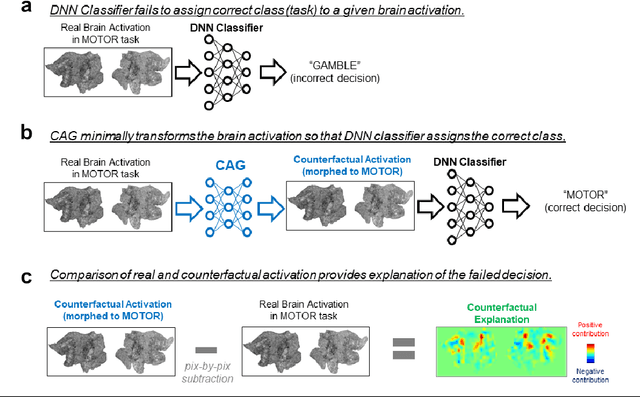
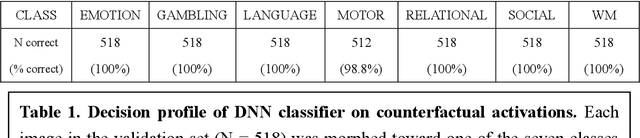
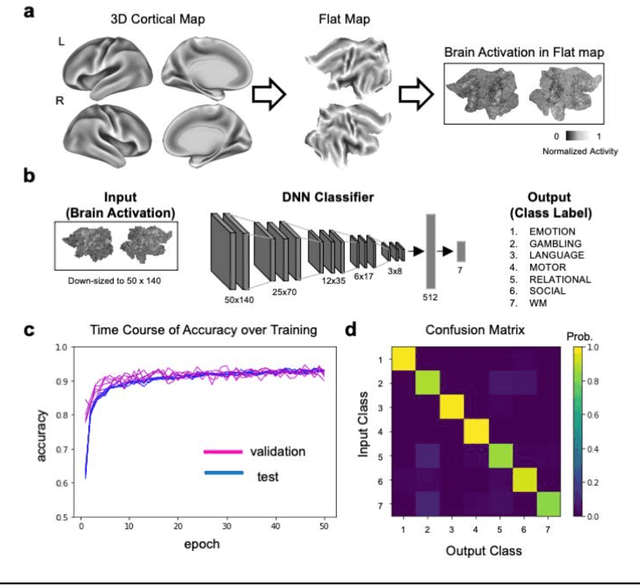

Deep neural networks (DNNs) can accurately decode task-related information from brain activations. However, because of the nonlinearity of the DNN, the decisions made by DNNs are hardly interpretable. One of the promising approaches for explaining such a black-box system is counterfactual explanation. In this framework, the behavior of a black-box system is explained by comparing real data and realistic synthetic data that are specifically generated such that the black-box system outputs an unreal outcome. Here we introduce a novel generative DNN (counterfactual activation generator, CAG) that can provide counterfactual explanations for DNN-based classifiers of brain activations. Importantly, CAG can simultaneously handle image transformation among multiple classes associated with different behavioral tasks. Using CAG, we demonstrated counterfactual explanation of DNN-based classifiers that learned to discriminate brain activations of seven behavioral tasks. Furthermore, by iterative applications of CAG, we were able to enhance and extract subtle spatial brain activity patterns that affected the classifier's decisions. Together, these results demonstrate that the counterfactual explanation based on image-to-image transformation would be a promising approach to understand and extend the current application of DNNs in fMRI analyses.