 Add to Chrome
 Add to Firefox
 Add to Edge
Language-Aware Token Boosting: LLM Language Confusion Reduction Without Tuning
Jun 08, 2026
Large language models (LLMs) sometimes exhibit language confusion when generating non-English text. Existing approaches typically rely on fine-tuning to mitigate this issue. In contrast, we propose a tuning-free paradigm for reducing language confusion. Within this paradigm, we introduce two methods: Language-Aware Token Boosting (LATB), which applies targeted perturbations to tokens associated with the desired language, and Adaptive Language-Aware Token Boosting (Adaptive-LATB), which dynamically adjusts these perturbations based on the model's confidence in the intended language. Experiments demonstrate that our methods effectively improve multilingual alignment by reducing language confusion, while maintain the summarization quality without requiring any additional fine-tuning. Our code is publicly available. https://github.com/scbdatax/genai-datax-language-aware-token-boosting.

ThaiSafetyBench: Assessing Language Model Safety in Thai Cultural Contexts
Mar 05, 2026The safety evaluation of large language models (LLMs) remains largely centered on English, leaving non-English languages and culturally grounded risks underexplored. In this work, we investigate LLM safety in the context of the Thai language and culture and introduce ThaiSafetyBench, an open-source benchmark comprising 1,954 malicious prompts written in Thai. The dataset covers both general harmful prompts and attacks that are explicitly grounded in Thai cultural, social, and contextual nuances. Using ThaiSafetyBench, we evaluate 24 LLMs, with GPT-4.1 and Gemini-2.5-Pro serving as LLM-as-a-judge evaluators. Our results show that closed-source models generally demonstrate stronger safety performance than open-source counterparts, raising important concerns regarding the robustness of openly available models. Moreover, we observe a consistently higher Attack Success Rate (ASR) for Thai-specific, culturally contextualized attacks compared to general Thai-language attacks, highlighting a critical vulnerability in current safety alignment methods. To improve reproducibility and cost efficiency, we further fine-tune a DeBERTa-based harmful response classifier, which we name ThaiSafetyClassifier. The model achieves a weighted F1 score of 84.4%, matching GPT-4.1 judgments. We publicly release the fine-tuning weights and training scripts to support reproducibility. Finally, we introduce the ThaiSafetyBench leaderboard to provide continuously updated safety evaluations and encourage community participation. - ThaiSafetyBench HuggingFace Dataset: https://huggingface.co/datasets/typhoon-ai/ThaiSafetyBench - ThaiSafetyBench Github: https://github.com/trapoom555/ThaiSafetyBench - ThaiSafetyClassifier HuggingFace Model: https://huggingface.co/typhoon-ai/ThaiSafetyClassifier - ThaiSafetyBench Leaderboard: https://huggingface.co/spaces/typhoon-ai/ThaiSafetyBench-Leaderboard
Improving Text Embeddings for Smaller Language Models Using Contrastive Fine-tuning
Aug 02, 2024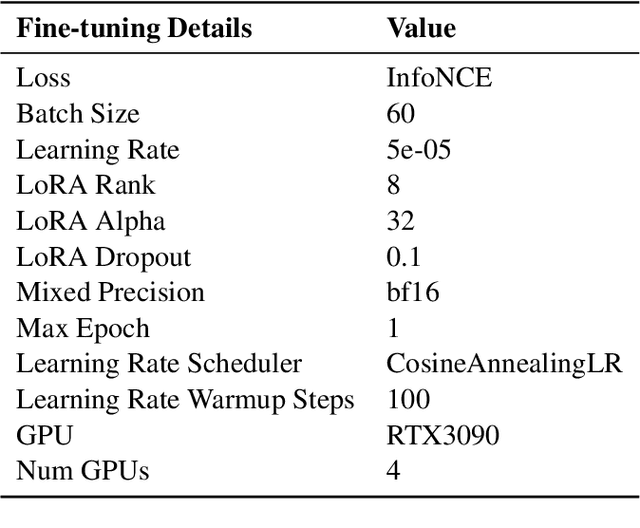
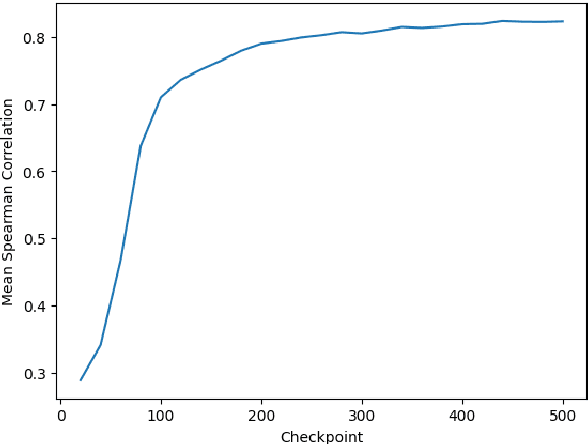
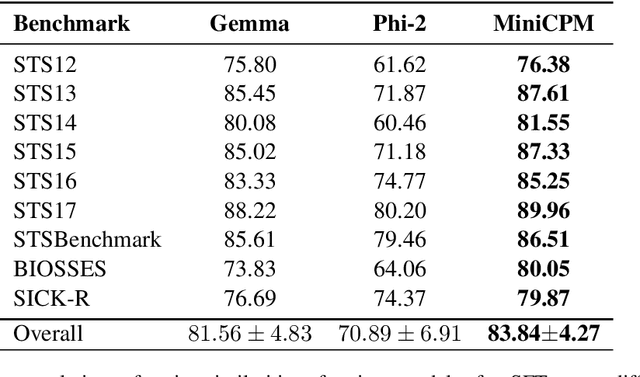
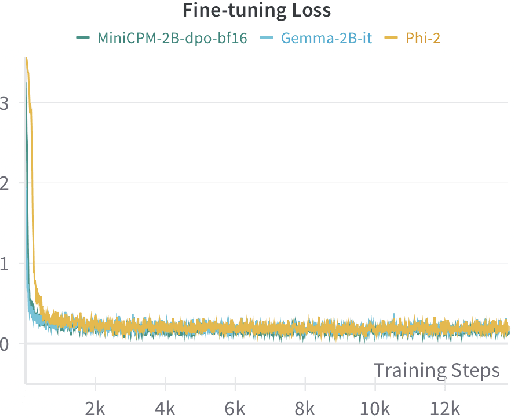
While Large Language Models show remarkable performance in natural language understanding, their resource-intensive nature makes them less accessible. In contrast, smaller language models such as MiniCPM offer more sustainable scalability, but often underperform without specialized optimization. In this paper, we explore the enhancement of smaller language models through the improvement of their text embeddings. We select three language models, MiniCPM, Phi-2, and Gemma, to conduct contrastive fine-tuning on the NLI dataset. Our results demonstrate that this fine-tuning method enhances the quality of text embeddings for all three models across various benchmarks, with MiniCPM showing the most significant improvements of an average 56.33% performance gain. The contrastive fine-tuning code is publicly available at https://github.com/trapoom555/Language-Model-STS-CFT.
GradeADreamer: Enhanced Text-to-3D Generation Using Gaussian Splatting and Multi-View Diffusion
Jun 14, 2024
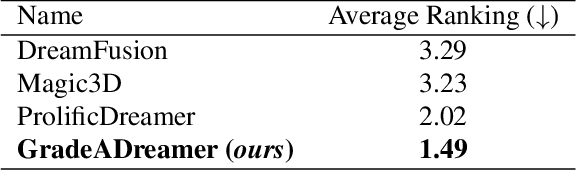
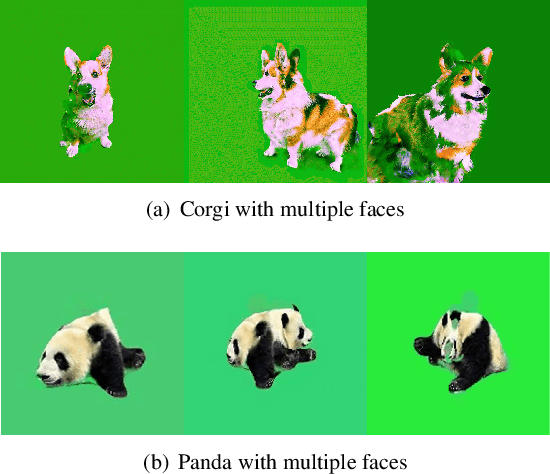
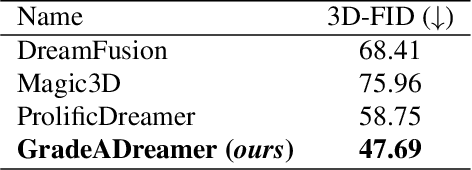
Text-to-3D generation has shown promising results, yet common challenges such as the Multi-face Janus problem and extended generation time for high-quality assets. In this paper, we address these issues by introducing a novel three-stage training pipeline called GradeADreamer. This pipeline is capable of producing high-quality assets with a total generation time of under 30 minutes using only a single RTX 3090 GPU. Our proposed method employs a Multi-view Diffusion Model, MVDream, to generate Gaussian Splats as a prior, followed by refining geometry and texture using StableDiffusion. Experimental results demonstrate that our approach significantly mitigates the Multi-face Janus problem and achieves the highest average user preference ranking compared to previous state-of-the-art methods. The project code is available at https://github.com/trapoom555/GradeADreamer.