 Add to Chrome
 Add to Firefox
 Add to Edge
Communication Reduction via Semantic-Based Encoding in DMPC Using LSTMs
Aug 18, 2026
The communication demands of distributed model prediction control (DMPC) can overwhelm even advanced wireless communication technologies as agents must exchange a significant amount of information at least once per time step. To semantically reduce communication demands, this work employs encoder-decoder networks built around long-short term memory (LSTM) cells in a distributed optimization algorithm. Agents publish a reduced representation of a message and receivers reconstruct the original message upon reception. In tests with reduced communication using formations of mobile robots, trained networks retain satisfactory performance and work reliably under conditions overwhelming full communication. As the results show, the usage of LSTMs either allows unprecedented reconstruction accuracy or the usage of different prediction-horizon lengths without the necessity to retrain.

Reducing the Communication of Distributed Model Predictive Control: Autoencoders and Formation Control
Apr 07, 2025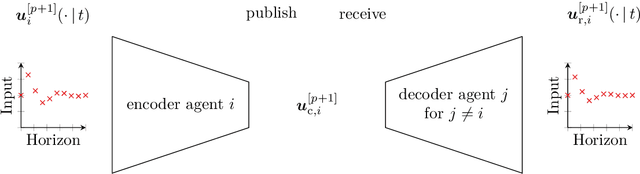

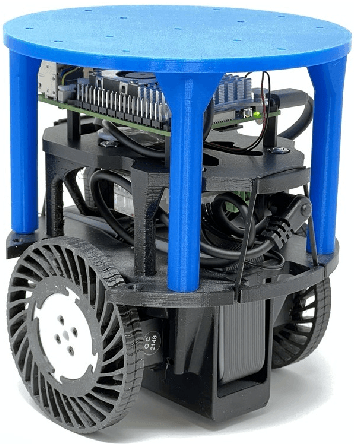
Communication remains a key factor limiting the applicability of distributed model predictive control (DMPC) in realistic settings, despite advances in wireless communication. DMPC schemes can require an overwhelming amount of information exchange between agents as the amount of data depends on the length of the predication horizon, for which some applications require a significant length to formally guarantee nominal asymptotic stability. This work aims to provide an approach to reduce the communication effort of DMPC by reducing the size of the communicated data between agents. Using an autoencoder, the communicated data is reduced by the encoder part of the autoencoder prior to communication and reconstructed by the decoder part upon reception within the distributed optimization algorithm that constitutes the DMPC scheme. The choice of a learning-based reduction method is motivated by structure inherent to the data, which results from the data's connection to solutions of optimal control problems. The approach is implemented and tested at the example of formation control of differential-drive robots, which is challenging for optimization-based control due to the robots' nonholonomic constraints, and which is interesting due to the practical importance of mobile robotics. The applicability of the proposed approach is presented first in form of a simulative analysis showing that the resulting control performance yields a satisfactory accuracy. In particular, the proposed approach outperforms the canonical naive way to reduce communication by reducing the length of the prediction horizon. Moreover, it is shown that numerical experiments conducted on embedded computation hardware, with real distributed computation and wireless communication, work well with the proposed way of reducing communication even in practical scenarios in which full communication fails.