 Add to Chrome
 Add to Firefox
 Add to Edge
Scalable Training of Continuous-Time Spiking Neural Networks with Differentiable Spike-Time Discretization
Jul 16, 2026
Continuous-time spiking neural networks (SNNs) provide an event-driven framework for temporal computation, computational neuroscience, and neuromorphic hardware. However, training deep continuous-time SNNs is severely constrained by the memory required for exact spike-time computation, which evaluates and retains candidate firing times over intervals determined by presynaptic spike ordering. Here we introduce a memory-efficient training framework based on differentiable spike-time discretization (DSTD) for leaky integrate-and-fire neurons with general membrane and synaptic time constants. DSTD maps irregular presynaptic spikes onto differentiable weighted events at fixed time points, replacing the input-dependent candidate dimension with $M$ fixed time intervals while accurately approximating continuous-time membrane-potential dynamics. This reduces candidate-related activation memory from $O(N_{\mathrm{out}}N_{\mathrm{in}})$ to $O(N_{\mathrm{out}}M)$ in the case of time-to-first-spike (TTFS) coding, where $N_{\mathrm{in}}$ and $N_{\mathrm{out}}$ denote the numbers of presynaptic and postsynaptic neurons, respectively. We further introduce synfire-chain-inspired temporal regularization that organizes layer-wise firing windows, mitigates dead-neuron failures, and enables pipeline-like processing. In dense LIF layers, DSTD reduced peak memory consumption by up to approximately 100-fold and training time by up to approximately 20-fold compared with exact spike-time computation. Together, these methods allowed us to train 9-layer convolutional SNNs on CIFAR-10 and 20-layer convolutional SNNs on Fashion-MNIST on a single GPU.

Learning the Simplest Neural ODE
May 04, 2025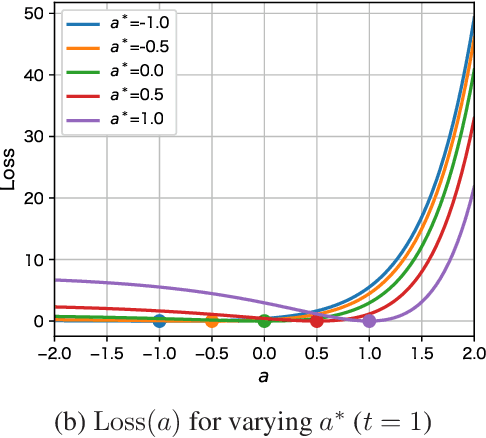
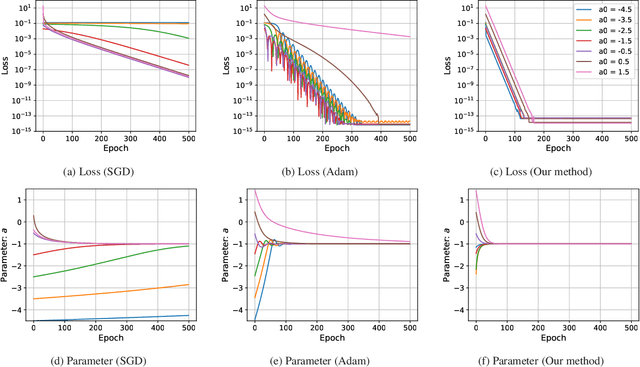
Since the advent of the ``Neural Ordinary Differential Equation (Neural ODE)'' paper, learning ODEs with deep learning has been applied to system identification, time-series forecasting, and related areas. Exploiting the diffeomorphic nature of ODE solution maps, neural ODEs has also enabled their use in generative modeling. Despite the rich potential to incorporate various kinds of physical information, training Neural ODEs remains challenging in practice. This study demonstrates, through the simplest one-dimensional linear model, why training Neural ODEs is difficult. We then propose a new stabilization method and provide an analytical convergence analysis. The insights and techniques presented here serve as a concise tutorial for researchers beginning work on Neural ODEs.