 Add to Chrome
 Add to Firefox
 Add to Edge
DRUM: Diffusion-based Raydrop-aware Unpaired Mapping for Sim2Real LiDAR Segmentation
Mar 27, 2026
LiDAR-based semantic segmentation is a key component for autonomous mobile robots, yet large-scale annotation of LiDAR point clouds is prohibitively expensive and time-consuming. Although simulators can provide labeled synthetic data, models trained on synthetic data often underperform on real-world data due to a data-level domain gap. To address this issue, we propose DRUM, a novel Sim2Real translation framework. We leverage a diffusion model pre-trained on unlabeled real-world data as a generative prior and translate synthetic data by reproducing two key measurement characteristics: reflectance intensity and raydrop noise. To improve sample fidelity, we introduce a raydrop-aware masked guidance mechanism that selectively enforces consistency with the input synthetic data while preserving realistic raydrop noise induced by the diffusion prior. Experimental results demonstrate that DRUM consistently improves Sim2Real performance across multiple representations of LiDAR data. The project page is available at https://miya-tomoya.github.io/drum.

Fast LiDAR Data Generation with Rectified Flows
Dec 03, 2024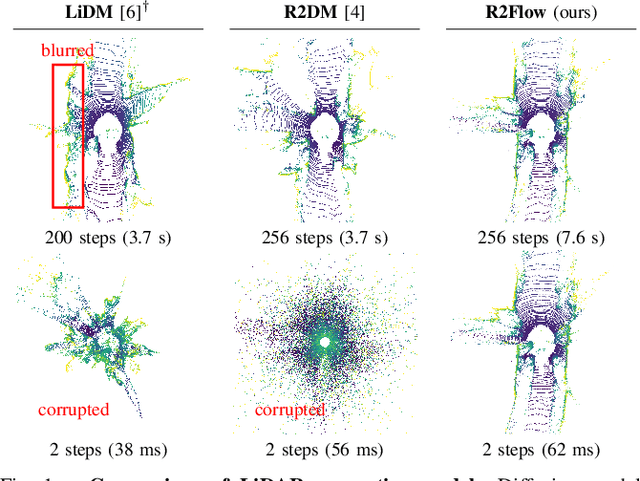
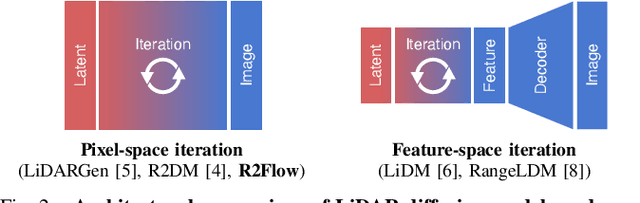
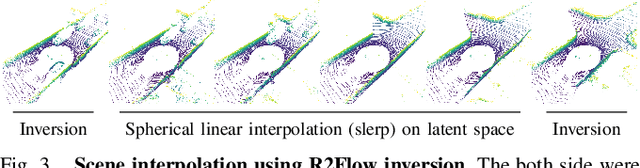
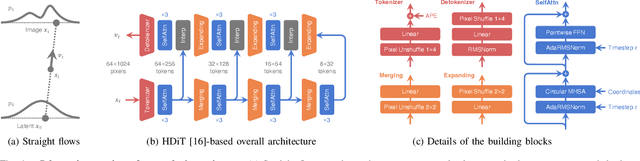
Building LiDAR generative models holds promise as powerful data priors for restoration, scene manipulation, and scalable simulation in autonomous mobile robots. In recent years, approaches using diffusion models have emerged, significantly improving training stability and generation quality. Despite the success of diffusion models, generating high-quality samples requires numerous iterations of running neural networks, and the increasing computational cost can pose a barrier to robotics applications. To address this challenge, this paper presents R2Flow, a fast and high-fidelity generative model for LiDAR data. Our method is based on rectified flows that learn straight trajectories, simulating data generation with much fewer sampling steps against diffusion models. We also propose a efficient Transformer-based model architecture for processing the image representation of LiDAR range and reflectance measurements. Our experiments on the unconditional generation of the KITTI-360 dataset demonstrate the effectiveness of our approach in terms of both efficiency and quality.