 Add to Chrome
 Add to Firefox
 Add to Edge
Post-ADC Inference: Valid Inference After Active Data Collection
May 12, 2026
The validity of statistical inference depends critically on how data are collected. When data gathered through active data collection (ADC) are reused for a post-hoc inferential task, conventional inference can fail because the sampling is adaptively biased toward regions favored by the collection strategy. This issue is especially pronounced in black-box optimization, where sequential model-based optimization (SMBO) methods such as the tree-structured Parzen estimator (TPE) and Gaussian process upper confidence bound (GP-UCB) preferentially concentrate evaluations in promising regions. We study statistical inference on actively collected data when the inferential target is constructed in a data-dependent manner after data collection. To enable valid inference in this setting, we propose post-ADC inference, a framework that accounts for the biases arising from both the active data collection process and the subsequent data-driven target construction. Our method builds on selective inference and provides valid $p$-values and confidence intervals that correct for both sources of bias. The framework applies to a broad class of ADC processes by imposing only assumptions on the observation noise, without requiring any assumptions on the underlying black-box function or the surrogate model used by the SMBO algorithm. Empirical results also show that post-ADC inference provides valid inference for data collected by GP-UCB and TPE.

Statistical Testing Framework for Clustering Pipelines by Selective Inference
Mar 19, 2026A data analysis pipeline is a structured sequence of steps that transforms raw data into meaningful insights by integrating multiple analysis algorithms.In many practical applications, analytical findings are obtained only after data pass through several data-dependent procedures within such pipelines.In this study, we address the problem of quantifying the statistical reliability of results produced by data analysis pipelines.As a proof of concept, we focus on clustering pipelines that identify cluster structures from complex and heterogeneous data through procedures such as outlier detection, feature selection, and clustering.We propose a novel statistical testing framework to assess the significance of clustering results obtained through these pipelines.Our framework, based on selective inference, enables the systematic construction of valid statistical tests for clustering pipelines composed of predefined components.We prove that the proposed test controls the type I error rate at any nominal level and demonstrate its validity and effectiveness through experiments on synthetic and real datasets.
Statistical Test for Saliency Maps of Graph Neural Networks via Selective Inference
May 22, 2025Graph Neural Networks (GNNs) have gained prominence for their ability to process graph-structured data across various domains. However, interpreting GNN decisions remains a significant challenge, leading to the adoption of saliency maps for identifying influential nodes and edges. Despite their utility, the reliability of GNN saliency maps has been questioned, particularly in terms of their robustness to noise. In this study, we propose a statistical testing framework to rigorously evaluate the significance of saliency maps. Our main contribution lies in addressing the inflation of the Type I error rate caused by double-dipping of data, leveraging the framework of Selective Inference. Our method provides statistically valid $p$-values while controlling the Type I error rate, ensuring that identified salient subgraphs contain meaningful information rather than random artifacts. To demonstrate the effectiveness of our method, we conduct experiments on both synthetic and real-world datasets, showing its effectiveness in assessing the reliability of GNN interpretations.
Statistically Significant $k$NNAD by Selective Inference
Feb 18, 2025In this paper, we investigate the problem of unsupervised anomaly detection using the k-Nearest Neighbor method. The k-Nearest Neighbor Anomaly Detection (kNNAD) is a simple yet effective approach for identifying anomalies across various domains and fields. A critical challenge in anomaly detection, including kNNAD, is appropriately quantifying the reliability of detected anomalies. To address this, we formulate kNNAD as a statistical hypothesis test and quantify the probability of false detection using $p$-values. The main technical challenge lies in performing both anomaly detection and statistical testing on the same data, which hinders correct $p$-value calculation within the conventional statistical testing framework. To resolve this issue, we introduce a statistical hypothesis testing framework called Selective Inference (SI) and propose a method named Statistically Significant NNAD (Stat-kNNAD). By leveraging SI, the Stat-kNNAD method ensures that detected anomalies are statistically significant with theoretical guarantees. The proposed Stat-kNNAD method is applicable to anomaly detection in both the original feature space and latent feature spaces derived from deep learning models. Through numerical experiments on synthetic data and applications to industrial product anomaly detection, we demonstrate the validity and effectiveness of the Stat-kNNAD method.
Time Series Anomaly Detection in the Frequency Domain with Statistical Reliability
Feb 05, 2025Effective anomaly detection in complex systems requires identifying change points (CPs) in the frequency domain, as abnormalities often arise across multiple frequencies. This paper extends recent advancements in statistically significant CP detection, based on Selective Inference (SI), to the frequency domain. The proposed SI method quantifies the statistical significance of detected CPs in the frequency domain using $p$-values, ensuring that the detected changes reflect genuine structural shifts in the target system. We address two major technical challenges to achieve this. First, we extend the existing SI framework to the frequency domain by appropriately utilizing the properties of discrete Fourier transform (DFT). Second, we develop an SI method that provides valid $p$-values for CPs where changes occur across multiple frequencies. Experimental results demonstrate that the proposed method reliably identifies genuine CPs with strong statistical guarantees, enabling more accurate root-cause analysis in the frequency domain of complex systems.
si4onnx: A Python package for Selective Inference in Deep Learning Models
Jan 29, 2025In this paper, we introduce si4onnx, a package for performing selective inference on deep learning models. Techniques such as CAM in XAI and reconstruction-based anomaly detection using VAE can be interpreted as methods for identifying significant regions within input images. However, the identified regions may not always carry meaningful significance. Therefore, evaluating the statistical significance of these regions represents a crucial challenge in establishing the reliability of AI systems. si4onnx is a Python package that enables straightforward implementation of hypothesis testing with controlled type I error rates through selective inference. It is compatible with deep learning models constructed using common frameworks such as PyTorch and TensorFlow.
Statistical Test for Data Analysis Pipeline by Selective Inference
Jun 27, 2024A data analysis pipeline is a structured sequence of processing steps that transforms raw data into meaningful insights by effectively integrating various analysis algorithms. In this paper, we propose a novel statistical test designed to assess the statistical significance of data analysis pipelines. Our approach allows for the systematic development of valid statistical tests applicable to any data analysis pipeline configuration composed of a set of data analysis components. We have developed this framework by adapting selective inference, which has gained recent attention as a new statistical inference technique for data-driven hypotheses. The proposed statistical test is theoretically designed to control the type I error at the desired significance level in finite samples. As examples, we consider a class of pipelines composed of three missing value imputation algorithms, three outlier detection algorithms, and three feature selection algorithms. We confirm the validity of our statistical test through experiments with both synthetic and real data for this class of data analysis pipelines. Additionally, we present an implementation framework that facilitates testing across any configuration of data analysis pipelines in this class without extra implementation costs.
Statistical Test for Generated Hypotheses by Diffusion Models
Feb 19, 2024The enhanced performance of AI has accelerated its integration into scientific research. In particular, the use of generative AI to create scientific hypotheses is promising and is increasingly being applied across various fields. However, when employing AI-generated hypotheses for critical decisions, such as medical diagnoses, verifying their reliability is crucial. In this study, we consider a medical diagnostic task using generated images by diffusion models, and propose a statistical test to quantify its reliability. The basic idea behind the proposed statistical test is to employ a selective inference framework, where we consider a statistical test conditional on the fact that the generated images are produced by a trained diffusion model. Using the proposed method, the statistical reliability of medical image diagnostic results can be quantified in the form of a p-value, allowing for decision-making with a controlled error rate. We show the theoretical validity of the proposed statistical test and its effectiveness through numerical experiments on synthetic and brain image datasets.
Statistical Test for Anomaly Detections by Variational Auto-Encoders
Feb 06, 2024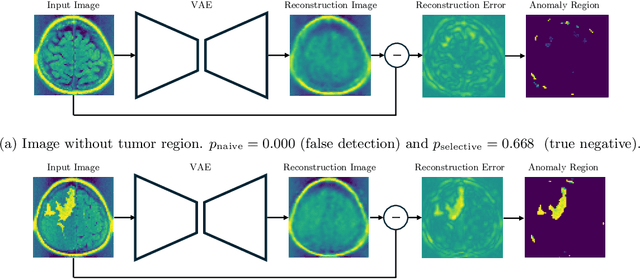
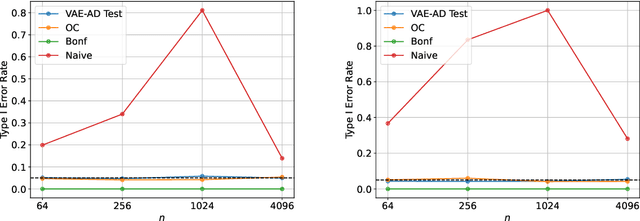
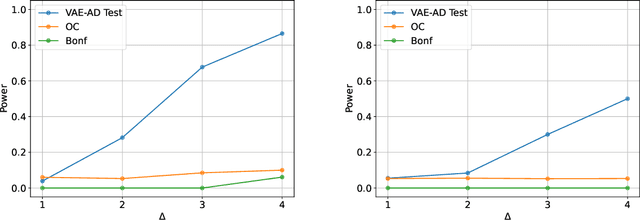

In this study, we consider the reliability assessment of anomaly detection (AD) using Variational Autoencoder (VAE). Over the last decade, VAE-based AD has been actively studied in various perspective, from method development to applied research. However, when the results of ADs are used in high-stakes decision-making, such as in medical diagnosis, it is necessary to ensure the reliability of the detected anomalies. In this study, we propose the VAE-AD Test as a method for quantifying the statistical reliability of VAE-based AD within the framework of statistical testing. Using the VAE-AD Test, the reliability of the anomaly regions detected by a VAE can be quantified in the form of p-values. This means that if an anomaly is declared when the p-value is below a certain threshold, it is possible to control the probability of false detection to a desired level. Since the VAE-AD Test is constructed based on a new statistical inference framework called selective inference, its validity is theoretically guaranteed in finite samples. To demonstrate the validity and effectiveness of the proposed VAE-AD Test, numerical experiments on artificial data and applications to brain image analysis are conducted.
Statistical Test for Attention Map in Vision Transformer
Jan 19, 2024The Vision Transformer (ViT) demonstrates exceptional performance in various computer vision tasks. Attention is crucial for ViT to capture complex wide-ranging relationships among image patches, allowing the model to weigh the importance of image patches and aiding our understanding of the decision-making process. However, when utilizing the attention of ViT as evidence in high-stakes decision-making tasks such as medical diagnostics, a challenge arises due to the potential of attention mechanisms erroneously focusing on irrelevant regions. In this study, we propose a statistical test for ViT's attentions, enabling us to use the attentions as reliable quantitative evidence indicators for ViT's decision-making with a rigorously controlled error rate. Using the framework called selective inference, we quantify the statistical significance of attentions in the form of p-values, which enables the theoretically grounded quantification of the false positive detection probability of attentions. We demonstrate the validity and the effectiveness of the proposed method through numerical experiments and applications to brain image diagnoses.