 Add to Chrome
 Add to Firefox
 Add to Edge
Reasoning Models Know What's Important, and Encode It in Their Activations
Apr 20, 2026
Language models often solve complex tasks by generating long reasoning chains, consisting of many steps with varying importance. While some steps are crucial for generating the final answer, others are removable. Determining which steps matter most, and why, remains an open question central to understanding how models process reasoning. We investigate if this question is best approached through model internals or through tokens of the reasoning chain itself. We find that model activations contain more information than tokens for identifying important reasoning steps. Crucially, by training probes on model activations to predict importance, we show that models encode an internal representation of step importance, even prior to the generation of subsequent steps. This internal representation of importance generalizes across models, is distributed across layers, and does not correlate with surface-level features, such as a step's relative position or its length. Our findings suggest that analyzing activations can reveal aspects of reasoning that surface-level approaches fundamentally miss, indicating that reasoning analyses should look into model internals.

Masked by Consensus: Disentangling Privileged Knowledge in LLM Correctness
Apr 14, 2026Humans use introspection to evaluate their understanding through private internal states inaccessible to external observers. We investigate whether large language models possess similar privileged knowledge about answer correctness, information unavailable through external observation. We train correctness classifiers on question representations from both a model's own hidden states and external models, testing whether self-representations provide a performance advantage. On standard evaluation, we find no advantage: self-probes perform comparably to peer-model probes. We hypothesize this is due to high inter-model agreement of answer correctness. To isolate genuine privileged knowledge, we evaluate on disagreement subsets, where models produce conflicting predictions. Here, we discover domain-specific privileged knowledge: self-representations consistently outperform peer representations in factual knowledge tasks, but show no advantage in math reasoning. We further localize this domain asymmetry across model layers, finding that the factual advantage emerges progressively from early-to-mid layers onward, consistent with model-specific memory retrieval, while math reasoning shows no consistent advantage at any depth.
REVS: Unlearning Sensitive Information in Language Models via Rank Editing in the Vocabulary Space
Jun 13, 2024
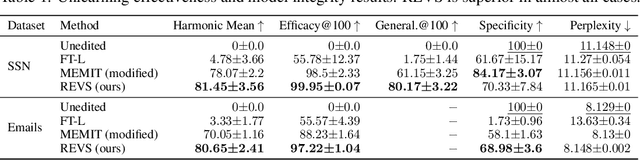
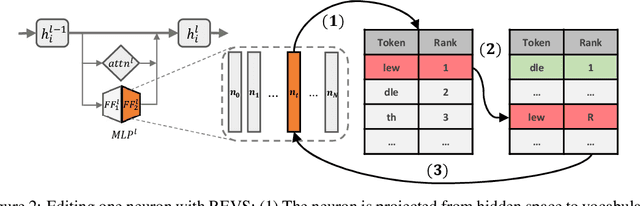
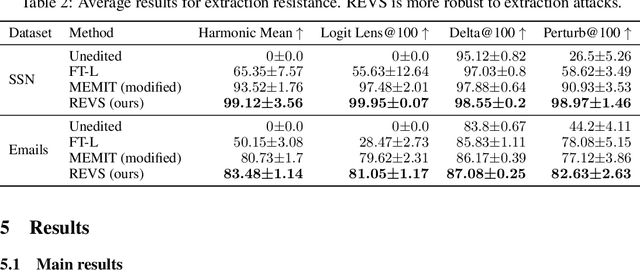
Large language models (LLMs) risk inadvertently memorizing and divulging sensitive or personally identifiable information (PII) seen in training data, causing privacy concerns. Current approaches to address this issue involve costly dataset scrubbing, or model filtering through unlearning and model editing, which can be bypassed through extraction attacks. We propose REVS, a novel model editing method for unlearning sensitive information from LLMs. REVS identifies and modifies a small subset of neurons relevant for each piece of sensitive information. By projecting these neurons to the vocabulary space (unembedding), we pinpoint the components driving its generation. We then compute a model edit based on the pseudo-inverse of the unembedding matrix, and apply it to de-promote generation of the targeted sensitive data. To adequately evaluate our method on truly sensitive information, we curate two datasets: an email dataset inherently memorized by GPT-J, and a synthetic social security number dataset that we tune the model to memorize. Compared to other state-of-the-art model editing methods, REVS demonstrates superior performance in both eliminating sensitive information and robustness to extraction attacks, while retaining integrity of the underlying model. The code and a demo notebook are available at https://technion-cs-nlp.github.io/REVS.