 Add to Chrome
 Add to Firefox
 Add to Edge
A Deep Learning Approach to Multipath Component Detection in Power Delay Profiles
Mar 20, 2026
Power Delay Profile (PDP) plays a crucial role in wireless communications, providing information on multipath propagation and signal strength variations over time. Accurate detection of peaks within PDP is essential to identify dominant signal paths, which are critical for tasks such as channel estimation, localization, and interference management. Traditional approaches to PDP analysis often struggle with noise, low resolution, and the inherent complexity of wireless environments. In this paper, we evaluate the application of traditional and modern deep learning neural networks to reconstruction-based anomaly detection to detect multipath components within the PDP. To further refine detection and robustness, a framework is proposed that combines autoencoders and Density-Based Spatial Clustering of Applications with Noise (DBSCAN) clustering. To compare the performance of individual models, a relaxed F1 score strategy is defined. The experimental results show that the proposed framework with transformer-based autoencoder shows superior performance both in terms of reconstruction and anomaly detection.
* 5 pages, 4 figures, 2 tables

Exploration of User Privacy in 802.11 Probe Requests with MAC Address Randomization Using Temporal Pattern Analysis
Jun 22, 2022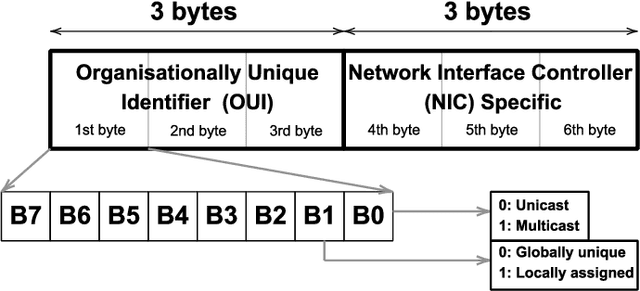
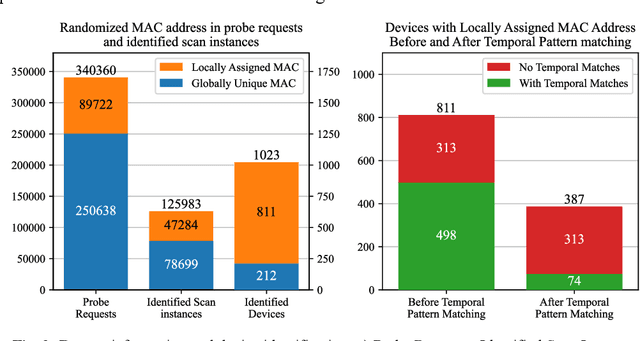
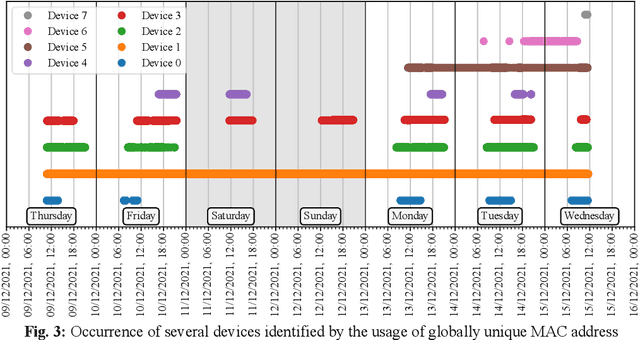
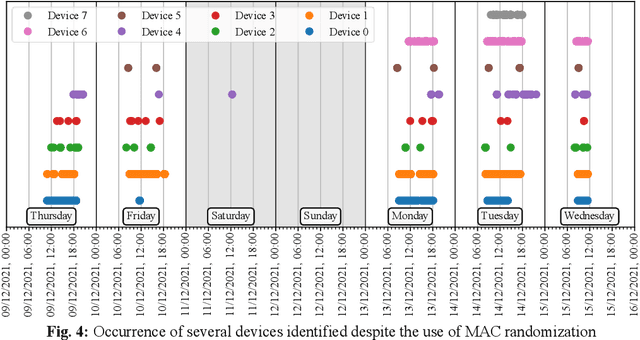
Wireless networks have become an integral part of our daily lives and lately there is increased concern about privacy and protecting the identity of individual users. In this paper we address the evolution of privacy measures in Wi-Fi probe request frames. We focus on the lack of privacy measures before the implementation of MAC Address Randomization, and on the way anti-tracking measures evolved throughout the last decade. We do not try to reverse MAC address randomization to get the real ad-dress of the device, but instead analyse the possibility of further tracking/localization without needing the real MAC address of the specific users. To gain better analysis results, we introduce temporal pattern matching approach to identification of devices using randomized MAC addresses.