 Add to Chrome
 Add to Firefox
 Add to Edge
GEM: Graph-Enhanced Mixture-of-Experts with ReAct Agents for Dialogue State Tracking
May 06, 2026
Dialogue State Tracking (DST) requires precise extraction of structured information from multi-domain conversations, a task where Large Language Models (LLMs) struggle despite their impressive general capabilities. We present GEM (Graph-Enhanced Mixture-of-Experts), a novel framework that combines language models and graph-structured dialogue understanding with ReAct agent-based reasoning for superior DST performance. Our approach dynamically routes between specialized experts: a Graph Neural Network that captures dialogue structure and turn-level dependencies, and a finetuned T5-Small encoder-decoder for sequence modeling, coordinated by an intelligent router. For complex value generation tasks, we integrate ReAct agents that perform structured reasoning over dialogue context. On MultiWOZ 2.2, GEM achieves 65.19% Joint Goal Accuracy, substantially outperforming end-to-end LLM approaches (best: 38.43%) and surpassing state-of-the-art (SOTA) methods including TOATOD (63.79%), D3ST (58.70%), and Diable (56.48%). Our graph-enhanced mixture-of-experts architecture with ReAct integration demonstrates that combining structured dialogue representation with dynamic expert routing and agent-based reasoning provides a powerful paradigm for dialogue state tracking, achieving superior accuracy while maintaining computational efficiency through selective expert activation.

ADEQA: A Question Answer based approach for joint ADE-Suspect Extraction using Sequence-To-Sequence Transformers
Dec 20, 2024


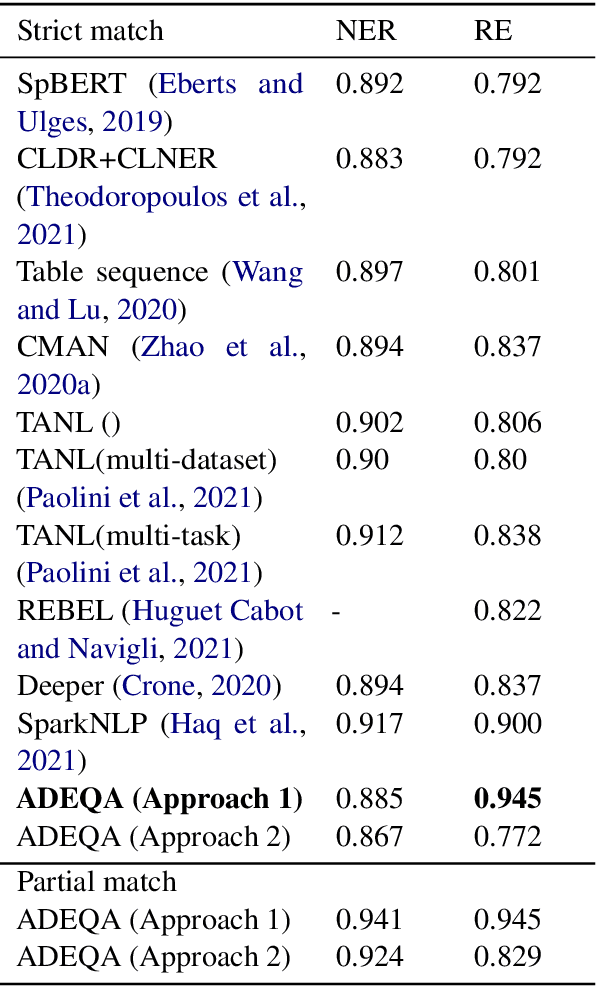
Early identification of Adverse Drug Events (ADE) is critical for taking prompt actions while introducing new drugs into the market. These ADEs information are available through various unstructured data sources like clinical study reports, patient health records, social media posts, etc. Extracting ADEs and the related suspect drugs using machine learning is a challenging task due to the complex linguistic relations between drug ADE pairs in textual data and unavailability of large corpus of labelled datasets. This paper introduces ADEQA, a question-answer(QA) based approach using quasi supervised labelled data and sequence-to-sequence transformers to extract ADEs, drug suspects and the relationships between them. Unlike traditional QA models, natural language generation (NLG) based models don't require extensive token level labelling and thereby reduces the adoption barrier significantly. On a public ADE corpus, we were able to achieve state-of-the-art results with an F1 score of 94% on establishing the relationships between ADEs and the respective suspects.