 Add to Chrome
 Add to Firefox
 Add to Edge
ALPACA: A Reinforcement Learning Environment for Medication Repurposing and Treatment Optimization in Alzheimer's Disease
Feb 22, 2026
Evaluating personalized, sequential treatment strategies for Alzheimer's disease (AD) using clinical trials is often impractical due to long disease horizons and substantial inter-patient heterogeneity. To address these constraints, we present the Alzheimer's Learning Platform for Adaptive Care Agents (ALPACA), an open-source, Gym-compatible reinforcement learning (RL) environment for systematically exploring personalized treatment strategies using existing therapies. ALPACA is powered by the Continuous Action-conditioned State Transitions (CAST) model trained on longitudinal trajectories from the Alzheimer's Disease Neuroimaging Initiative (ADNI), enabling medication-conditioned simulation of disease progression under alternative treatment decisions. We show that CAST autoregressively generates realistic medication-conditioned trajectories and that RL policies trained in ALPACA outperform no-treatment and behavior-cloned clinician baselines on memory-related outcomes. Interpretability analyses further indicated that the learned policies relied on clinically meaningful patient features when selecting actions. Overall, ALPACA provides a reusable in silico testbed for studying individualized sequential treatment decision-making for AD.

ShapeBots: Shape-changing Swarm Robots
Sep 08, 2019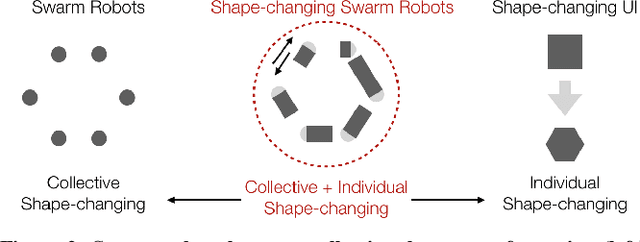
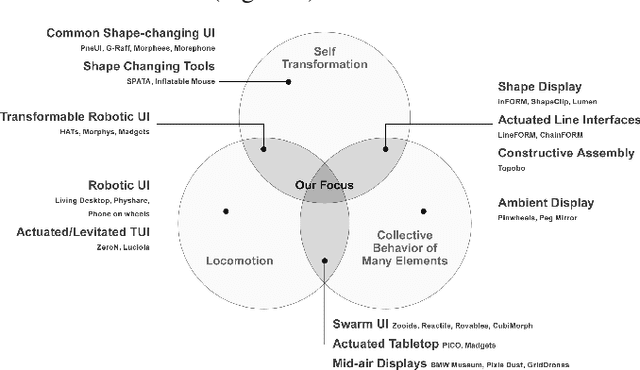
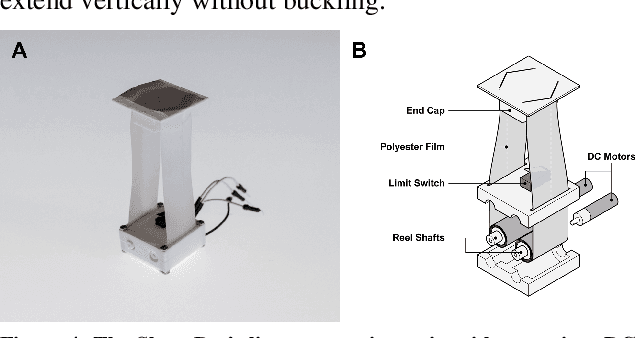
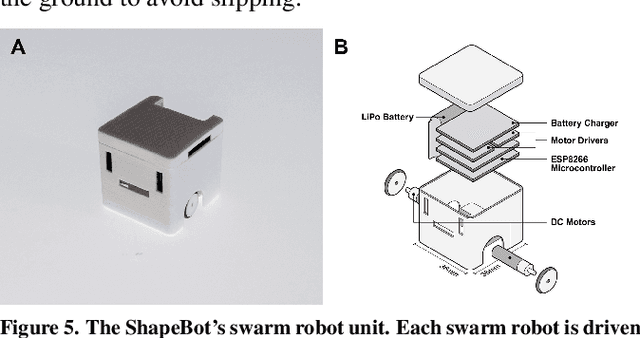
We introduce shape-changing swarm robots. A swarm of self-transformable robots can both individually and collectively change their configuration to display information, actuate objects, act as tangible controllers, visualize data, and provide physical affordances. ShapeBots is a concept prototype of shape-changing swarm robots. Each robot can change its shape by leveraging small linear actuators that are thin (2.5 cm) and highly extendable (up to 20cm) in both horizontal and vertical directions. The modular design of each actuator enables various shapes and geometries of self-transformation. We illustrate potential application scenarios and discuss how this type of interface opens up possibilities for the future of ubiquitous and distributed shape-changing interfaces.