 Add to Chrome
 Add to Firefox
 Add to Edge
DELUGE: Towards Continental-Scale Daily Pluvial Flood Damage Prediction via Interpretable Conditioning on Foundation Model Embeddings
Jul 17, 2026
Pluvial (rainfall-driven) flooding accounts for 45% of National Flood Insurance Program (NFIP) claims in the United States and is harder to predict than its riverine and coastal counterparts, with existing approaches limited to coarse resolution, regional domains, or computationally intensive process-based models unsuitable for daily continental-scale use. We present DELUGE, a multimodal deep learning framework for daily pluvial flood damage prediction at ~1 km resolution and national scale, trained on spatially and temporally corrected NFIP claims (2017-2022) and structured around the hazard, exposure, and vulnerability components of disaster risk. Rather than blanket coverage of the Conterminous United States (CONUS), we model the top 100 highest-claim 75 km cells, distributed nationwide and accounting for ~81% of total pluvial flood claims. Our architectural novelty is a pair of parametric modules in the hydrometeorology branch, a Value Modulator and a Temporal Modulator, conditioned on terrain descriptors and AlphaEarth foundation-model embeddings, that expose directly inspectable hydrological response parameters and provide architecture-level interpretability-by-design. Under a spatial block holdout, DELUGE outperforms tuned Random Forest, XGBoost, and LightGBM baselines by 9% to 30% on a dollar-weighted area under the precision-recall curve (PR-AUC), a metric that emphasizes the rare, high-cost claims of greatest operational interest. Beyond DELUGE, we argue this interpretable conditioning scheme is a transferable pattern for integrating foundation-model embeddings into other geospatial prediction tasks.

ClimaBench: A Benchmark Dataset For Climate Change Text Understanding in English
Jan 11, 2023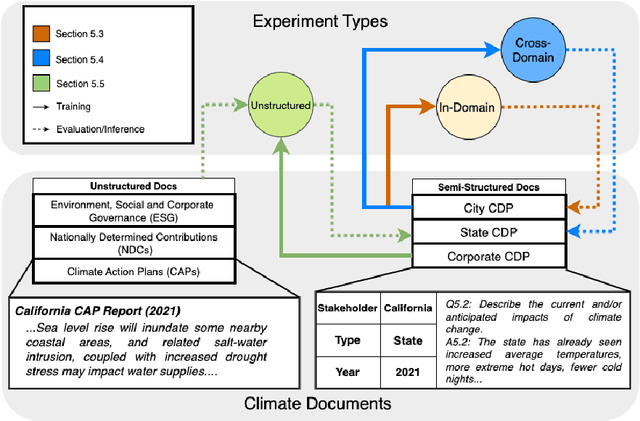
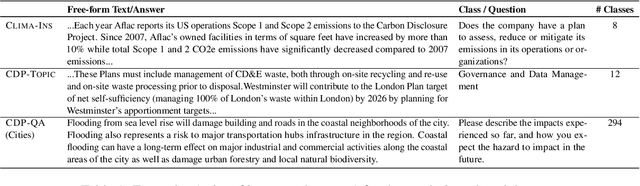
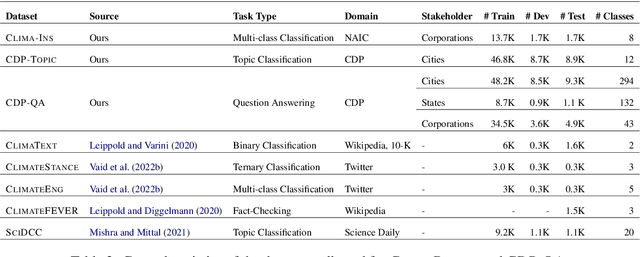
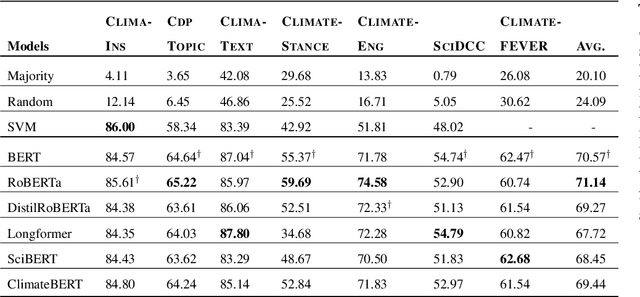
The topic of Climate Change (CC) has received limited attention in NLP despite its real world urgency. Activists and policy-makers need NLP tools in order to effectively process the vast and rapidly growing textual data produced on CC. Their utility, however, primarily depends on whether the current state-of-the-art models can generalize across various tasks in the CC domain. In order to address this gap, we introduce Climate Change Benchmark (ClimaBench), a benchmark collection of existing disparate datasets for evaluating model performance across a diverse set of CC NLU tasks systematically. Further, we enhance the benchmark by releasing two large-scale labelled text classification and question-answering datasets curated from publicly available environmental disclosures. Lastly, we provide an analysis of several generic and CC-oriented models answering whether fine-tuning on domain text offers any improvements across these tasks. We hope this work provides a standard assessment tool for research on CC text data.