 Add to Chrome
 Add to Firefox
 Add to Edge
Semantic analysis of behavior in a DNA-functionalized molecular swarm
Apr 07, 2026
In this paper, we propose applying semantic embedding to learn the range of behaviors exhibited by molecular swarms, thereby providing a richer set of features to optimize such systems. Specifically, we consider a standard molecular swarm where the individuals are cytoskeletal filaments (called microtubules) propelled by surface-adhered kinesin motors, with the addition of DNA functionalization for further control. We extend a microtubule model with that additional interaction and show that the extracted semantic atoms from simulation results match the expected behaviors. Moreover, the decomposition of each frame in the simulations accurately describes the expected impact of the external control values. Those results provide relevant leads towards the explainability of simulated experiments, making them more reliable for designing and optimizing in-vitro systems.

SMIC: Semantic Multi-Item Compression based on CLIP dictionary
Dec 06, 2024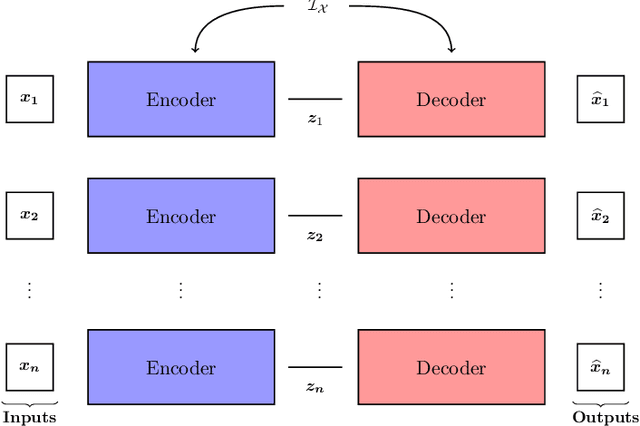

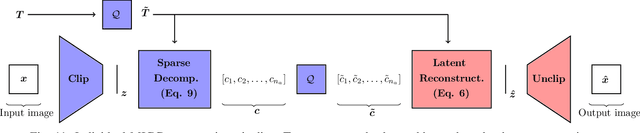
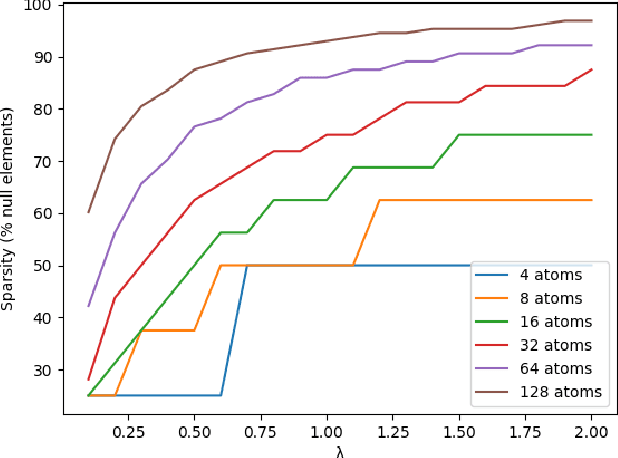
Semantic compression, a compression scheme where the distortion metric, typically MSE, is replaced with semantic fidelity metrics, tends to become more and more popular. Most recent semantic compression schemes rely on the foundation model CLIP. In this work, we extend such a scheme to image collection compression, where inter-item redundancy is taken into account during the coding phase. For that purpose, we first show that CLIP's latent space allows for easy semantic additions and subtractions. From this property, we define a dictionary-based multi-item codec that outperforms state-of-the-art generative codec in terms of compression rate, around $10^{-5}$ BPP per image, while not sacrificing semantic fidelity. We also show that the learned dictionary is of a semantic nature and works as a semantic projector for the semantic content of images.