 Add to Chrome
 Add to Firefox
 Add to Edge
SentiFuse: Deep Multi-model Fusion Framework for Robust Sentiment Extraction
Feb 01, 2026
Sentiment analysis models exhibit complementary strengths, yet existing approaches lack a unified framework for effective integration. We present SentiFuse, a flexible and model-agnostic framework that integrates heterogeneous sentiment models through a standardization layer and multiple fusion strategies. Our approach supports decision-level fusion, feature-level fusion, and adaptive fusion, enabling systematic combination of diverse models. We conduct experiments on three large-scale social-media datasets: Crowdflower, GoEmotions, and Sentiment140. These experiments show that SentiFuse consistently outperforms individual models and naive ensembles. Feature-level fusion achieves the strongest overall effectiveness, yielding up to 4\% absolute improvement in F1 score over the best individual model and simple averaging, while adaptive fusion enhances robustness on challenging cases such as negation, mixed emotions, and complex sentiment expressions. These results demonstrate that systematically leveraging model complementarity yields more accurate and reliable sentiment analysis across diverse datasets and text types.

CaST: Causal Discovery via Spatio-Temporal Graphs in Disaster Tweets
Feb 01, 2026Understanding causality between real-world events from social media is essential for situational awareness, yet existing causal discovery methods often overlook the interplay between semantic, spatial, and temporal contexts. We propose CaST: Causal Discovery via Spatio-Temporal Graphs, a unified framework for causal discovery in disaster domain that integrates semantic similarity and spatio-temporal proximity using Large Language Models (LLMs) pretrained on disaster datasets. CaST constructs an event graph for each window of tweets. Each event extracted from tweets is represented as a node embedding enriched with its contextual semantics, geographic coordinates, and temporal features. These event nodes are then connected to form a spatio-temporal event graph, which is processed using a multi-head Graph Attention Network (GAT) \cite{gat} to learn directed causal relationships. We construct an in-house dataset of approximately 167K disaster-related tweets collected during Hurricane Harvey and annotated following the MAVEN-ERE schema. Experimental results show that CaST achieves superior performance over both traditional and state-of-the-art methods. Ablation studies further confirm that incorporating spatial and temporal signals substantially improves both recall and stability during training. Overall, CaST demonstrates that integrating spatio-temporal reasoning into event graphs enables more robust and interpretable causal discovery in disaster-related social media text.
Measles Rash Image Detection Using Deep Convolutional Neural Network
Jun 08, 2020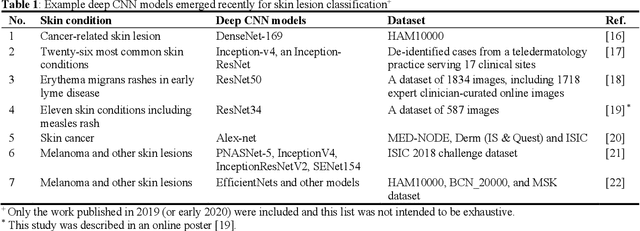

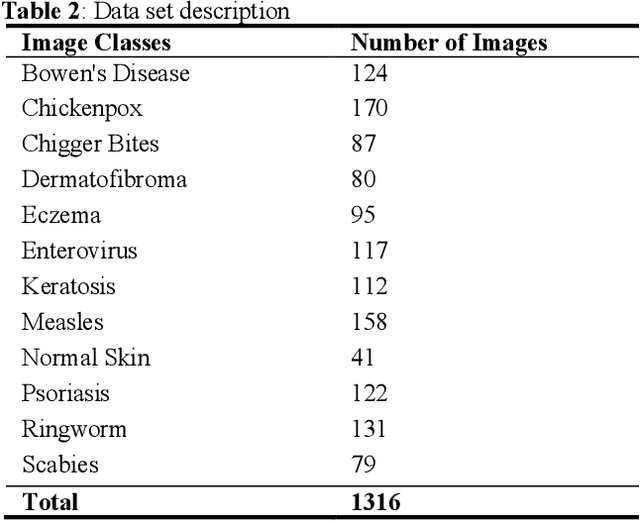
Measles is extremely contagious and is one of the leading causes of vaccine-preventable illness and death in developing countries, claiming more than 100,000 lives each year. Measles was declared eliminated in the US in 2000. As a result, an increasing number of US healthcare professionals and the public have never seen the disease. Unfortunately, the Measles resurged in the US in 2019 with 1,282 confirmed cases. To assist in diagnosing measles, we created a dataset of more than 1300 images of a variety of skin conditions and utilized deep convolutional neural network to distinguish measles rash from other skin conditions. On our curated image dataset, our model reaches a classification accuracy 95.2%, a sensitivity 81.7%, and specificity 97.1%. Our model can potentially be used to facilitate an accurate and early detection of measles to help contain measles outbreaks.