 Add to Chrome
 Add to Firefox
 Add to Edge
Knowing When to Stop: Bayesian Optimal Stopping for LLM Evaluations
Aug 14, 2026
LLM evaluations often use fixed sampling budgets, testing every item the same number of times even after estimates are precise. We introduce optstop, a precision-based adaptive stopping framework that treats evaluation as a sequential measurement problem: keep sampling where uncertainty remains high, and stop where estimates are precise or stable enough. The framework builds on hierarchical Bayesian inference, supports binary, ordinal, and continuous outcomes, and keeps every benchmark item eligible for sampling, without requiring a calibrated item bank. It runs live or retrospectively, and includes a safeguard that samples more cautiously as measured performance approaches zero, where rare successes matter most. In an illustrative 200-item, 10-epoch evaluation, it removes 57%-97% of planned trials across nine validation settings, with overall conclusions equivalent to the full run. These results show that LLM evaluation compute can be allocated by uncertainty rather than by fixed repetition counts, with the magnitude of savings depending on evaluation design.

Implications for Governance in Public Perceptions of Societal-scale AI Risks
Jun 10, 2024
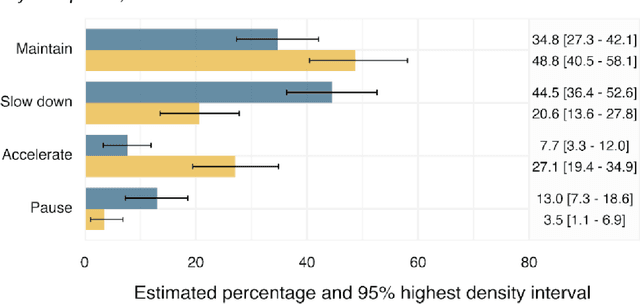
Amid growing concerns over AI's societal risks--ranging from civilizational collapse to misinformation and systemic bias--this study explores the perceptions of AI experts and the general US registered voters on the likelihood and impact of 18 specific AI risks, alongside their policy preferences for managing these risks. While both groups favor international oversight over national or corporate governance, our survey reveals a discrepancy: voters perceive AI risks as both more likely and more impactful than experts, and also advocate for slower AI development. Specifically, our findings indicate that policy interventions may best assuage collective concerns if they attempt to more carefully balance mitigation efforts across all classes of societal-scale risks, effectively nullifying the near-vs-long-term debate over AI risks. More broadly, our results will serve not only to enable more substantive policy discussions for preventing and mitigating AI risks, but also to underscore the challenge of consensus building for effective policy implementation.
The Reasoning Under Uncertainty Trap: A Structural AI Risk
Jan 29, 2024This report examines a novel risk associated with current (and projected) AI tools. Making effective decisions about future actions requires us to reason under uncertainty (RUU), and doing so is essential to many critical real world problems. Overfaced by this challenge, there is growing demand for AI tools like LLMs to assist decision-makers. Having evidenced this demand and the incentives behind it, we expose a growing risk: we 1) do not currently sufficiently understand LLM capabilities in this regard, and 2) have no guarantees of performance given fundamental computational explosiveness and deep uncertainty constraints on accuracy. This report provides an exposition of what makes RUU so challenging for both humans and machines, and relates these difficulties to prospective AI timelines and capabilities. Having established this current potential misuse risk, we go on to expose how this seemingly additive risk (more misuse additively contributed to potential harm) in fact has multiplicative properties. Specifically, we detail how this misuse risk connects to a wider network of underlying structural risks (e.g., shifting incentives, limited transparency, and feedback loops) to produce non-linear harms. We go on to provide a solutions roadmap that targets multiple leverage points in the structure of the problem. This includes recommendations for all involved actors (prospective users, developers, and policy-makers) and enfolds insights from areas including Decision-making Under Deep Uncertainty and complex systems theory. We argue this report serves not only to raise awareness (and subsequently mitigate/correct) of a current, novel AI risk, but also awareness of the underlying class of structural risks by illustrating how their interconnected nature poses twin-dangers of camouflaging their presence, whilst amplifying their potential effects.