 Add to Chrome
 Add to Firefox
 Add to Edge
Universal Approximation Constraints of Narrow ResNets: The Tunnel Effect
Mar 30, 2026
We analyze the universal approximation constraints of narrow Residual Neural Networks (ResNets) both theoretically and numerically. For deep neural networks without input space augmentation, a central constraint is the inability to represent critical points of the input-output map. We prove that this has global consequences for target function approximations and show that the manifestation of this defect is typically a shift of the critical point to infinity, which we call the ``tunnel effect'' in the context of classification tasks. While ResNets offer greater expressivity than standard multilayer perceptrons (MLPs), their capability strongly depends on the signal ratio between the skip and residual channels. We establish quantitative approximation bounds for both the residual-dominant (close to MLP) and skip-dominant (close to neural ODE) regimes. These estimates depend explicitly on the channel ratio and uniform network weight bounds. Low-dimensional examples further provide a detailed analysis of the different ResNet regimes and how architecture-target incompatibility influences the approximation error.

Tracking Finite-Time Lyapunov Exponents to Robustify Neural ODEs
Feb 10, 2026We investigate finite-time Lyapunov exponents (FTLEs), a measure for exponential separation of input perturbations, of deep neural networks within the framework of continuous-depth neural ODEs. We demonstrate that FTLEs are powerful organizers for input-output dynamics, allowing for better interpretability and the comparison of distinct model architectures. We establish a direct connection between Lyapunov exponents and adversarial vulnerability, and propose a novel training algorithm that improves robustness by FTLE regularization. The key idea is to suppress exponents far from zero in the early stage of the input dynamics. This approach enhances robustness and reduces computational cost compared to full-interval regularization, as it avoids a full ``double'' backpropagation.
A minimax optimal control approach for robust neural ODEs
Nov 03, 2023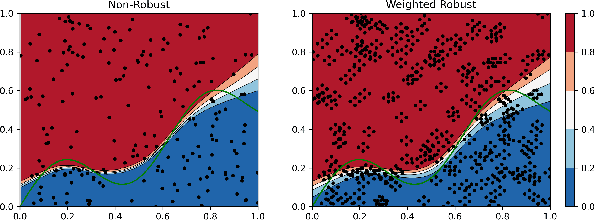
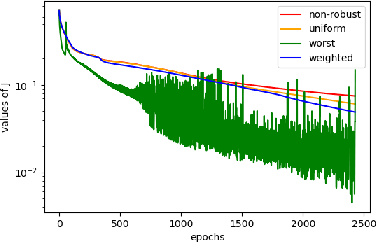
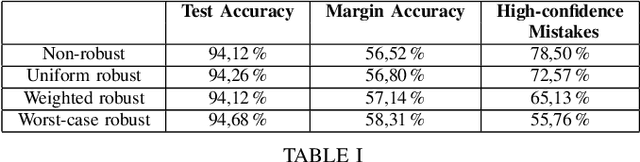
In this paper, we address the adversarial training of neural ODEs from a robust control perspective. This is an alternative to the classical training via empirical risk minimization, and it is widely used to enforce reliable outcomes for input perturbations. Neural ODEs allow the interpretation of deep neural networks as discretizations of control systems, unlocking powerful tools from control theory for the development and the understanding of machine learning. In this specific case, we formulate the adversarial training with perturbed data as a minimax optimal control problem, for which we derive first order optimality conditions in the form of Pontryagin's Maximum Principle. We provide a novel interpretation of robust training leading to an alternative weighted technique, which we test on a low-dimensional classification task.