 Add to Chrome
 Add to Firefox
 Add to Edge
State Algebra for Probabilistic Logic
Mar 13, 2026
This paper presents a Probabilistic State Algebra as an extension of deterministic propositional logic, providing a computational framework for constructing Markov Random Fields (MRFs) through pure linear algebra. By mapping logical states to real-valued coordinates interpreted as energy potentials, we define an energy-based model where global probability distributions emerge from coordinate-wise Hadamard products. This approach bypasses the traditional reliance on graph-traversal algorithms and compiled circuits, utilising $t$-objects and wildcards to embed logical reduction natively within matrix operations. We demonstrate that this algebra constructs formal Gibbs distributions, offering a rigorous mathematical link between symbolic constraints and statistical inference. A central application of this framework is the development of Probabilistic Rule Models (PRMs), which are uniquely capable of incorporating both probabilistic associations and deterministic logical constraints simultaneously. These models are designed to be inherently interpretable, supporting a human-in-the-loop approach to decisioning in high-stakes environments such as healthcare and finance. By representing decision logic as a modular summation of rules within a vector space, the framework ensures that complex probabilistic systems remain auditable and maintainable without compromising the rigour of the underlying configuration space.

Exponential time differencing for matrix-valued dynamical systems
Jun 19, 2024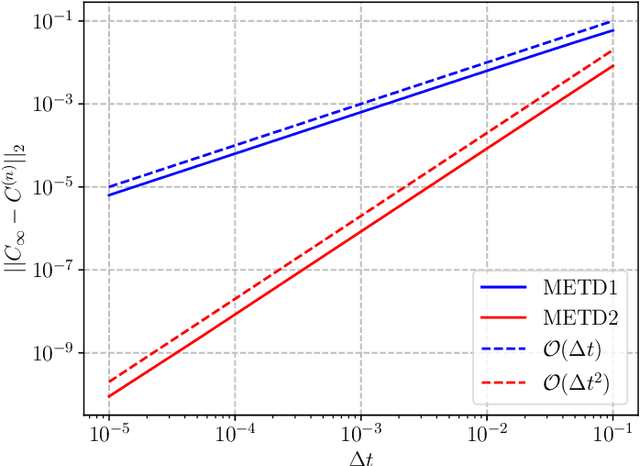
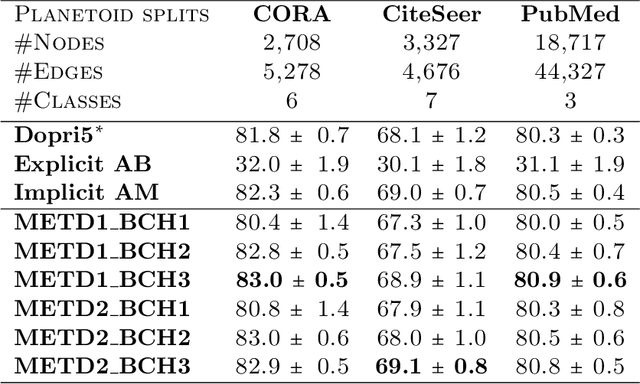
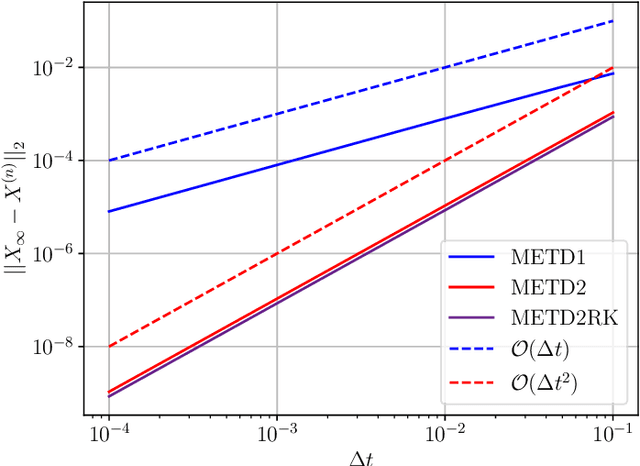

Matrix evolution equations occur in many applications, such as dynamical Lyapunov/Sylvester systems or Riccati equations in optimization and stochastic control, machine learning or data assimilation. In many cases, their tightest stability condition is coming from a linear term. Exponential time differencing (ETD) is known to produce highly stable numerical schemes by treating the linear term in an exact fashion. In particular, for stiff problems, ETD methods are a method of choice. We propose an extension of the class of ETD algorithms to matrix-valued dynamical equations. This allows us to produce highly efficient and stable integration schemes. We show their efficiency and applicability for a variety of real-world problems, from geophysical applications to dynamical problems in machine learning.