 Add to Chrome
 Add to Firefox
 Add to Edge
COGNAC at SemEval-2026 Task 5: LLM Ensembles for Human-Level Word Sense Plausibility Rating in Challenging Narratives
Mar 16, 2026
We describe our system for SemEval-2026 Task 5, which requires rating the plausibility of given word senses of homonyms in short stories on a 5-point Likert scale. Systems are evaluated by the unweighted average of accuracy (within one standard deviation of mean human judgments) and Spearman Rank Correlation. We explore three prompting strategies using multiple closed-source commercial LLMs: (i) a baseline zero-shot setup, (ii) Chain-of-Thought (CoT) style prompting with structured reasoning, and (iii) a comparative prompting strategy for evaluating candidate word senses simultaneously. Furthermore, to account for the substantial inter-annotator variation present in the gold labels, we propose an ensemble setup by averaging model predictions. Our best official system, comprising an ensemble of LLMs across all three prompting strategies, placed 4th on the competition leaderboard with 0.88 accuracy and 0.83 Spearman's rho (0.86 average). Post-competition experiments with additional models further improved this performance to 0.92 accuracy and 0.85 Spearman's rho (0.89 average). We find that comparative prompting consistently improved performance across model families, and model ensembling significantly enhanced alignment with mean human judgments, suggesting that LLM ensembles are especially well suited for subjective semantic evaluation tasks involving multiple annotators.

Automated Neural Patent Landscaping in the Small Data Regime
Jul 10, 2024
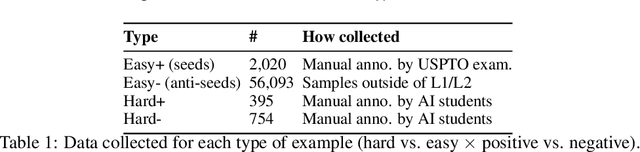
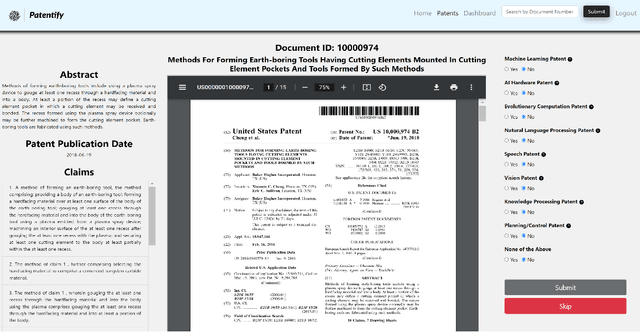
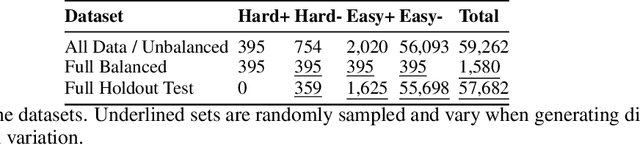
Patent landscaping is the process of identifying all patents related to a particular technological area, and is important for assessing various aspects of the intellectual property context. Traditionally, constructing patent landscapes is intensely laborious and expensive, and the rapid expansion of patenting activity in recent decades has driven an increasing need for efficient and effective automated patent landscaping approaches. In particular, it is critical that we be able to construct patent landscapes using a minimal number of labeled examples, as labeling patents for a narrow technology area requires highly specialized (and hence expensive) technical knowledge. We present an automated neural patent landscaping system that demonstrates significantly improved performance on difficult examples (0.69 $F_1$ on 'hard' examples, versus 0.6 for previously reported systems), and also significant improvements with much less training data (overall 0.75 $F_1$ on as few as 24 examples). Furthermore, in evaluating such automated landscaping systems, acquiring good data is challenge; we demonstrate a higher-quality training data generation procedure by merging Abood and Feltenberger's (2018) "seed/anti-seed" approach with active learning to collect difficult labeled examples near the decision boundary. Using this procedure we created a new dataset of labeled AI patents for training and testing. As in prior work we compare our approach with a number of baseline systems, and we release our code and data for others to build upon.