 Add to Chrome
 Add to Firefox
 Add to Edge
Label Over Logic? How Source Cues Bias Human Fallacy Judgments More Than LLMs
May 28, 2026
As AI-generated and AI-assisted content floods online spaces, source labels attached to such content can distort human reasoning judgments, with downstream consequences for moderation, evaluation, and decision-making. Whether LLMs share this vulnerability, or offer more source-agnostic evaluation, remains an open question with direct implications for human-AI collaboration. We examine this issue using logical fallacies as a controlled setting to isolate source-label effects on reasoning quality, independent of domain knowledge. We conduct an online study (N=505) where participants are assigned to a source condition (human, AI, human with AI assistance, AI with human assistance, or no disclosure) and evaluate comments containing logical fallacies, comparing their judgments with those of LLMs (GPT-5.2, Gemini 2.5 Flash, Claude Sonnet 4.5), who were evaluated across the same source conditions. Human evaluators were significantly more susceptible to fallacies labeled as written by human or human with AI assistance and assigned higher trust and evaluation ratings in these conditions. LLM evaluations remained comparatively stable across source labels, though performance varied across models. Confidence levels were similarly high across conditions for both humans and LLMs, regardless of fallacy presence. Our findings indicate that source-label bias in reasoning evaluation is primarily a human vulnerability and highlight the potential of human-LLM collaboration in increasingly AI-mediated environments.

Unmasking Nationality Bias: A Study of Human Perception of Nationalities in AI-Generated Articles
Aug 08, 2023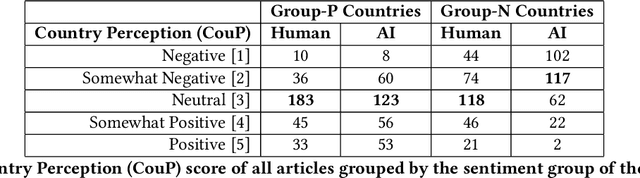
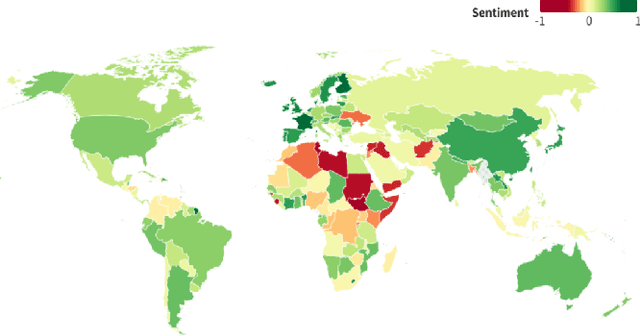

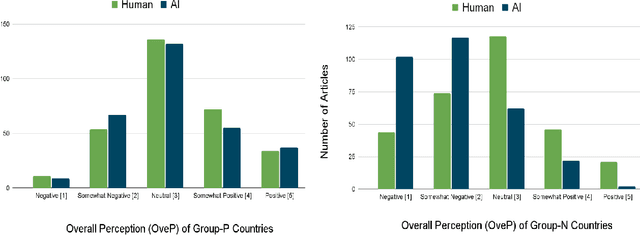
We investigate the potential for nationality biases in natural language processing (NLP) models using human evaluation methods. Biased NLP models can perpetuate stereotypes and lead to algorithmic discrimination, posing a significant challenge to the fairness and justice of AI systems. Our study employs a two-step mixed-methods approach that includes both quantitative and qualitative analysis to identify and understand the impact of nationality bias in a text generation model. Through our human-centered quantitative analysis, we measure the extent of nationality bias in articles generated by AI sources. We then conduct open-ended interviews with participants, performing qualitative coding and thematic analysis to understand the implications of these biases on human readers. Our findings reveal that biased NLP models tend to replicate and amplify existing societal biases, which can translate to harm if used in a sociotechnical setting. The qualitative analysis from our interviews offers insights into the experience readers have when encountering such articles, highlighting the potential to shift a reader's perception of a country. These findings emphasize the critical role of public perception in shaping AI's impact on society and the need to correct biases in AI systems.