 Add to Chrome
 Add to Firefox
 Add to Edge
Language-Based Agent Control
May 13, 2026
This paper introduces language-based agent control (LBAC), a new programming model for agentic applications that brings techniques from programming languages and language-based security to the problem of agent control. In conventional programming, combinations of static typing and runtime enforcement have long been used to guarantee that well-typed programs satisfy user-specified policies, including policies for access control, information flow, data provenance, and more. The key idea behind LBAC is to extend these guarantees to agentic applications by requiring agents to generate programs that are themselves well typed in the context of the surrounding scaffolding code. Unsafe programs are rejected by the type-checker before execution, allowing policies to apply uniformly across the entire application, including both agent-generated behavior and developer-written scaffolding. At the same time, LBAC preserves substantial expressiveness: agents may perform arbitrary side-effect-free computation and recursively invoke subagents, which retain full tool access subject to the same -- or potentially more restrictive -- policies. We demonstrate LBAC with three case studies: I/O sandboxing via filesystem capabilities, data provenance, and information-flow control.

Flexible and Efficient Grammar-Constrained Decoding
Feb 07, 2025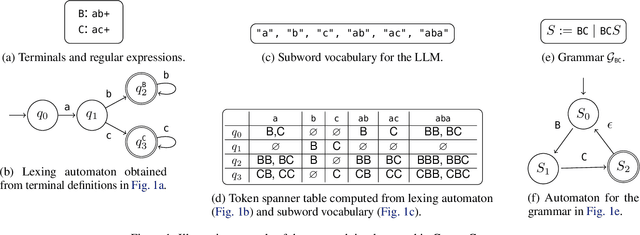
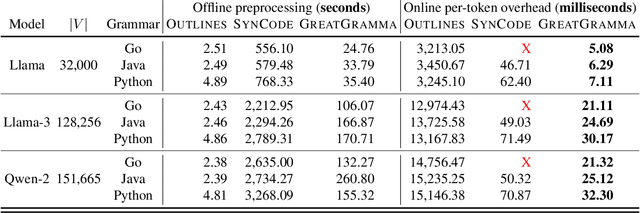
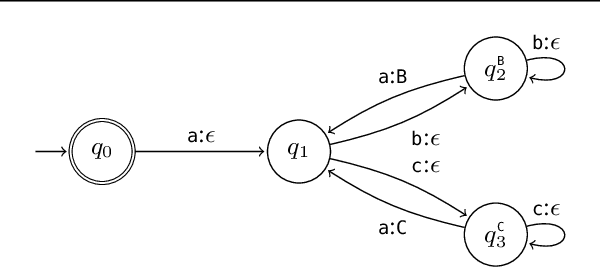
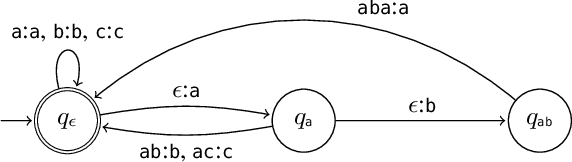
Large Language Models (LLMs) are often asked to generate structured outputs that obey precise syntactic rules, such as code snippets or formatted data. Grammar-constrained decoding (GCD) can guarantee that LLM outputs matches such rules by masking out tokens that will provably lead to outputs that do not belong to a specified context-free grammar (CFG). To guarantee soundness, GCD algorithms have to compute how a given LLM subword tokenizer can align with the tokens used by a given context-free grammar and compute token masks based on this information. Doing so efficiently is challenging and existing GCD algorithms require tens of minutes to preprocess common grammars. We present a new GCD algorithm together with an implementation that offers 17.71x faster offline preprocessing than existing approaches while preserving state-of-the-art efficiency in online mask computation.