 Add to Chrome
 Add to Firefox
 Add to Edge
How Much Would a Clinician Edit This Draft? Evaluating LLM Alignment for Patient Message Response Drafting
Jan 16, 2026
Large language models (LLMs) show promise in drafting responses to patient portal messages, yet their integration into clinical workflows raises various concerns, including whether they would actually save clinicians time and effort in their portal workload. We investigate LLM alignment with individual clinicians through a comprehensive evaluation of the patient message response drafting task. We develop a novel taxonomy of thematic elements in clinician responses and propose a novel evaluation framework for assessing clinician editing load of LLM-drafted responses at both content and theme levels. We release an expert-annotated dataset and conduct large-scale evaluations of local and commercial LLMs using various adaptation techniques including thematic prompting, retrieval-augmented generation, supervised fine-tuning, and direct preference optimization. Our results reveal substantial epistemic uncertainty in aligning LLM drafts with clinician responses. While LLMs demonstrate capability in drafting certain thematic elements, they struggle with clinician-aligned generation in other themes, particularly question asking to elicit further information from patients. Theme-driven adaptation strategies yield improvements across most themes. Our findings underscore the necessity of adapting LLMs to individual clinician preferences to enable reliable and responsible use in patient-clinician communication workflows.

In-Context Learning for Preserving Patient Privacy: A Framework for Synthesizing Realistic Patient Portal Messages
Nov 10, 2024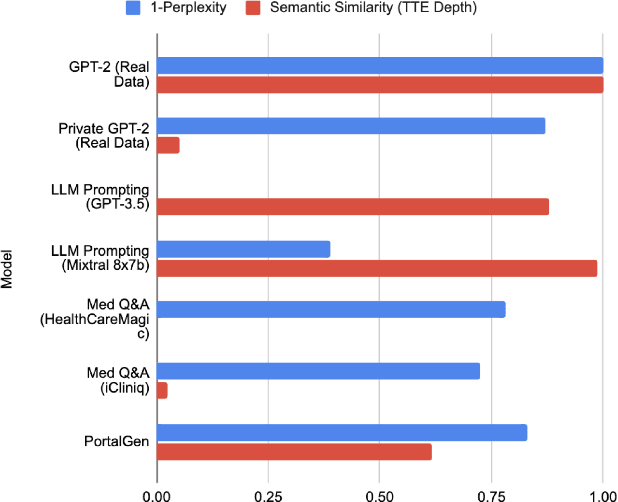
Since the COVID-19 pandemic, clinicians have seen a large and sustained influx in patient portal messages, significantly contributing to clinician burnout. To the best of our knowledge, there are no large-scale public patient portal messages corpora researchers can use to build tools to optimize clinician portal workflows. Informed by our ongoing work with a regional hospital, this study introduces an LLM-powered framework for configurable and realistic patient portal message generation. Our approach leverages few-shot grounded text generation, requiring only a small number of de-identified patient portal messages to help LLMs better match the true style and tone of real data. Clinical experts in our team deem this framework as HIPAA-friendly, unlike existing privacy-preserving approaches to synthetic text generation which cannot guarantee all sensitive attributes will be protected. Through extensive quantitative and human evaluation, we show that our framework produces data of higher quality than comparable generation methods as well as all related datasets. We believe this work provides a path forward for (i) the release of large-scale synthetic patient message datasets that are stylistically similar to ground-truth samples and (ii) HIPAA-friendly data generation which requires minimal human de-identification efforts.