 Add to Chrome
 Add to Firefox
 Add to Edge
Identifying Connectivity Distributions from Neural Dynamics Using Flows
Mar 27, 2026
Connectivity structure shapes neural computation, but inferring this structure from population recordings is degenerate: multiple connectivity structures can generate identical dynamics. Recent work uses low-rank recurrent neural networks (lrRNNs) to infer low-dimensional latent dynamics and connectivity structure from observed activity, enabling a mechanistic interpretation of the dynamics. However, standard approaches for training lrRNNs can recover spurious structures irrelevant to the underlying dynamics. We first characterize the identifiability of connectivity structures in lrRNNs and determine conditions under which a unique solution exists. Then, to find such solutions, we develop an inference framework based on maximum entropy and continuous normalizing flows (CNFs), trained via flow matching. Instead of estimating a single connectivity matrix, our method learns the maximally unbiased distribution over connection weights consistent with observed dynamics. This approach captures complex yet necessary distributions such as heavy-tailed connectivity found in empirical data. We validate our method on synthetic datasets with connectivity structures that generate multistable attractors, limit cycles, and ring attractors, and demonstrate its applicability in recordings from rat frontal cortex during decision-making. Our framework shifts circuit inference from recovering connectivity to identifying which connectivity structures are computationally required, and which are artifacts of underconstrained inference.

Trainability, Expressivity and Interpretability in Gated Neural ODEs
Jul 12, 2023
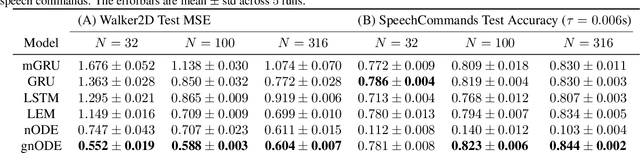

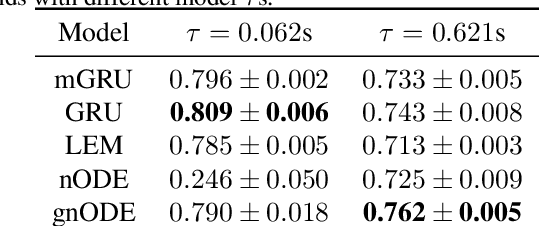
Understanding how the dynamics in biological and artificial neural networks implement the computations required for a task is a salient open question in machine learning and neuroscience. In particular, computations requiring complex memory storage and retrieval pose a significant challenge for these networks to implement or learn. Recently, a family of models described by neural ordinary differential equations (nODEs) has emerged as powerful dynamical neural network models capable of capturing complex dynamics. Here, we extend nODEs by endowing them with adaptive timescales using gating interactions. We refer to these as gated neural ODEs (gnODEs). Using a task that requires memory of continuous quantities, we demonstrate the inductive bias of the gnODEs to learn (approximate) continuous attractors. We further show how reduced-dimensional gnODEs retain their modeling power while greatly improving interpretability, even allowing explicit visualization of the structure of learned attractors. We introduce a novel measure of expressivity which probes the capacity of a neural network to generate complex trajectories. Using this measure, we explore how the phase-space dimension of the nODEs and the complexity of the function modeling the flow field contribute to expressivity. We see that a more complex function for modeling the flow field allows a lower-dimensional nODE to capture a given target dynamics. Finally, we demonstrate the benefit of gating in nODEs on several real-world tasks.