 Add to Chrome
 Add to Firefox
 Add to Edge
Certified but Private: Scalable Zero-Knowledge Proofs for Neural Network Guarantees
Aug 17, 2026
With the growing deployment of machine learning models, formal guarantees of the robustness and fairness of these models have become increasingly important in safety-critical and legal-compliance settings. However, model parameters are often commercial secrets that cannot be disclosed to auditors or end users. To this end, we present PANDA, a scalable system that uses zero-knowledge proofs (ZKPs) to prove the robustness and fairness properties of a model without revealing its private parameters. PANDA is built on top of CROWN, an efficient robustness certification framework that is used in many state-of-the-art formal verification tools for neural networks. The core contribution of PANDA is a novel algorithm for proving linear relaxation bounds for non-linear activation layers, yielding simple, lightweight proofs. Remarkably, our system can generate proofs of local robustness for neural networks with more than 2.9M parameters in 5 minutes, and can verify them in 10 seconds. Prior ZKP-based robustness system rely on exponential-time algorithms that cannot scale to nontrivial networks. In contrast, PANDA scales polynomially in the number of neurons in a network, allowing us to support neural networks 4 orders of magnitude larger than previous approaches with significantly reduced prover overhead.

Learning Randomized Reductions and Program Properties
Dec 24, 2024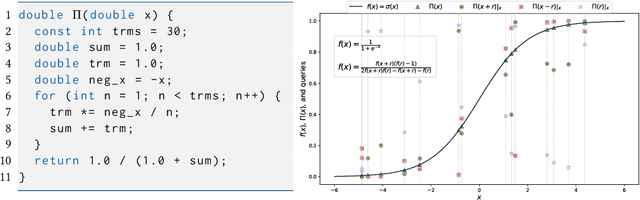
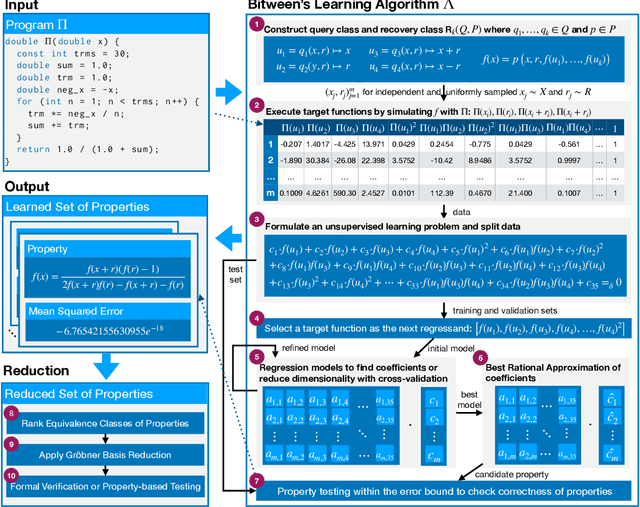
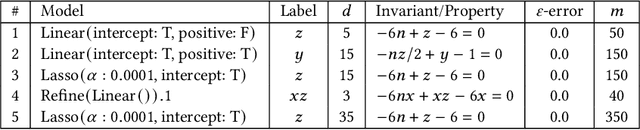

The correctness of computations remains a significant challenge in computer science, with traditional approaches relying on automated testing or formal verification. Self-testing/correcting programs introduce an alternative paradigm, allowing a program to verify and correct its own outputs via randomized reductions, a concept that previously required manual derivation. In this paper, we present Bitween, a method and tool for automated learning of randomized (self)-reductions and program properties in numerical programs. Bitween combines symbolic analysis and machine learning, with a surprising finding: polynomial-time linear regression, a basic optimization method, is not only sufficient but also highly effective for deriving complex randomized self-reductions and program invariants, often outperforming sophisticated mixed-integer linear programming solvers. We establish a theoretical framework for learning these reductions and introduce RSR-Bench, a benchmark suite for evaluating Bitween's capabilities on scientific and machine learning functions. Our empirical results show that Bitween surpasses state-of-the-art tools in scalability, stability, and sample efficiency when evaluated on nonlinear invariant benchmarks like NLA-DigBench. Bitween is open-source as a Python package and accessible via a web interface that supports C language programs.
Analyzing Intentional Behavior in Autonomous Agents under Uncertainty
Jul 04, 2023Principled accountability for autonomous decision-making in uncertain environments requires distinguishing intentional outcomes from negligent designs from actual accidents. We propose analyzing the behavior of autonomous agents through a quantitative measure of the evidence of intentional behavior. We model an uncertain environment as a Markov Decision Process (MDP). For a given scenario, we rely on probabilistic model checking to compute the ability of the agent to influence reaching a certain event. We call this the scope of agency. We say that there is evidence of intentional behavior if the scope of agency is high and the decisions of the agent are close to being optimal for reaching the event. Our method applies counterfactual reasoning to automatically generate relevant scenarios that can be analyzed to increase the confidence of our assessment. In a case study, we show how our method can distinguish between 'intentional' and 'accidental' traffic collisions.