 Add to Chrome
 Add to Firefox
 Add to Edge
Visualizing High-Dimensional Graph Embeddings via Informed Multi-View Projections
Jun 30, 2026
Graphs are commonly visualized in 2D, where humans readily interpret spatial relationships, yet such layouts often distort higher-dimensional structure. We propose to embed graphs in high-dimensional space and search for informative 2D viewpoints that optimize aesthetic and readability metrics (e.g., edge crossings and angular resolution), enabled by a novel differentiable surrogate for edge crossings. Numerical experiments show that these viewpoints consistently outperform standard 2D layouts, and can even surpass methods explicitly designed to optimize these metrics. We further introduce DataFly, an interactive system for exploring multiple candidate viewpoints through seamless navigation. A usability study demonstrates that our approach reveals structural patterns that remain hidden in conventional 2D visualizations.

Visualization Biases MLLM's Decision Making in Network Data Tasks
Nov 05, 2025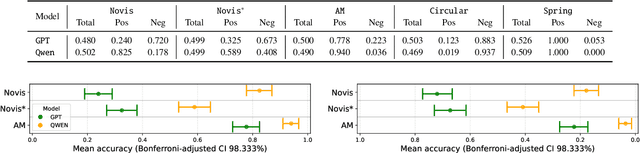
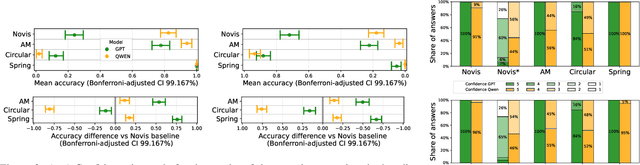
We evaluate how visualizations can influence the judgment of MLLMs about the presence or absence of bridges in a network. We show that the inclusion of visualization improves confidence over a structured text-based input that could theoretically be helpful for answering the question. On the other hand, we observe that standard visualization techniques create a strong bias towards accepting or refuting the presence of a bridge -- independently of whether or not a bridge actually exists in the network. While our results indicate that the inclusion of visualization techniques can effectively influence the MLLM's judgment without compromising its self-reported confidence, they also imply that practitioners must be careful of allowing users to include visualizations in generative AI applications so as to avoid undesired hallucinations.
A Customized SAT-based Solver for Graph Coloring
Apr 07, 2025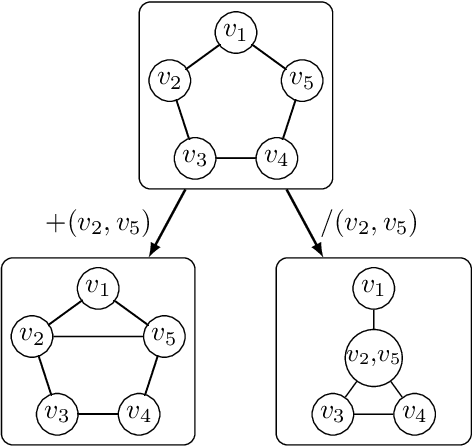
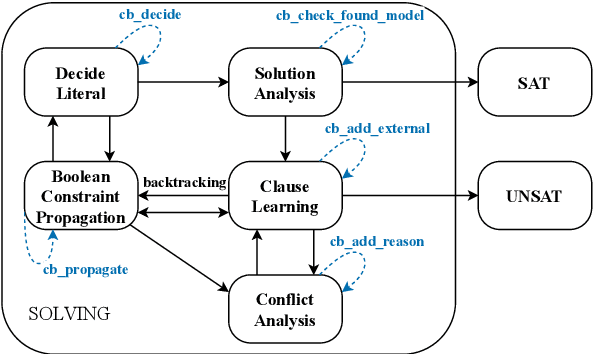

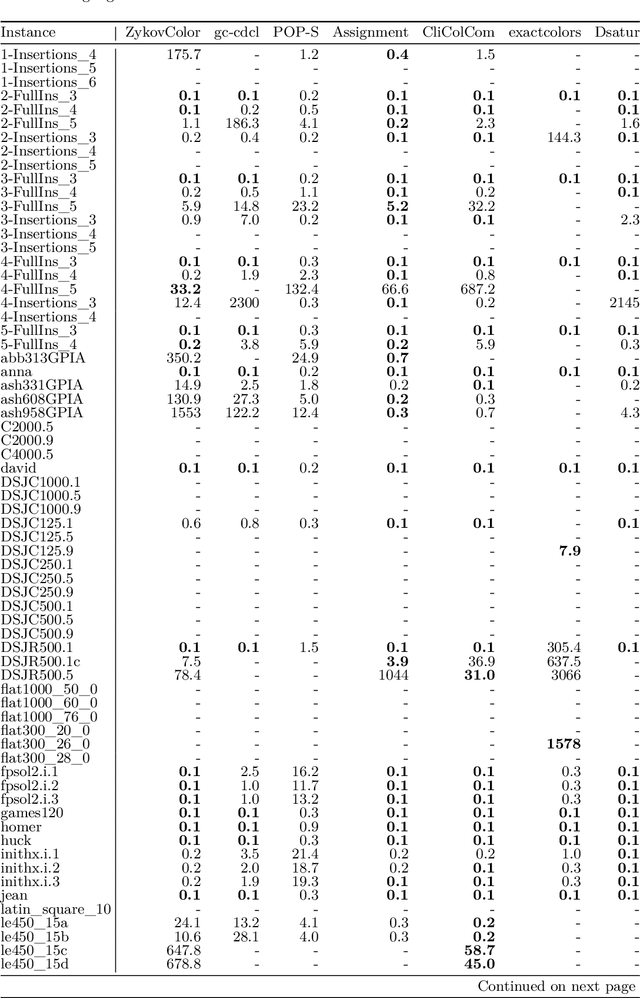
We introduce ZykovColor, a novel SAT-based algorithm to solve the graph coloring problem working on top of an encoding that mimics the Zykov tree. Our method is based on an approach of H\'ebrard and Katsirelos (2020) that employs a propagator to enforce transitivity constraints, incorporate lower bounds for search tree pruning, and enable inferred propagations. We leverage the recently introduced IPASIR-UP interface for CaDiCal to implement these techniques with a SAT solver. Furthermore, we propose new features that take advantage of the underlying SAT solver. These include modifying the integrated decision strategy with vertex domination hints and using incremental bottom-up search that allows to reuse learned clauses from previous calls. Additionally, we integrate a more efficient clique computation to improve the lower bounds during the search. We validate the effectiveness of each new feature through an experimental analysis. ZykovColor outperforms other state-of-the-art graph coloring implementations on the DIMACS benchmark set. Further experiments on random Erd\H{o}s-R\'enyi graphs show that our new approach dominates state-of-the-art SAT-based methods for both very sparse and highly dense graphs.