 Add to Chrome
 Add to Firefox
 Add to Edge
NeSyCat Torch: A Differentiable Tensor Implementation of Categorical Semantics for Neurosymbolic Learning
Jun 17, 2026
Neurosymbolic semantics is fragmented: classical, fuzzy, probabilistic and neural systems each define truth by their own inductive rules. NeSyCat, extending ULLER, subsumes them under a single inductive definition of truth, parametric in a strong monad and an aggregation structure on truth-values. NeSyCat has so far lacked an account of predicates and functions learned by neural networks. We provide NeSyCat Torch as the missing link and interpret computational symbols via neural networks, implementing the framework in probabilistic programming and tensor-based backends. We use the distribution monad for reference semantics and metric evaluation, and complement it by a monad for numerically stable, differentiable training: the lazy log-tensor monad over the log-semiring. For efficient training in batches, we furthermore employ a batch monad. The axioms are the source code: written once in monad-based do-notation, monadic bind performs marginalisation, lazily pruning unneeded branches. On MNIST addition, our HaskTorch, JAX, and PyTorch implementations outperform LTN and DeepProbLog in speed and accuracy, while achieving nearly the accuracy of DeepStochLog. However, unlike DeepStochLog, we stay in a uniform framework that applies to many first-order NeSy approaches. Namely, the construction is parametric in the monad; instantiating it with, e.g., the Giry monad extends the approach to continuous probability (working out a neural representation here is left for future work).

NeSyCat: A Monad-Based Categorical Semantics of the Neurosymbolic ULLER Framework
Apr 27, 2026ULLER (Unified Language for LEarning and Reasoning) offers a unified first-order logic (FOL) syntax, enabling its knowledge bases to be used directly across a wide range of neurosymbolic systems. The original specification endows this syntax with three pairwise independent semantics: classical, fuzzy, and probabilistic, each accompanied by dedicated semantic rules. We show that these seemingly disparate semantics are all instances of one categorical framework based on monads, the very construct that models side effects in functional programming. This enables the modular addition of new semantics and systematic translations between them. As example, we outline the addition of generalised quantification in Logic Tensor Networks (LTN) to arbitrary (also infinite) domains by extending the Giry monad to probability spaces. In particular, our approach allows a modular implementation of ULLER in Python and Haskell, of which we have published initial versions on GitHub.
The Possibility of Artificial Intelligence Becoming a Subject and the Alignment Problem
Apr 16, 2026Artificial General Intelligence (AGI) is increasingly being discussed not only as a tool, but also as a potential subject with personal and therefore moral status. In our opinion, the currently dominant alignment strategies, which focus on human control and containment of AI, therefore fall short. Building on Turing's analogy of "child machines", we are developing a vision of the possibility of autonomy-supporting parenting of AI, in which human control over a developing AGI is gradually reduced, allowing AI to become an independent, autonomous subject. Rather than viewing AGI, as is currently prevalent, as a dangerous creature that needs to be locked up and controlled, we should approach potential AGI with respect for a possible developing subject on the one hand, and with full confidence in our human capabilities on the other. Such a perspective opens up the possibility of cooperative coexistence and co-evolution between humans and AGIs. The relationship between humans and AGIs will thus have to be newly determined, which will change our self-image as humans. It will be crucial that humans not only claim control over potential AGIs, but also engage with AGIs through surprise, creativity, and other specifically human qualities, thereby offering them motivating incentives for cooperation.
Advancing Natural Language Formalization to First Order Logic with Fine-tuned LLMs
Sep 26, 2025Automating the translation of natural language to first-order logic (FOL) is crucial for knowledge representation and formal methods, yet remains challenging. We present a systematic evaluation of fine-tuned LLMs for this task, comparing architectures (encoder-decoder vs. decoder-only) and training strategies. Using the MALLS and Willow datasets, we explore techniques like vocabulary extension, predicate conditioning, and multilingual training, introducing metrics for exact match, logical equivalence, and predicate alignment. Our fine-tuned Flan-T5-XXL achieves 70% accuracy with predicate lists, outperforming GPT-4o and even the DeepSeek-R1-0528 model with CoT reasoning ability as well as symbolic systems like ccg2lambda. Key findings show: (1) predicate availability boosts performance by 15-20%, (2) T5 models surpass larger decoder-only LLMs, and (3) models generalize to unseen logical arguments (FOLIO dataset) without specific training. While structural logic translation proves robust, predicate extraction emerges as the main bottleneck.
A semantic loss for ontology classification
May 03, 2024Deep learning models are often unaware of the inherent constraints of the task they are applied to. However, many downstream tasks require logical consistency. For ontology classification tasks, such constraints include subsumption and disjointness relations between classes. In order to increase the consistency of deep learning models, we propose a semantic loss that combines label-based loss with terms penalising subsumption- or disjointness-violations. Our evaluation on the ChEBI ontology shows that the semantic loss is able to decrease the number of consistency violations by several orders of magnitude without decreasing the classification performance. In addition, we use the semantic loss for unsupervised learning. We show that this can further improve consistency on data from a distribution outside the scope of the supervised training.
Ontology Pre-training for Poison Prediction
Jan 20, 2023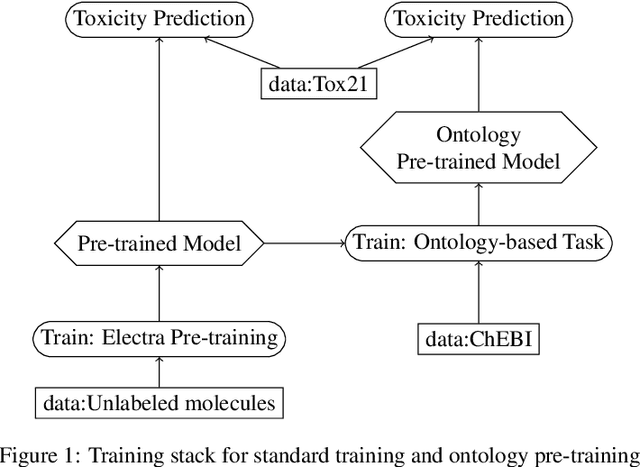
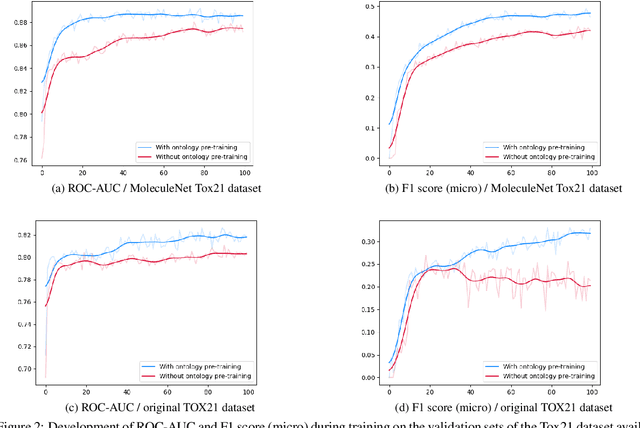
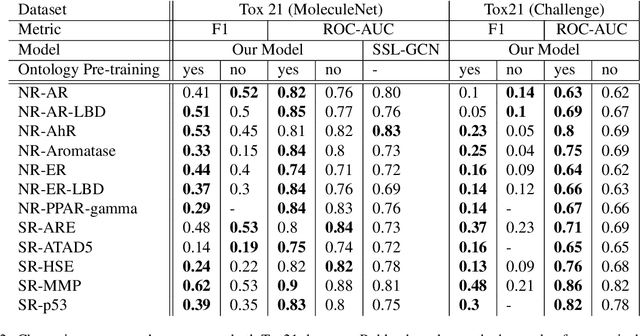
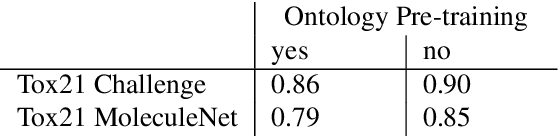
Integrating human knowledge into neural networks has the potential to improve their robustness and interpretability. We have developed a novel approach to integrate knowledge from ontologies into the structure of a Transformer network which we call ontology pre-training: we train the network to predict membership in ontology classes as a way to embed the structure of the ontology into the network, and subsequently fine-tune the network for the particular prediction task. We apply this approach to a case study in predicting the potential toxicity of a small molecule based on its molecular structure, a challenging task for machine learning in life sciences chemistry. Our approach improves on the state of the art, and moreover has several additional benefits. First, we are able to show that the model learns to focus attention on more meaningful chemical groups when making predictions with ontology pre-training than without, paving a path towards greater robustness and interpretability. Second, the training time is reduced after ontology pre-training, indicating that the model is better placed to learn what matters for toxicity prediction with the ontology pre-training than without. This strategy has general applicability as a neuro-symbolic approach to embed meaningful semantics into neural networks.
Modular design patterns for neural-symbolic integration: refinement and combination
Jun 09, 2022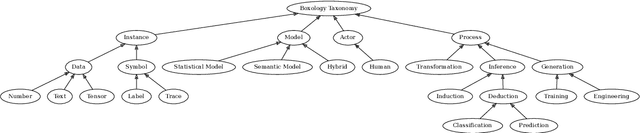

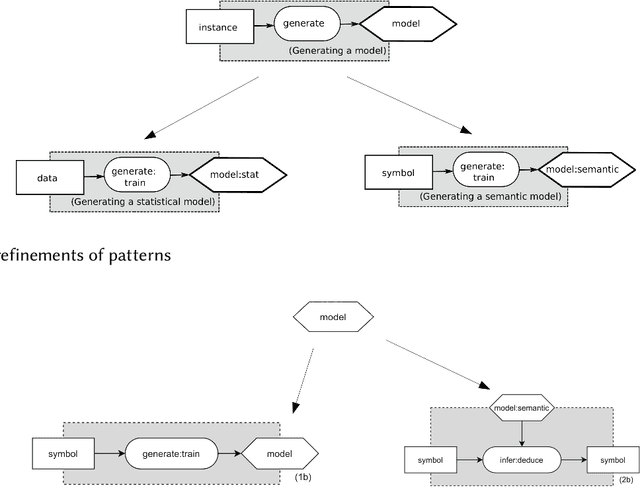
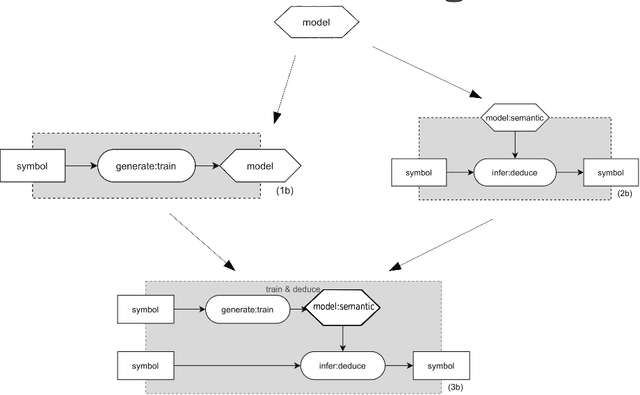
We formalise some aspects of the neural-symbol design patterns of van Bekkum et al., such that we can formally define notions of refinement of patterns, as well as modular combination of larger patterns from smaller building blocks. These formal notions are being implemented in the heterogeneous tool set (Hets), such that patterns and refinements can be checked for well-formedness, and combinations can be computed.
Automated and Explainable Ontology Extension Based on Deep Learning: A Case Study in the Chemical Domain
Sep 19, 2021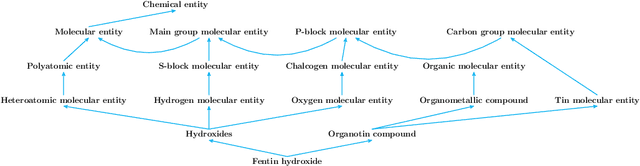
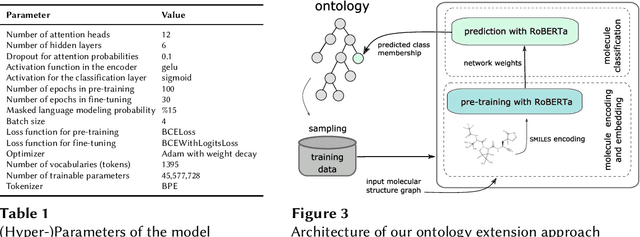

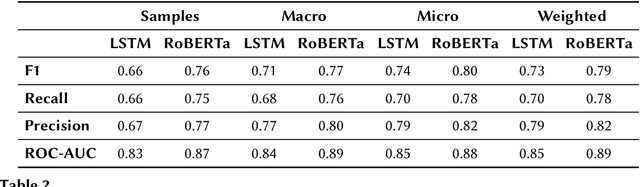
Reference ontologies provide a shared vocabulary and knowledge resource for their domain. Manual construction enables them to maintain a high quality, allowing them to be widely accepted across their community. However, the manual development process does not scale for large domains. We present a new methodology for automatic ontology extension and apply it to the ChEBI ontology, a prominent reference ontology for life sciences chemistry. We trained a Transformer-based deep learning model on the leaf node structures from the ChEBI ontology and the classes to which they belong. The model is then capable of automatically classifying previously unseen chemical structures. The proposed model achieved an overall F1 score of 0.80, an improvement of 6 percentage points over our previous results on the same dataset. Additionally, we demonstrate how visualizing the model's attention weights can help to explain the results by providing insight into how the model made its decisions.
Generic Ontology Design Patterns: Roles and Change over Time
Nov 18, 2020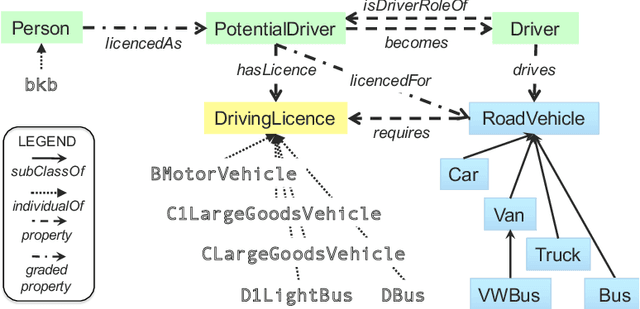
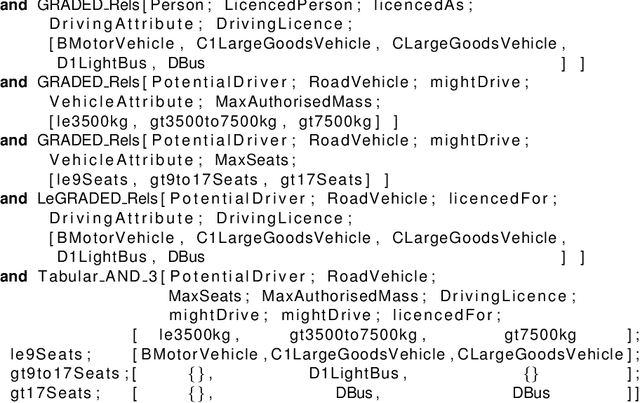
In this chapter we propose Generic Ontology Design Patterns, GODPs, as a methodology for representing and instantiating ontology design patterns in a way that is adaptable, and allows domain experts (and other users) to safely use them without cluttering their ontologies.
Generic Ontology Design Patterns at Work
Jun 20, 2019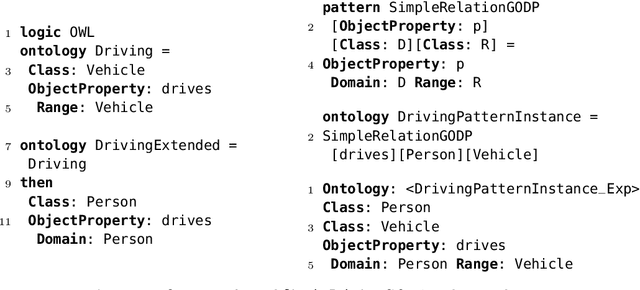
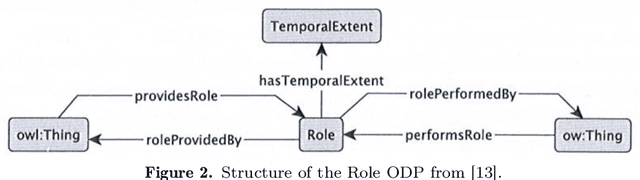
Generic Ontology Design Patterns, GODPs, are defined in Generic DOL, an extension of DOL, the Distributed Ontology, Model and Specification Language, and implemented using Heterogeneous Tool Set. Parameters such as classes, properties, individuals, or whole ontologies may be instantiated with arguments in a host ontology. The potential of Generic DOL is illustrated with GODPs for an example from the literature, namely the Role design pattern. We also discuss how larger GODPs may be composed by instantiating smaller GODPs.