 Add to Chrome
 Add to Firefox
 Add to Edge
Stories of Your Life as Others: A Round-Trip Evaluation of LLM-Generated Life Stories Conditioned on Rich Psychometric Profiles
Apr 07, 2026
Personality traits are richly encoded in natural language, and large language models (LLMs) trained on human text can simulate personality when conditioned on persona descriptions. However, existing evaluations rely predominantly on questionnaire self-report by the conditioned model, are limited in architectural diversity, and rarely use real human psychometric data. Without addressing these limitations, it remains unclear whether personality conditioning produces psychometrically informative representations of individual differences or merely superficial alignment with trait descriptors. To test how robustly LLMs can encode personality into extended text, we condition LLMs on real psychometric profiles from 290 participants to generate first-person life story narratives, and then task independent LLMs to recover personality scores from those narratives alone. We show that personality scores can be recovered from the generated narratives at levels approaching human test-retest reliability (mean r = 0.750, 85% of the human ceiling), and that recovery is robust across 10 LLM narrative generators and 3 LLM personality scorers spanning 6 providers. Decomposing systematic biases reveals that scoring models achieve their accuracy while counteracting alignment-induced defaults. Content analysis of the generated narratives shows that personality conditioning produces behaviourally differentiated text: nine of ten coded features correlate significantly with the same features in participants' real conversations, and personality-driven emotional reactivity patterns in narratives replicate in real conversational data. These findings provide evidence that the personality-language relationship captured during pretraining supports robust encoding and decoding of individual differences, including characteristic emotional variability patterns that replicate in real human behaviour.

Indeterminacy in Affective Computing: Considering Meaning and Context in Data Collection Practices
Feb 13, 2025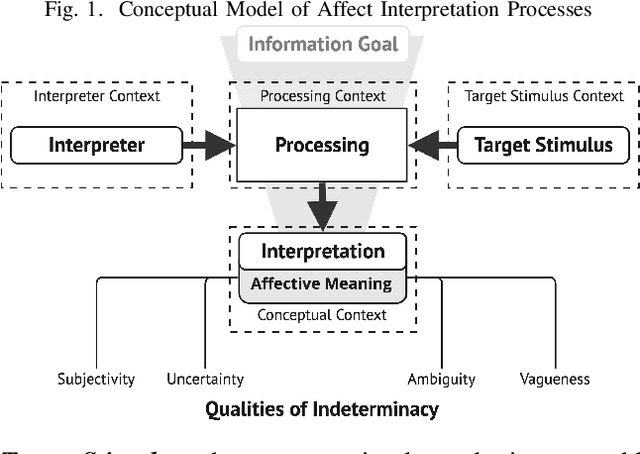
Automatic Affect Prediction (AAP) uses computational analysis of input data such as text, speech, images, and physiological signals to predict various affective phenomena (e.g., emotions or moods). These models are typically constructed using supervised machine-learning algorithms, which rely heavily on labeled training datasets. In this position paper, we posit that all AAP training data are derived from human Affective Interpretation Processes, resulting in a form of Affective Meaning. Research on human affect indicates a form of complexity that is fundamental to such meaning: it can possess what we refer to here broadly as Qualities of Indeterminacy (QIs) - encompassing Subjectivity (meaning depends on who is interpreting), Uncertainty (lack of confidence regarding meanings' correctness), Ambiguity (meaning contains mutually exclusive concepts) and Vagueness (meaning is situated at different levels in a nested hierarchy). Failing to appropriately consider QIs leads to results incapable of meaningful and reliable predictions. Based on this premise, we argue that a crucial step in adequately addressing indeterminacy in AAP is the development of data collection practices for modeling corpora that involve the systematic consideration of 1) a relevant set of QIs and 2) context for the associated interpretation processes. To this end, we are 1) outlining a conceptual model of AIPs and the QIs associated with the meaning these produce and a conceptual structure of relevant context, supporting understanding of its role. Finally, we use our framework for 2) discussing examples of context-sensitivity-related challenges for addressing QIs in data collection setups. We believe our efforts can stimulate a structured discussion of both the role of aspects of indeterminacy and context in research on AAP, informing the development of better practices for data collection and analysis.