 Add to Chrome
 Add to Firefox
 Add to Edge
FecalFed: Privacy-Preserving Poultry Disease Detection via Federated Learning
Apr 01, 2026
Early detection of highly pathogenic avian influenza (HPAI) and endemic poultry diseases is critical for global food security. While computer vision models excel at classifying diseases from fecal imaging, deploying these systems at scale is bottlenecked by farm data privacy concerns and institutional data silos. Furthermore, existing open-source agricultural datasets frequently suffer from severe, undocumented data contamination. In this paper, we introduce $\textbf{FecalFed}$, a privacy-preserving federated learning framework for poultry disease classification. We first curate and release $\texttt{poultry-fecal-fl}$, a rigorously deduplicated dataset of 8,770 unique images across four disease classes, revealing and eliminating a 46.89$\%$ duplication rate in popular public repositories. To simulate realistic agricultural environments, we evaluate FecalFed under highly heterogeneous, non-IID conditions (Dirichlet $α=0.5$). While isolated single-farm training collapses under this data heterogeneity, yielding only 64.86$\%$ accuracy, our federated approach recovers performance without centralizing sensitive data. Specifically, utilizing server-side adaptive optimization (FedAdam) with a Swin-Small architecture achieves 90.31$\%$ accuracy, closely approaching the centralized upper bound of 95.10\%. Furthermore, we demonstrate that an edge-optimized Swin-Tiny model maintains highly competitive performance at 89.74$\%$, establishing a highly efficient, privacy-first blueprint for on-farm avian disease monitoring.

V"Mean"ba: Visual State Space Models only need 1 hidden dimension
Dec 21, 2024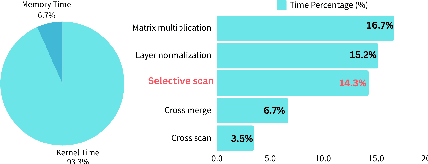
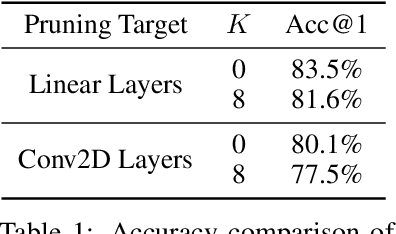
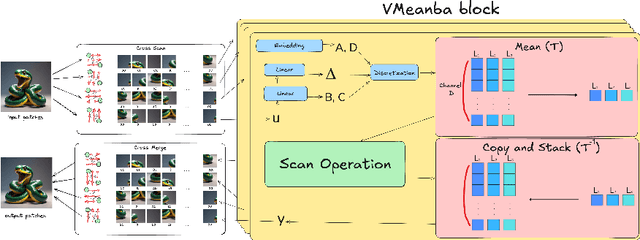
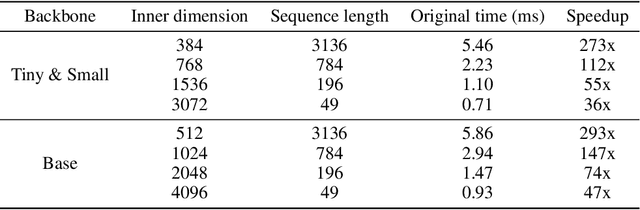
Vision transformers dominate image processing tasks due to their superior performance. However, the quadratic complexity of self-attention limits the scalability of these systems and their deployment on resource-constrained devices. State Space Models (SSMs) have emerged as a solution by introducing a linear recurrence mechanism, which reduces the complexity of sequence modeling from quadratic to linear. Recently, SSMs have been extended to high-resolution vision tasks. Nonetheless, the linear recurrence mechanism struggles to fully utilize matrix multiplication units on modern hardware, resulting in a computational bottleneck. We address this issue by introducing \textit{VMeanba}, a training-free compression method that eliminates the channel dimension in SSMs using mean operations. Our key observation is that the output activations of SSM blocks exhibit low variances across channels. Our \textit{VMeanba} leverages this property to optimize computation by averaging activation maps across the channel to reduce the computational overhead without compromising accuracy. Evaluations on image classification and semantic segmentation tasks demonstrate that \textit{VMeanba} achieves up to a 1.12x speedup with less than a 3\% accuracy loss. When combined with 40\% unstructured pruning, the accuracy drop remains under 3\%.