 Add to Chrome
 Add to Firefox
 Add to Edge
A Novel Approach to Explainable AI with Quantized Active Ingredients in Decision Making
Jan 13, 2026
Artificial Intelligence (AI) systems have shown good success at classifying. However, the lack of explainability is a true and significant challenge, especially in high-stakes domains, such as health and finance, where understanding is paramount. We propose a new solution to this challenge: an explainable AI framework based on our comparative study with Quantum Boltzmann Machines (QBMs) and Classical Boltzmann Machines (CBMs). We leverage principles of quantum computing within classical machine learning to provide substantive transparency around decision-making. The design involves training both models on a binarised and dimensionally reduced MNIST dataset, where Principal Component Analysis (PCA) is applied for preprocessing. For interpretability, we employ gradient-based saliency maps in QBMs and SHAP (SHapley Additive exPlanations) in CBMs to evaluate feature attributions.QBMs deploy hybrid quantum-classical circuits with strongly entangling layers, allowing for richer latent representations, whereas CBMs serve as a classical baseline that utilises contrastive divergence. Along the way, we found that QBMs outperformed CBMs on classification accuracy (83.5% vs. 54%) and had more concentrated distributions in feature attributions as quantified by entropy (1.27 vs. 1.39). In other words, QBMs not only produced better predictive performance than CBMs, but they also provided clearer identification of "active ingredient" or the most important features behind model predictions. To conclude, our results illustrate that quantum-classical hybrid models can display improvements in both accuracy and interpretability, which leads us toward more trustworthy and explainable AI systems.
* Accepted and published in IEEE 2025. This is the authors manuscript version; final version available at IEEE Xplore: https://ieeexplore.ieee.org/document/11318441

Enhancing Small Dataset Classification Using Projected Quantum Kernels with Convolutional Neural Networks
Jan 06, 2026Convolutional Neural Networks (CNNs) have shown promising results in efficiency and accuracy in image classification. However, their efficacy often relies on large, labeled datasets, posing challenges for applications with limited data availability. Our research addresses these challenges by introducing an innovative approach that leverages projected quantum kernels (PQK) to enhance feature extraction for CNNs, specifically tailored for small datasets. Projected quantum kernels, derived from quantum computing principles, offer a promising avenue for capturing complex patterns and intricate data structures that traditional CNNs might miss. By incorporating these kernels into the feature extraction process, we improved the representational ability of CNNs. Our experiments demonstrated that, with 1000 training samples, the PQK-enhanced CNN achieved 95% accuracy on the MNIST dataset and 90% on the CIFAR-10 dataset, significantly outperforming the classical CNN, which achieved only 60% and 12% accuracy on the respective datasets. This research reveals the potential of quantum computing in overcoming data scarcity issues in machine learning and paves the way for future exploration of quantum-assisted neural networks, suggesting that projected quantum kernels can serve as a powerful approach for enhancing CNN-based classification in data-constrained environments.
* Accepted and published in IEEE 2024. This is the authors manuscript version; final version available at IEEE Xplore: https://ieeexplore.ieee.org/document/10844961/
VizGen: Data Exploration and Visualization from Natural Language via a Multi-Agent AI Architecture
Sep 26, 2025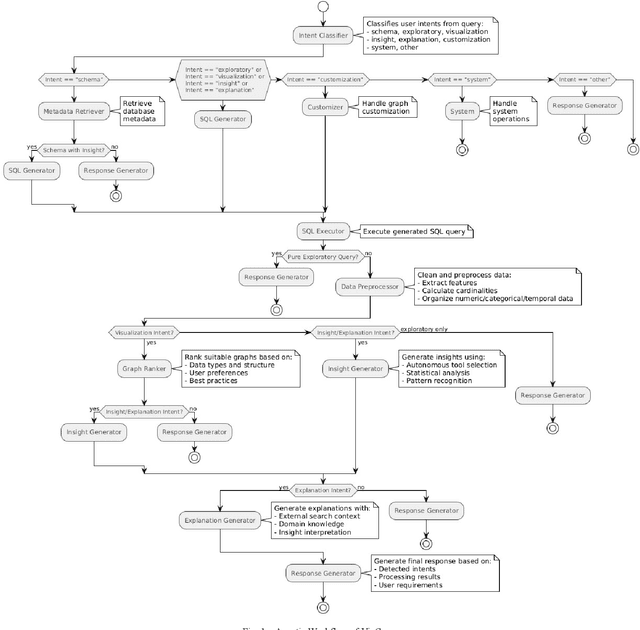
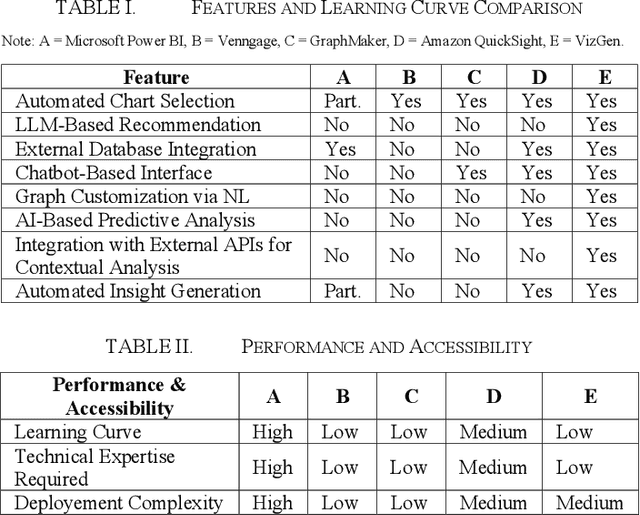
Data visualization is essential for interpreting complex datasets, yet traditional tools often require technical expertise, limiting accessibility. VizGen is an AI-assisted graph generation system that empowers users to create meaningful visualizations using natural language. Leveraging advanced NLP and LLMs like Claude 3.7 Sonnet and Gemini 2.0 Flash, it translates user queries into SQL and recommends suitable graph types. Built on a multi-agent architecture, VizGen handles SQL generation, graph creation, customization, and insight extraction. Beyond visualization, it analyzes data for patterns, anomalies, and correlations, and enhances user understanding by providing explanations enriched with contextual information gathered from the internet. The system supports real-time interaction with SQL databases and allows conversational graph refinement, making data analysis intuitive and accessible. VizGen democratizes data visualization by bridging the gap between technical complexity and user-friendly design.