 Add to Chrome
 Add to Firefox
 Add to Edge
Learning Long Range Spatio-Temporal Representations over Continuous Time Dynamic Graphs with State Space Models
Jun 04, 2026
Continuous-time dynamic graphs (CTDGs) provide a richer framework to capture fine-grained temporal patterns in evolving relational data. Long-range information propagation is a key challenge while learning representations, wherein it is important to retain and update information over long temporal horizons. Existing approaches restrict models to capture one-hop or local temporal neighborhoods and fail to capture multi-hop or global structural patterns. To mitigate this, we derive a parameter-efficient state-space modeling framework for continuous-time dynamic graphs (CTDG-SSM) from first principles. We first introduce continuous-time Topology-Aware higher order polynomial projection operator (CTT-HiPPO), a novel memory-based reformulation of HiPPO to jointly encode temporal dynamics and graph structure. The solution from CTT-HiPPO is obtained by projecting the classical HiPPO solution through a polynomial of the Laplacian matrix, yielding topology-aware memory updates that admit an equivalent state-space formulation for CTDGs (CTDG-SSM). Then a computationally efficient discrete formulation is obtained using the zero-order hold approach for model implementation. Across benchmarks on dynamic link prediction, dynamic node classification, and sequence classification, CTDG-SSM achieves state-of-the-art performance. Notably, it achieves large performance gains on datasets that require long range temporal (LRT) and spatial reasoning.

HoT-SSM:Higher-order Temporal Knowledge Graph Reasoning with State Space Models for Health Care
Jun 04, 2026Medical knowledge graphs (MKGs) infused with clinical knowledge have been increasingly used to model electronic health records (EHRs) to support interpretable predictions in healthcare domain. However, existing MKG-based approaches are limited in capturing pairwise relations between clinical concepts (e.g., conditions, procedures, and medications), and restricts their ability to model higher-order interactions among co-occurring or semantically related concepts. In addition, most representation learning methods that leverage MKGs either collapse temporal information across visits or lack an explicit mechanism for modeling long-range temporal dependencies, which is critical for clinical tasks such as mortality prediction. To mitigate these limitations, we propose HoT-SSM, a parameter efficient and higher-order temporal graph reasoning with state space models. For each visit, HoT-SSM constructs hypergraphs by grouping semantically related clinical concepts into hyperedges using domain knowledge, thereby preserving visit-level clinical context. Further, to model the temporal dynamics while learning the representations, we introduce a novel dynamic hypergraph-based state space model that explicitly captures patients latent state evolution over time while preserving long-range information. The learned representations are used for downstream clinical prediction and reasoning. Experiments on MIMIC-III and MIMIC-IV datasets shows significant performance improvement over the current state-of-the-art models, demonstrating the effectiveness of jointly modeling higher-order clinical interactions and long-range temporal dependencies.
Clustering with Simplicial Complexes
Mar 14, 2023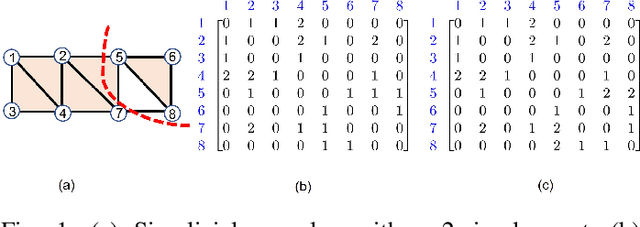

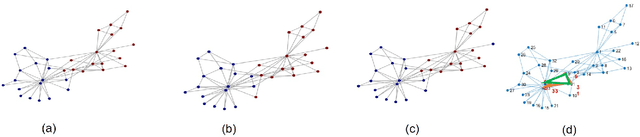
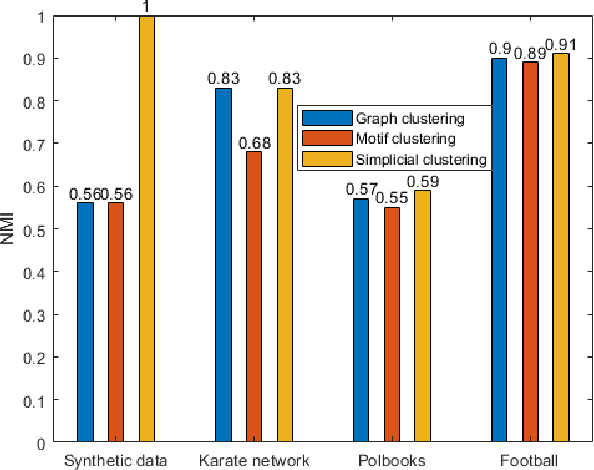
In this work, we propose a new clustering algorithm to group nodes in networks based on second-order simplices (aka filled triangles) to leverage higher-order network interactions. We define a simplicial conductance function, which on minimizing, yields an optimal partition with a higher density of filled triangles within the set while the density of filled triangles is smaller across the sets. To this end, we propose a simplicial adjacency operator that captures the relation between the nodes through second-order simplices. This allows us to extend the well-known Cheeger inequality to cluster a simplicial complex. Then, leveraging the Cheeger inequality, we propose the simplicial spectral clustering algorithm. We report results from numerical experiments on synthetic and real-world network data to demonstrate the efficacy of the proposed approach.