 Add to Chrome
 Add to Firefox
 Add to Edge
Gap Safe Screening Rules for Fast Training of Robust Support Vector Machines under Feature Noise
Mar 26, 2026
Robust Support Vector Machines (R-SVMs) address feature noise by adopting a worst-case robust formulation that explicitly incorporates uncertainty sets into training. While this robustness improves reliability, it also leads to increased computational cost. In this work, we develop safe sample screening rules for R-SVMs that reduce the training complexity without affecting the optimal solution. To the best of our knowledge, this is the first study to apply safe screening techniques to worst-case robust models in supervised machine learning. Our approach safely identifies training samples whose uncertainty sets are guaranteed to lie entirely on either side of the margin hyperplane, thereby reducing the problem size and accelerating optimization. Owing to the nonstandard structure of R-SVMs, the proposed screening rules are derived from the Lagrangian duality rather than the Fenchel-Rockafellar duality commonly used in recent methods. Based on this analysis, we first establish an ideal screening rule, and then derive a practical rule by adapting GAP-based safe regions to the robust setting. Experiments demonstrate that the proposed method significantly reduces training time while preserving classification accuracy.

One to beat them all: "RYU'' -- a unifying framework for the construction of safe balls
Dec 01, 2023In this paper, we put forth a novel framework (named ``RYU'') for the construction of ``safe'' balls, i.e. regions that provably contain the dual solution of a target optimization problem. We concentrate on the standard setup where the cost function is the sum of two terms: a closed, proper, convex Lipschitz-smooth function and a closed, proper, convex function. The RYU framework is shown to generalize or improve upon all the results proposed in the last decade for the considered family of optimization problems.
Beyond GAP screening for Lasso by exploiting new dual cutting half-spaces with supplementary material
Mar 02, 2022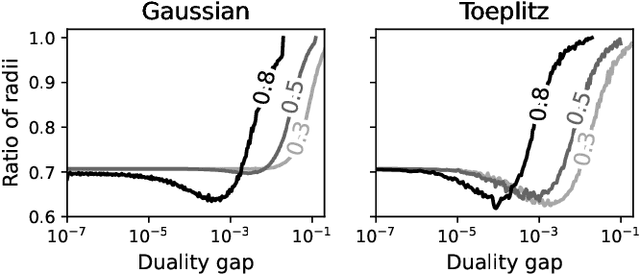
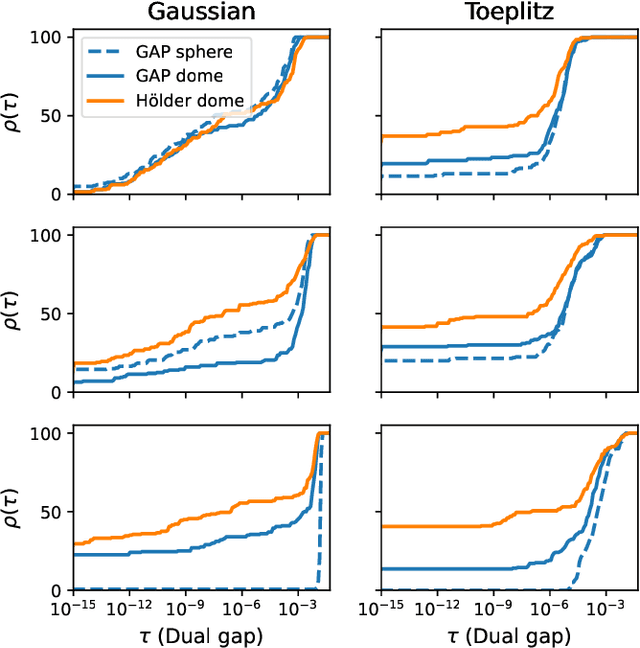
In this paper, we propose a novel safe screening test for Lasso. Our procedure is based on a safe region with a dome geometry and exploits a canonical representation of the set of half-spaces (referred to as "dual cutting half-spaces" in this paper) containing the dual feasible set. The proposed safe region is shown to be always included in the state-of-the-art "GAP Sphere" and "GAP Dome" proposed by Fercoq et al. (and strictly so under very mild conditions) while involving the same computational burden. Numerical experiments confirm that our new dome enables to devise more powerful screening tests than GAP regions and lead to significant acceleration to solve Lasso.