 Add to Chrome
 Add to Firefox
 Add to Edge
Adjoint-based shape optimization of a ship hull using a Conditional Variational Autoencoder (CVAE) assisted propulsion surrogate model
Feb 17, 2026
Adjoint-based shape optimization of ship hulls is a powerful tool for addressing high-dimensional design problems in naval architecture, particularly in minimizing the ship resistance. However, its application to vessels that employ complex propulsion systems introduces significant challenges. They arise from the need for transient simulations extending over long periods of time with small time steps and from the reverse temporal propagation of the primal and adjoint solutions. These challenges place considerable demands on the required storage and computing power, which significantly hamper the use of adjoint methods in the industry. To address this issue, we propose a machine learning-assisted optimization framework that employs a Conditional Variational Autoencoder-based surrogate model of the propulsion system. The surrogate model replicates the time-averaged flow field induced by a Voith Schneider Propeller and replaces the geometrically and time-resolved propeller with a data-driven approximation. Primal flow verification examples demonstrate that the surrogate model achieves significant computational savings while maintaining the necessary accuracy of the resolved propeller. Optimization studies show that ignoring the propulsion system can yield designs that perform worse than the initial shape. In contrast, the proposed method produces shapes that achieve more than an 8\% reduction in resistance.

Disentangled Latent Spaces for Reduced Order Models using Deterministic Autoencoders
Feb 20, 2025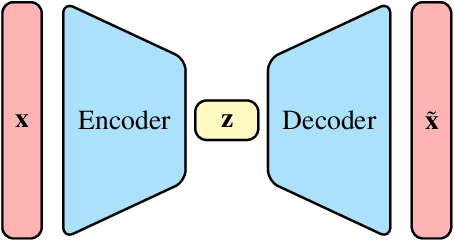
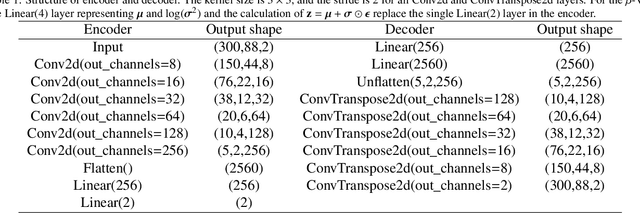
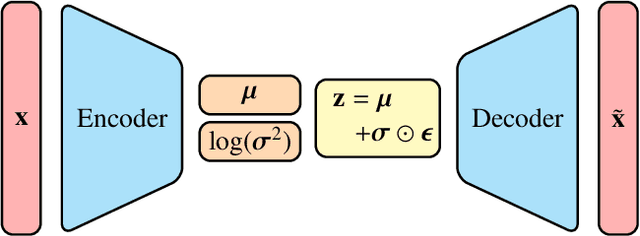
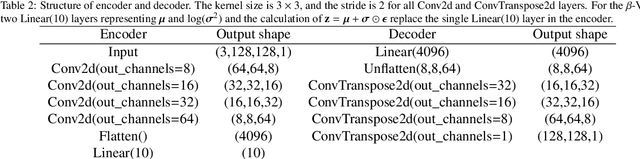
Data-driven reduced-order models based on autoencoders generally lack interpretability compared to classical methods such as the proper orthogonal decomposition. More interpretability can be gained by disentangling the latent variables and analyzing the resulting modes. For this purpose, probabilistic $\beta$-variational autoencoders ($\beta$-VAEs) are frequently used in computational fluid dynamics and other simulation sciences. Using a benchmark periodic flow dataset, we show that competitive results can be achieved using non-probabilistic autoencoder approaches that either promote orthogonality or penalize correlation between latent variables. Compared to probabilistic autoencoders, these approaches offer more robustness with respect to the choice of hyperparameters entering the loss function. We further demonstrate the ability of a non-probabilistic approach to identify a reduced number of active latent variables by introducing a correlation penalty, a function also known from the use of $\beta$-VAE. The investigated probabilistic and non-probabilistic autoencoder models are finally used for the dimensionality reduction of aircraft ditching loads, which serves as an industrial application in this work.
Machine Learning based Prediction of Ditching Loads
Feb 16, 2024We present approaches to predict dynamic ditching loads on aircraft fuselages using machine learning. The employed learning procedure is structured into two parts, the reconstruction of the spatial loads using a convolutional autoencoder (CAE) and the transient evolution of these loads in a subsequent part. Different CAE strategies are assessed and combined with either long short-term memory (LSTM) networks or Koopman-operator based methods to predict the transient behaviour. The training data is compiled by an extension of the momentum method of von-Karman and Wagner and the rationale of the training approach is briefly summarised. The application included refers to a full-scale fuselage of a DLR-D150 aircraft for a range of horizontal and vertical approach velocities at 6{\deg} incidence. Results indicate a satisfactory level of predictive agreement for all four investigated surrogate models examined, with the combination of an LSTM and a deep decoder CAE showing the best performance.