 Add to Chrome
 Add to Firefox
 Add to Edge
Promoting Simple Agents: Ensemble Methods for Event-Log Prediction
Apr 23, 2026
We compare lightweight automata-based models (n-grams) with neural architectures (LSTM, Transformer) for next-activity prediction in streaming event logs. Experiments on synthetic patterns and five real-world process mining datasets show that n-grams with appropriate context windows achieve comparable accuracy to neural models while requiring substantially fewer resources. Unlike windowed neural architectures, which show unstable performance patterns, n-grams provide stable and consistent accuracy. While we demonstrate that classical ensemble methods like voting improve n-gram performance, they require running many agents in parallel during inference, increasing memory consumption and latency. We propose an ensemble method, the promotion algorithm, that dynamically selects between two active models during inference, reducing overhead compared to classical voting schemes. On real-world datasets, these ensembles match or exceed the accuracy of non-windowed neural models with lower computational cost.

Provable Coordination for LLM Agents via Message Sequence Charts
Apr 19, 2026Multi-agent systems built on large language models (LLMs) are difficult to reason about. Coordination errors such as deadlocks or type-mismatched messages are often hard to detect through testing. We introduce a domain-specific language for specifying agent coordination based on message sequence charts (MSCs). The language separates message-passing structure from LLM actions, whose outputs remain unpredictable. We define the syntax and semantics of the language and present a syntax-directed projection that generates deadlock-free local agent programs from global coordination specifications. We illustrate the approach with a diagnosis consensus protocol and show how coordination properties can be established independently of LLM nondeterminism. We also describe a runtime planning extension in which an LLM dynamically generates a coordination workflow for which the same structural guarantees apply. An open-source Python implementation of our framework is available as ZipperGen.
A Framework for Streaming Event-Log Prediction in Business Processes
Dec 20, 2024
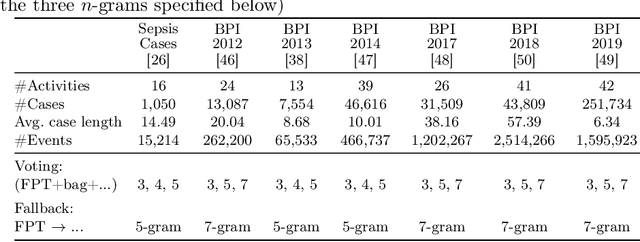

We present a Python-based framework for event-log prediction in streaming mode, enabling predictions while data is being generated by a business process. The framework allows for easy integration of streaming algorithms, including language models like n-grams and LSTMs, and for combining these predictors using ensemble methods. Using our framework, we conducted experiments on various well-known process-mining data sets and compared classical batch with streaming mode. Though, in batch mode, LSTMs generally achieve the best performance, there is often an n-gram whose accuracy comes very close. Combining basic models in ensemble methods can even outperform LSTMs. The value of basic models with respect to LSTMs becomes even more apparent in streaming mode, where LSTMs generally lack accuracy in the early stages of a prediction run, while basic methods make sensible predictions immediately.
A Composable Glitch-Aware Delay Model
Apr 22, 2021


We introduce the Composable Involution Delay Model (CIDM) for fast and accurate digital simulation. It is based on the Involution Delay Model (IDM) [F\"ugger et al., IEEE TCAD 2020], which has been shown to be the only existing candidate for faithful glitch propagation known so far. In its present form, however, it has shortcomings that limit its practical applicability and utility. First, IDM delay predictions are conceptually based on discretizing the analog signal waveforms using specific matching input and output discretization threshold voltages. Unfortunately, they are difficult to determine and typically different for interconnected gates. Second, metastability and high-frequency oscillations in a real circuit could be invisible in the IDM signal predictions. Our CIDM reduces the characterization effort by allowing independent discretization thresholds, improves composability and increases the modeling power by exposing canceled pulse trains at the gate interconnect. We formally show that, despite these improvements, the CIDM still retains the IDM's faithfulness, which is a consequence of the mathematical properties of involution delay functions.