 Add to Chrome
 Add to Firefox
 Add to Edge
Deep Tech to Space: Space Data Centers and AI Revolution at the Edge
May 19, 2026
Dramatic cost reductions driven by private sector innovations have led to a rapid increase in the number of satellites in orbit and a corresponding surge in space-generated data. As this trend continues, transmitting large volumes of data to Earth for processing may become increasingly costly and challenging due to potential space-to-Earth link congestion and increased latency. Moreover, traditional ground station networks may face difficulties accommodating growing data flows and workloads because of capacity constraints, complex scheduling logistics, and restricted visibility windows, which can limit scalability. Space Data Centers (SDCs) -- software-driven, multi-tenant artificial intelligence-based service platforms capable of processing data in orbit to generate actionable insights for client satellites and ground users -- represent a promising approach to address these challenges. This article presents the architecture of a Low Earth Orbit SDC satellite constellation, considering orbital design, inter-satellite links and network topology, computational resource organization, and software service orchestration. We analyze the potential technical feasibility and economic viability of SDCs using forecasting models informed by technology roadmaps and illustrate the concept through Earth observation and lunar exploration use cases.

A cryogenic SRAM based arbitrary waveform generator in 14 nm for spin qubit control
Nov 03, 2022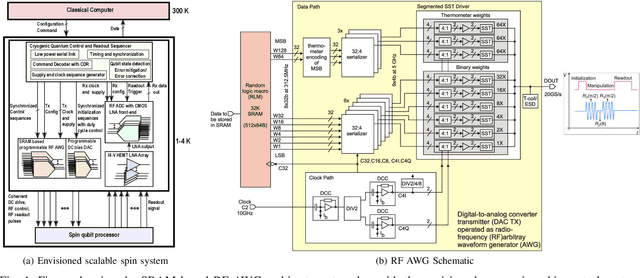
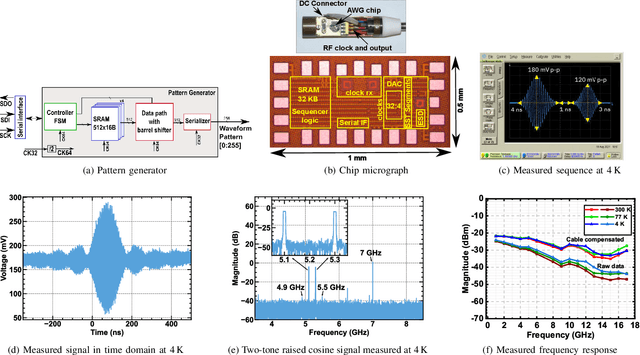
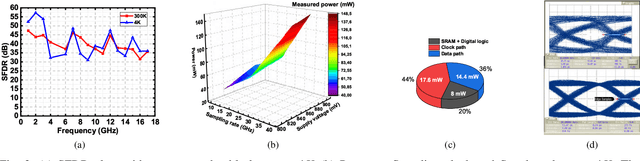
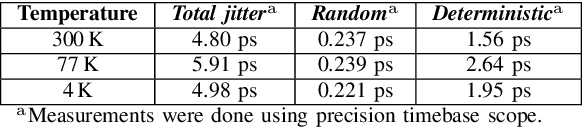
Realization of qubit gate sequences require coherent microwave control pulses with programmable amplitude, duration, spacing and phase. We propose an SRAM based arbitrary waveform generator for cryogenic control of spin qubits. We demonstrate in this work, the cryogenic operation of a fully programmable radio frequency arbitrary waveform generator in 14 nm FinFET technology. The waveform sequence from a control processor can be stored in an SRAM memory array, which can be programmed in real time. The waveform pattern is converted to microwave pulses by a source-series-terminated digital to analog converter. The chip is operational at 4 K, capable of generating an arbitrary envelope shape at the desired carrier frequency. Total power consumption of the AWG is 40-140mW at 4 K, depending upon the baud rate. A wide signal band of 1-17 GHz is measured at 4 K, while multiple qubit control can be achieved using frequency division multiplexing at an average spurious free dynamic range of 40 dB. This work paves the way to optimal qubit control and closed loop feedback control, which is necessary to achieve low latency error mitigation
* 4 pages, IEEE ESSCIRC 2022 conference