 Add to Chrome
 Add to Firefox
 Add to Edge
Ultra-precise TDoA-based Localization of Frequency Hopping LPWAN Transmitters
Jun 03, 2026
The Internet of Things (IoT) is a highly emerging market. It serves as a key enabler for a variety of applications like the digital twin or asset tracking in industrial scenarios. This often requires the provision of precise position information. However, systems like Global Navigation Satellite Systems (GNSS) are ruled out due to high energy costs and indoor applications. A variety of systems is discussed to close this gap. In order to contribute to the investigations of possible gold standards, this paper discusses the localization based on Low Power Wide Area Networks (LPWAN). Therefore, a concept is presented, based on Time Difference of Arrival (TDoA) measurements within the LPWAN standard ETSI TS 103 357. This paper addresses two major challenges. At first, TDoA measurements require highly precise temporal synchronization of the receiving base stations. Within this work, this issue is solved by exploiting Signals of Opportunity (SoO) as synchronization source, enabling sub-meter synchronization accuracy. A further issue arises from the Frequency Hopping (FH) waveform of the transmitting endpoints, resulting in a loss of phase information and thus usable localization bandwidth. A method is introduced to overcome this limitation. This paper states the system concept, proves its functionality in theoretical investigations and simulations. Finally, real-world measurements verify the functionality and show a 2D localization accuracy of below 10 m in Line of Sight (LOS) scenarios.

IoT Cloud RAN Testbed for Ultra-Precise TDoA-based Localization in LPWANs
Jan 21, 2024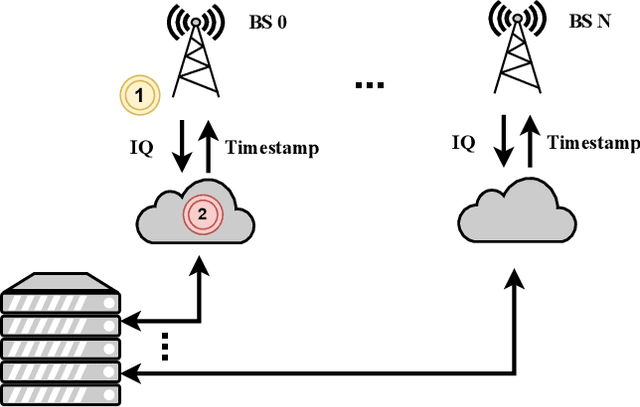
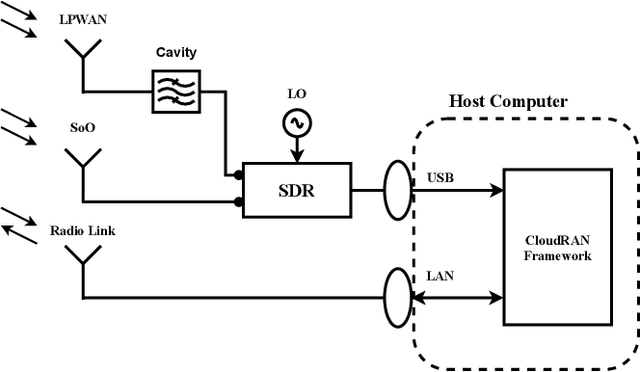
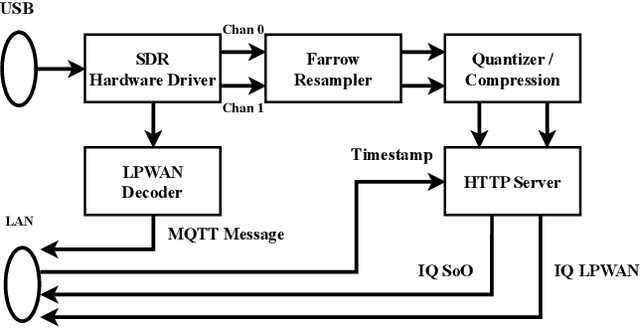
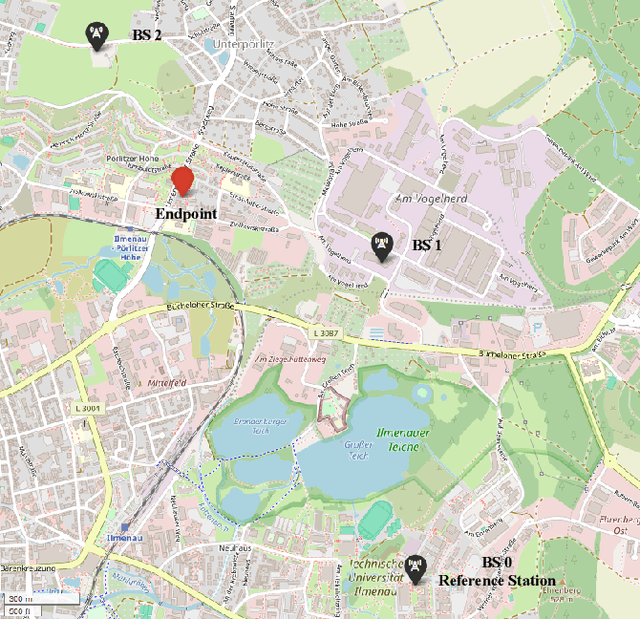
There have been many research efforts in the area of localization in recent years. Especially within the Internet of Things (IoT), the knowledge of position information for individual components is of great interest, for example, in asset tracking, to name just one. However, many of these use cases require a high energy efficiency, making a GNSS-based approach infeasible. One promising candidate can be found in Low Power Wide Area Networks (LPWAN), which enable battery lifetimes of up to 20 years. However, no gold standard for localization exists for these types of networks. Our work proposes a testbed architecture that allows the investigation and development of localization algorithms within LPWA Networks. The concept is built on a Cloud Radio Access Network (CRAN) architecture that allows the streaming of IQ from remote base stations to a central processing unit. Furthermore, the architecture is expanded by a synchronization concept based on Signals of Opportunity (SoO) to enable the testbed for runtime-based positioning. Therefore, we propose a hardware concept consisting of antennas and a low-cost off-the-shelf software-defined radio (SDR)-based frontend architecture and a software framework using a hypertext transfer protocol (HTTP)-based server and client architecture. The proposed system is installed in an urban environment. Initial measurements are conducted, where it can be shown that the proposed architecture can be used for highly precise Time Difference of Arrival (TDoA) measurements, offering the possibility of time synchronization down to approximately 200 ps and frequency synchronization of 3 mHz.
Ultra-Precise Synchronization for TDoA-based Localization Using Signals of Opportunity
Jun 08, 2023Precise localization is one key element of the Internet of Things (IoT). Especially concepts for position estimation when Global Navigation Satellite Systems (GNSS) are unavailable have moved into the focus. One crucial component for localization systems in general and precise runtime-based positioning, in particular, is the necessity of ultra-precise clock synchronization between the receiving base stations. Our work presents a software-based approach for the wireless synchronization of spatially separated base stations using a low-cost off-the-shelf frontend architecture. The proposed system estimates the time synchronization, sampling clock offset, and carrier frequency offset using broadcast signals as Signals of Opportunity. In this paper, we derive the theoretical lower bound for the estimation variance according to the Modified Cramer-Rao Bound. We show that a theoretical time synchronization accuracy in the range of ps and a frequency synchronization precision in the range of milli-Hertz is achievable. An algorithm is presented that estimates the desired parameter based on evaluating the Cross-Correlation Function between base stations. Initial measurements are conducted in a real-world environment. It is shown that the presented estimator nearly reaches the theoretical bound within a time and frequency synchronization accuracy of down to 200 ps and 6 mHz, respectively.