 Add to Chrome
 Add to Firefox
 Add to Edge
EquiFiLM: Charge-Conditioned Equivariant Force Fields via Feature-wise Linear Modulation
Jul 06, 2026
Foundation machine learning force fields (MLFFs) such as MACE-MP-0 and UMA cover broad chemical space at near density functional theory (DFT) accuracy. However, they assume equilibrium ground-state physics and do not natively handle externally induced changes to the electronic state, such as charging, applied fields, or electronic excitation, which limits their use for driven processes such as photoexcitation and charge injection. We propose EquiFiLM, a lightweight extension that adds continuous external conditioning to any equivariant foundation MLFF via a per-layer Feature-wise Linear Modulation (FiLM) block, learning externally driven changes to the potential energy surface from minimal training data. The block modulates only scalar channels and preserves E(3)-equivariance exactly. We demonstrate the recipe on charged liquid water with the foundation model MACE-MatPES as the backbone, yielding E-MACE. On the four training charges, E-MACE delivers a $3.1\times$ reduction in force RMSE ($21.3$ to $6.96$ meV/$\mathring{A}$) and a $61\times$ reduction in per-atom energy RMSE ($6.1$ to $0.1$ meV/atom) over a baseline without EquiFiLM trained on the same data, at indistinguishable inference cost. Across seven held-out interpolation and extrapolation charges, force RMSE stays within $18-61$ meV/$\mathring{A}$ and energy RMSE within $0.7-5.4$ meV/atom. The model runs stable molecular dynamics across the full range tested and predicts the charge-dependent first-shell response of the reduced pair distribution function probed by ultrafast electron diffraction. Adding this conditioning axis to the foundation requires only a few thousand DFT-labeled frames, against the $\approx 10^8$ structures of a charge-aware foundation trained from scratch. The recipe is backbone- and conditioning-agnostic: it applies without architectural change to any equivariant MLFF with scalar interaction-layer channels.

Allegro-Legato: Scalable, Fast, and Robust Neural-Network Quantum Molecular Dynamics via Sharpness-Aware Minimization
Mar 14, 2023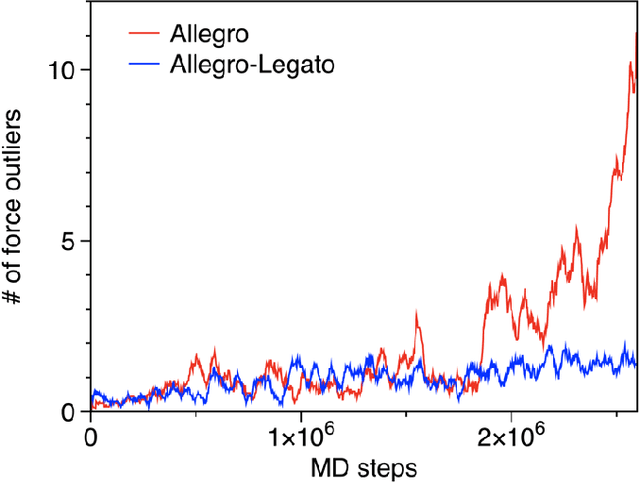

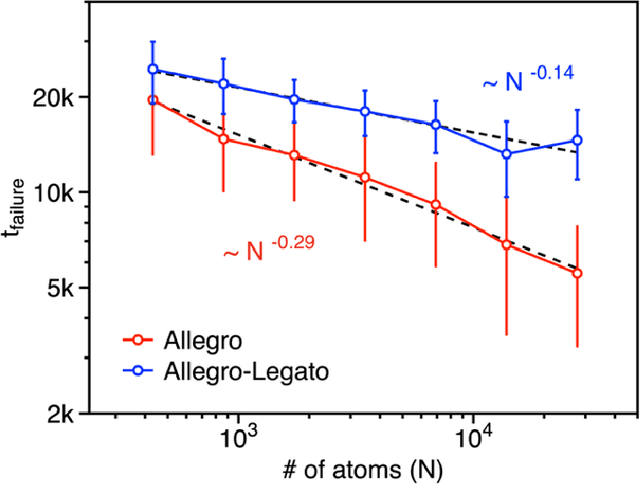
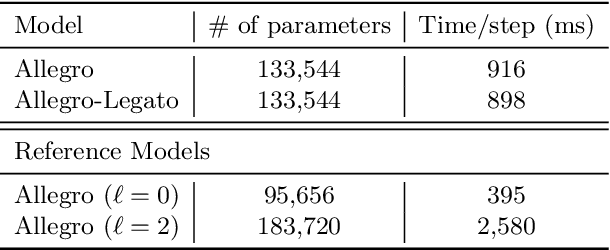
Neural-network quantum molecular dynamics (NNQMD) simulations based on machine learning are revolutionizing atomistic simulations of materials by providing quantum-mechanical accuracy but orders-of-magnitude faster, illustrated by ACM Gordon Bell prize (2020) and finalist (2021). State-of-the-art (SOTA) NNQMD model founded on group theory featuring rotational equivariance and local descriptors has provided much higher accuracy and speed than those models, thus named Allegro (meaning fast). On massively parallel supercomputers, however, it suffers a fidelity-scaling problem, where growing number of unphysical predictions of interatomic forces prohibits simulations involving larger numbers of atoms for longer times. Here, we solve this problem by combining the Allegro model with sharpness aware minimization (SAM) for enhancing the robustness of model through improved smoothness of the loss landscape. The resulting Allegro-Legato (meaning fast and "smooth") model was shown to elongate the time-to-failure $t_\textrm{failure}$, without sacrificing computational speed or accuracy. Specifically, Allegro-Legato exhibits much weaker dependence of timei-to-failure on the problem size, $t_{\textrm{failure}} \propto N^{-0.14}$ ($N$ is the number of atoms) compared to the SOTA Allegro model $\left(t_{\textrm{failure}} \propto N^{-0.29}\right)$, i.e., systematically delayed time-to-failure, thus allowing much larger and longer NNQMD simulations without failure. The model also exhibits excellent computational scalability and GPU acceleration on the Polaris supercomputer at Argonne Leadership Computing Facility. Such scalable, accurate, fast and robust NNQMD models will likely find broad applications in NNQMD simulations on emerging exaflop/s computers, with a specific example of accounting for nuclear quantum effects in the dynamics of ammonia.