 Add to Chrome
 Add to Firefox
 Add to Edge
ChessMimic: Per-Rating Transformer Models for Human Move, Clock, and Outcome Prediction in Online Blitz Chess
Jun 03, 2026
We present ChessMimic, a system of three small encoder-only transformers - for move, thinking-time, and outcome prediction - conditioned on the position, recent move history, player rating, and clock state. We fit a separate instance of each model per 100-Elo rating band, trading parameter efficiency for sharper per-skill calibration. On a held-out month-wide slice of Lichess Rated Blitz games ChessMimic's human move prediction accuracy outperforms Maia-2 in every Elo band. Compared to Maia-3, our 9M parameter model's accuracy sits between Maia-3-5M and Maia-3-23M without the additional complexity of Geometric Attention Bias. In addition to the move matching model, we also train a game outcome model that conditions not only on the position, but also player ratings, time control, and remaining clock times. The outcome model achieves an AUC of 0.78 out of sample, beating Maia-2 as well as logistic regressions based on material, ratings, and clock time. Finally, we train a clock model that predicts human thinking times. The clock model provides a usable but non-SOTA per-ply think-time signal under ALLIE-style filters (Pearson r = 0.41, Spearman rho = 0.50, MAE 4.10 s, against ALLIE's reported r = 0.70), with the residual gap concentrated in per-position bucket sharpness rather than bucket-marginal calibration. A public demo is at 1e4.ai and we release code, per-band weights, and the C++ data-filter pipeline code in GitHub.

DigitalExposome: Quantifying the Urban Environment Influence on Wellbeing based on Real-Time Multi-Sensor Fusion and Deep Belief Network
Jan 29, 2021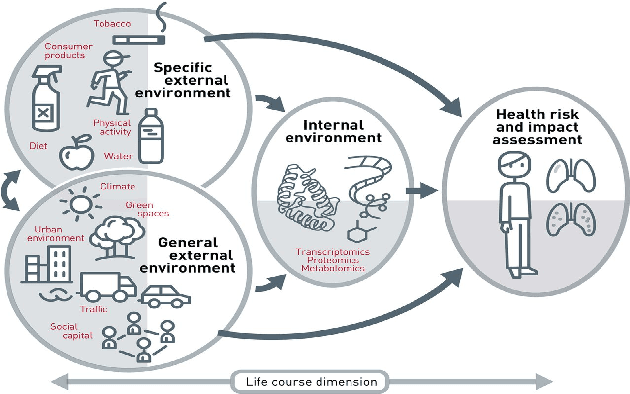
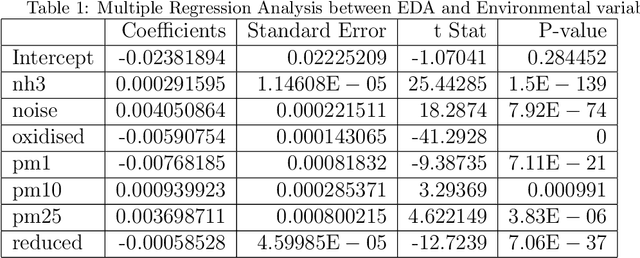
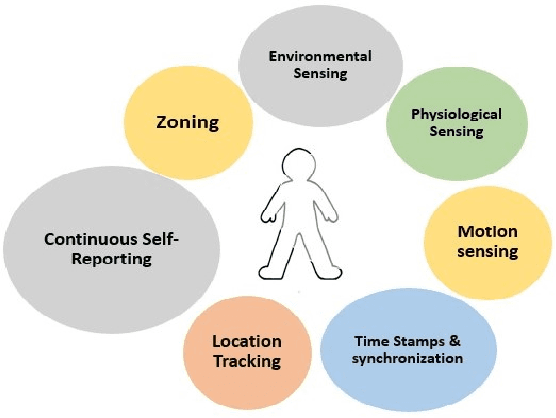
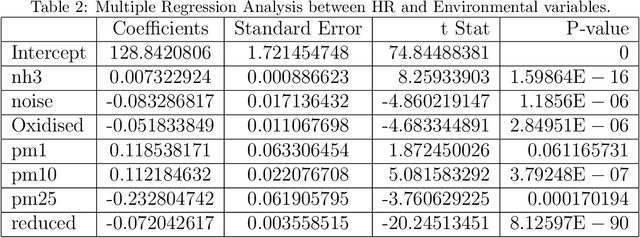
In this paper, we define the term 'DigitalExposome' as a conceptual framework that takes us closer towards understanding the relationship between environment, personal characteristics, behaviour and wellbeing using multimodel mobile sensing technology. Specifically, we simultaneously collected (for the first time) multi-sensor data including urban environmental factors (e.g. air pollution including: PM1, PM2.5, PM10, Oxidised, Reduced, NH3 and Noise, People Count in the vicinity), body reaction (physiological reactions including: EDA, HR, HRV, Body Temperature, BVP and movement) and individuals' perceived responses (e.g. self-reported valence) in urban settings. Our users followed a pre-specified urban path and collected the data using a comprehensive sensing edge devices. The data is instantly fused, time-stamped and geo-tagged at the point of collection. A range of multivariate statistical analysis techniques have been applied including Principle Component Analysis, Regression and spatial visualisations to unravel the relationship between the variables. Results showed that EDA and Heart Rate Variability HRV are noticeably impacted by the level of Particulate Matters (PM) in the environment well with the environmental variables. Furthermore, we adopted Deep Belief Network to extract features from the multimodel data feed which outperformed Convolutional Neural Network and achieved up to (a=80.8%, {\sigma}=0.001) accuracy.