 Add to Chrome
 Add to Firefox
 Add to Edge
Greedy Approaches for Packing While Travelling with Deterministic and Stochastic Constraints
Apr 15, 2026
The travelling thief problem (TTP) is a well-known multi-component optimisation problem that captures the interdependence between two components: the tour across cities and the packing of items. The packing while travelling problem (PWT) is an NP-hard subproblem of TTP where the packing of items should be optimised for a given fixed tour. In many solvers, the packing component is often addressed using greedy heuristics. Here, the use of suitable greedy functions is essential for the success of greedy algorithms. In this paper, we introduce new reward functions tailored to the PWT and extend them to a hyper-heuristic framework to achieve further advantage. Furthermore, we investigate the chance constrained PWT for greedy approaches and adopt the newly introduced reward functions for stochastic weights. The experimental results clearly demonstrate the benefit of the tailored heuristics over the standard heuristics in both deterministic and stochastic constraints.

Weighted-Scenario Optimisation for the Chance Constrained Travelling Thief Problem
May 01, 2025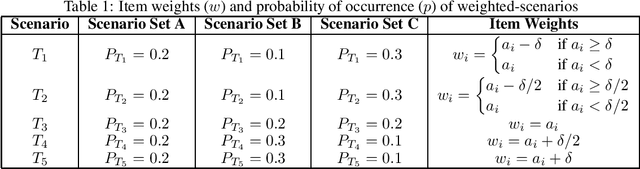
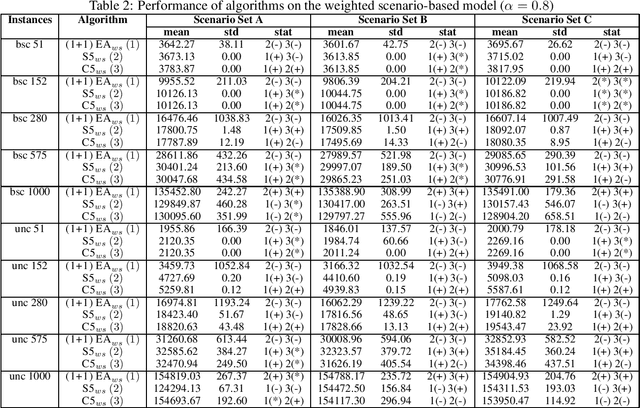
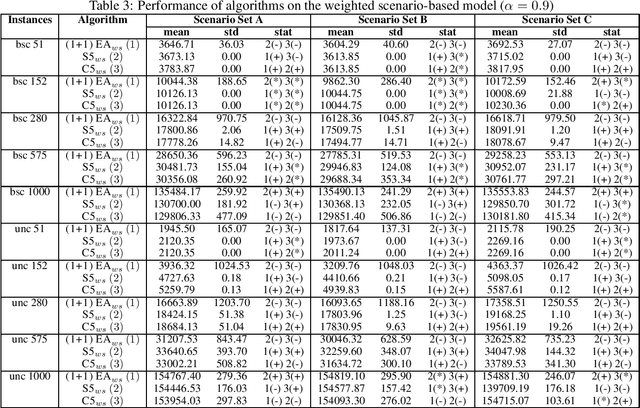
The chance constrained travelling thief problem (chance constrained TTP) has been introduced as a stochastic variation of the classical travelling thief problem (TTP) in an attempt to embody the effect of uncertainty in the problem definition. In this work, we characterise the chance constrained TTP using a limited number of weighted scenarios. Each scenario represents a similar TTP instance, differing slightly in the weight profile of the items and associated with a certain probability of occurrence. Collectively, the weighted scenarios represent a relaxed form of a stochastic TTP instance where the objective is to maximise the expected benefit while satisfying the knapsack constraint with a larger probability. We incorporate a set of evolutionary algorithms and heuristic procedures developed for the classical TTP, and formulate adaptations that apply to the weighted scenario-based representation of the problem. The analysis focuses on the performance of the algorithms on different settings and examines the impact of uncertainty on the quality of the solutions.