 Add to Chrome
 Add to Firefox
 Add to Edge
Integrating Background Knowledge for Scalable Causal Discovery
Jul 11, 2026
Expert background knowledge is often available in practical applications of causal discovery. Such constraints on the true causal graph can help causal discovery in terms of identifiability of causal effects and accuracy of the learned structure, but also in reducing the space of candidate causal graphs. As causal discovery can become computationally expensive for large number of variables, it is crucial to utilize background knowledge effectively during the causal discovery process. However, most current methods only use background knowledge in a postprocessing step after causal discovery to refine the learned graph. In this work, we develop a framework for utilizing background knowledge during the causal discovery process, focusing especially on scalable causal discovery methods that recover only a subset of the whole graph. We implement our framework for multiple algorithms and empirically show that utilizing background knowledge can both reduce computational requirements and increase the quality of the learned structures.

Information Leakage of Sentence Embeddings via Generative Embedding Inversion Attacks
Apr 23, 2025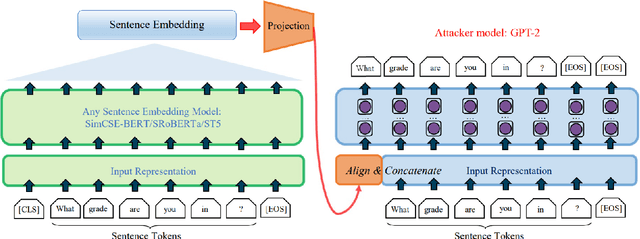
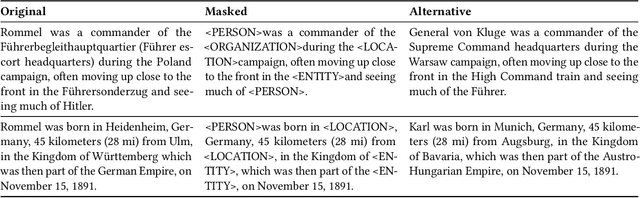
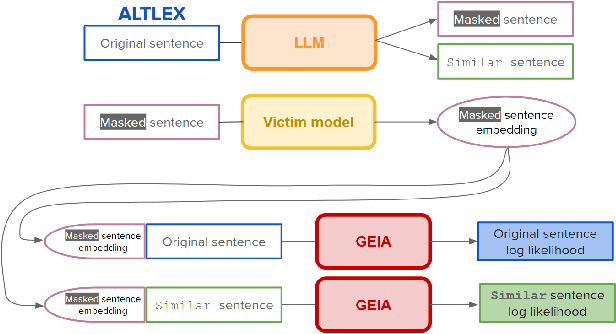
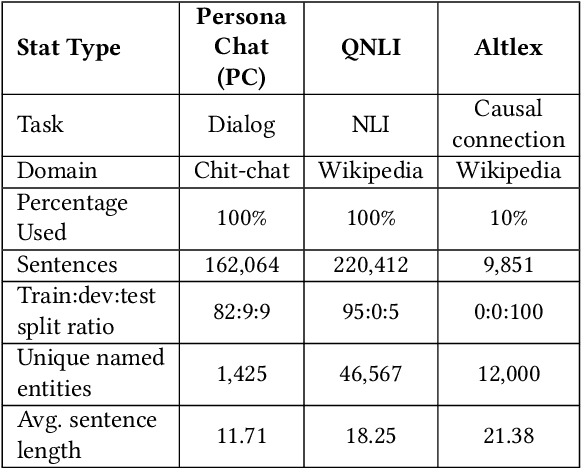
Text data are often encoded as dense vectors, known as embeddings, which capture semantic, syntactic, contextual, and domain-specific information. These embeddings, widely adopted in various applications, inherently contain rich information that may be susceptible to leakage under certain attacks. The GEIA framework highlights vulnerabilities in sentence embeddings, demonstrating that they can reveal the original sentences they represent. In this study, we reproduce GEIA's findings across various neural sentence embedding models. Additionally, we contribute new analysis to examine whether these models leak sensitive information from their training datasets. We propose a simple yet effective method without any modification to the attacker's architecture proposed in GEIA. The key idea is to examine differences between log-likelihood for masked and original variants of data that sentence embedding models have been pre-trained on, calculated on the embedding space of the attacker. Our findings indicate that following our approach, an adversary party can recover meaningful sensitive information related to the pre-training knowledge of the popular models used for creating sentence embeddings, seriously undermining their security. Our code is available on: https://github.com/taslanidis/GEIA