 Add to Chrome
 Add to Firefox
 Add to Edge
Spectral Embeddings Leak Graph Topology: Theory, Benchmark, and Adaptive Reconstruction
Apr 22, 2026
Graph Neural Networks (GNNs) excel on relational data, but standard benchmarks unrealistically assume the graph is centrally available. In practice, settings such as Federated Graph Learning, distributed systems, and privacy-sensitive applications involve graph data that are localized, fragmented, noisy, and privacy-leaking. We present a unified framework for this setting. We introduce LoGraB (Local Graph Benchmark), which decomposes standard datasets into fragmented benchmarks using three strategies and four controls: neighborhood radius $d$, spectral quality $k$, noise level $σ$, and coverage ratio $p$. LoGraB supports graph reconstruction, localized node classification, and inter-fragment link prediction, with Island Cohesion. We propose AFR (Adaptive Fidelity-driven Reconstruction), a method for noisy spectral fragments. AFR scores patch quality via a fidelity measure combining a gap-to-truncation stability ratio and structural entropy, then assembles fragments using RANSAC-Procrustes alignment, adaptive stitching, and Bundle Adjustment. Rather than forcing a single global graph, AFR recovers large faithful islands. We prove heat-kernel edge recovery under a separation condition, Davis--Kahan perturbation stability, and bounded alignment error. We establish a Spectral Leakage Proposition: under a spectral-gap assumption, polynomial-time Bayesian recovery is feasible once enough eigenvectors are shared, complementing AFR's deterministic guarantees. Experiments on nine benchmarks show that LoGraB reveals model strengths and weaknesses under fragmentation, AFR achieves the best F1 on 7/9 datasets, and under per-embedding $(ε,δ)$-Gaussian differential privacy, AFR retains 75% of its undefended F1 at $ε=2$. Our anonymous code is available at https://anonymous.4open.science/r/JMLR_submission

Energy Scale Degradation in Sparse Quantum Solvers: A Barrier to Quantum Utility
Mar 11, 2025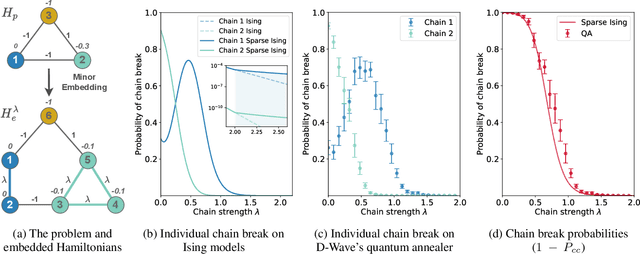
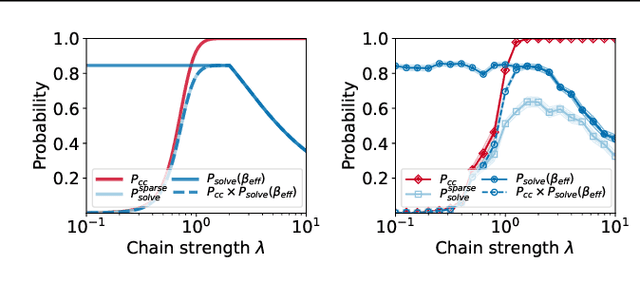
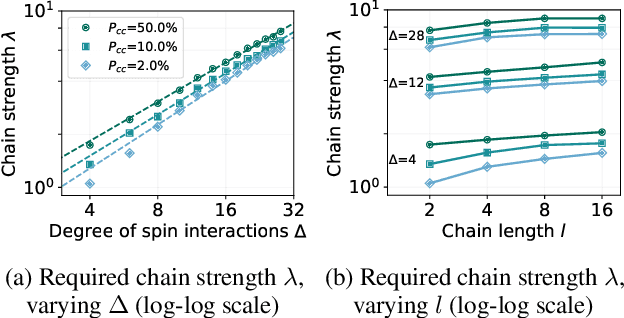
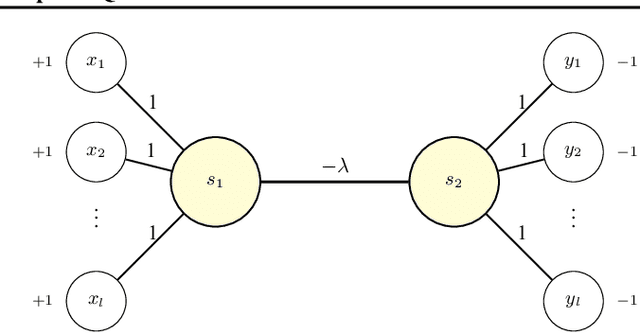
Quantum computing offers a promising route for tackling hard optimization problems by encoding them as Ising models. However, sparse qubit connectivity requires the use of minor-embedding, mapping logical qubits onto chains of physical qubits, which necessitates stronger intra-chain coupling to maintain consistency. This elevated coupling strength forces a rescaling of the Hamiltonian due to hardware-imposed limits on the allowable ranges of coupling strengths, reducing the energy gaps between competing states, thus, degrading the solver's performance. Here, we introduce a theoretical model that quantifies this degradation. We show that as the connectivity degree increases, the effective temperature rises as a polynomial function, resulting in a success probability that decays exponentially. Our analysis further establishes worst-case bounds on the energy scale degradation based on the inverse conductance of chain subgraphs, revealing two most important drivers of chain strength, \textit{chain volume} and \textit{chain connectivity}. Our findings indicate that achieving quantum advantage is inherently challenging. Experiments on D-Wave quantum annealers validate these findings, highlighting the need for hardware with improved connectivity and optimized scale-aware embedding algorithms.
Blockchain-based Secure Client Selection in Federated Learning
May 11, 2022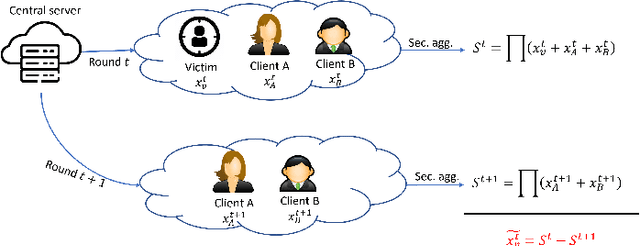
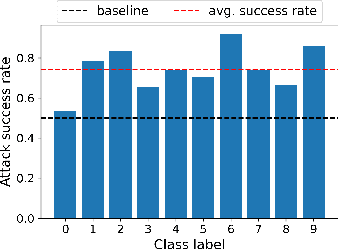
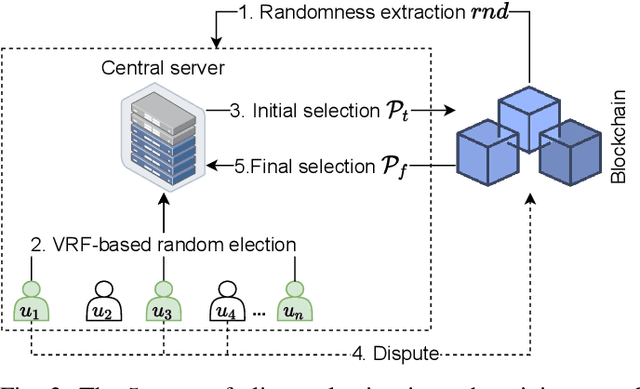
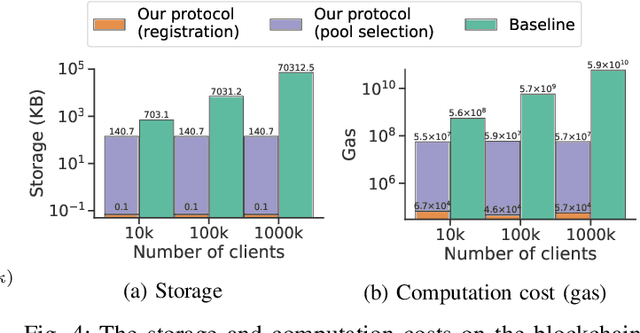
Despite the great potential of Federated Learning (FL) in large-scale distributed learning, the current system is still subject to several privacy issues due to the fact that local models trained by clients are exposed to the central server. Consequently, secure aggregation protocols for FL have been developed to conceal the local models from the server. However, we show that, by manipulating the client selection process, the server can circumvent the secure aggregation to learn the local models of a victim client, indicating that secure aggregation alone is inadequate for privacy protection. To tackle this issue, we leverage blockchain technology to propose a verifiable client selection protocol. Owing to the immutability and transparency of blockchain, our proposed protocol enforces a random selection of clients, making the server unable to control the selection process at its discretion. We present security proofs showing that our protocol is secure against this attack. Additionally, we conduct several experiments on an Ethereum-like blockchain to demonstrate the feasibility and practicality of our solution.