 Add to Chrome
 Add to Firefox
 Add to Edge
Waveform Design for ISAC System: A Consensus ADMM Approach
Feb 17, 2026
We study joint transmit-waveform and receive-filter design for a multi-user downlink integrated sensing and communication (ISAC) system under practical constant-modulus and similarity constraints. We cast the design as a unified multi-objective program that balances communication sum rate and sensing signal-to-interference-plus-noise ratio (SINR). To address this, we introduce an efficient algorithm that use consensus alternating direction method of multipliers (ADMM) framework to alternately update the transmit waveform and radar filter. The proposed method effectively handles the non-convex fractional sensing's SINR formulation and ensures fast convergence. Simulation results demonstrate that the proposed approach achieves better trade-offs between communication sum rate and sensing's SINR compared to existing benchmark schemes.

Sparse Orthogonal Matching Pursuit-based Parameter Estimation for Integrated Sensing and Communications
Mar 04, 2025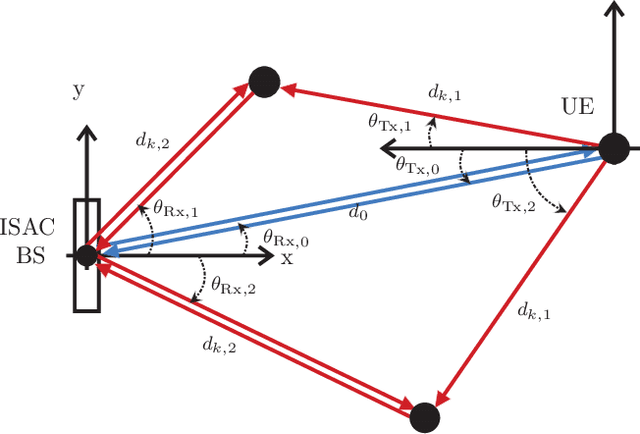

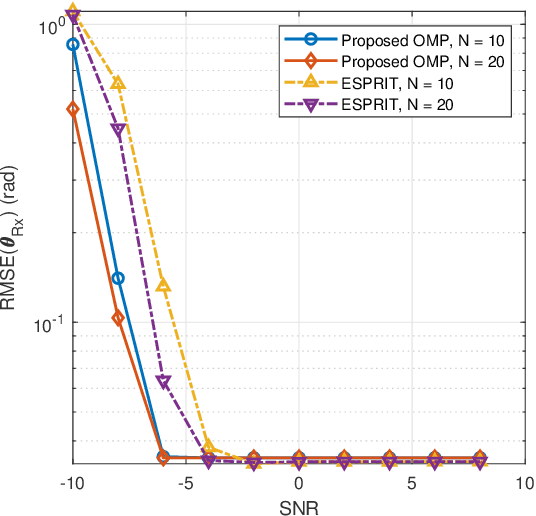
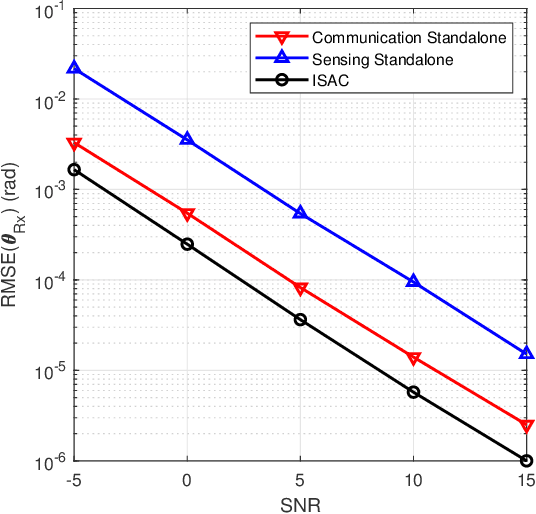
Accurate parameter estimation such as angle of arrival (AOA) is essential to enhance the performance of integrated sensing and communication (ISAC) in mmWave multiple-input multiple-output (MIMO) systems. This work presents a sensing-aided communication channel estimation mechanism, where the sensing channel shares the same AOA with the uplink communication channel. First, we propose a novel orthogonal matching pursuit (OMP)-based method for coarsely estimating the AOA in a sensing channel, offering improved accuracy compared to conventional methods that rely on rotational invariance techniques. Next, we refine the coarse estimates obtained in the first step by modifying the Space-Alternating Generalized Expectation Maximization algorithm for fine parameter estimation. Through simulations and mathematical analysis, we demonstrate that scenarios with shared AOA achieve a better Cramer-Rao lower bound (CRLB) than those without sharing. This finding highlights the potential of leveraging joint sensing and communication channels to enhance parameter estimation accuracy, particularly in channel or location estimation applications.