 Add to Chrome
 Add to Firefox
 Add to Edge
An Elementary Proof of the Near Optimality of LogSumExp Smoothing
Dec 11, 2025
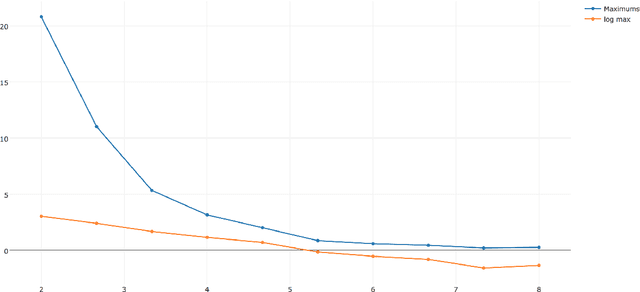
We consider the design of smoothings of the (coordinate-wise) max function in $\mathbb{R}^d$ in the infinity norm. The LogSumExp function $f(x)=\ln(\sum^d_i\exp(x_i))$ provides a classical smoothing, differing from the max function in value by at most $\ln(d)$. We provide an elementary construction of a lower bound, establishing that every overestimating smoothing of the max function must differ by at least $\sim 0.8145\ln(d)$. Hence, LogSumExp is optimal up to constant factors. However, in small dimensions, we provide stronger, exactly optimal smoothings attaining our lower bound, showing that the entropy-based LogSumExp approach to smoothing is not exactly optimal.

On the Consistency of Graph-based Bayesian Learning and the Scalability of Sampling Algorithms
Oct 20, 2017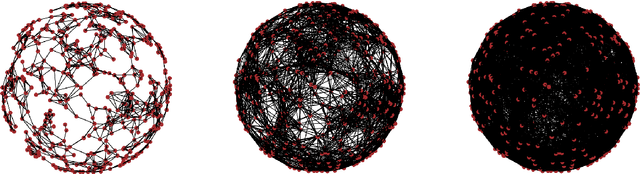

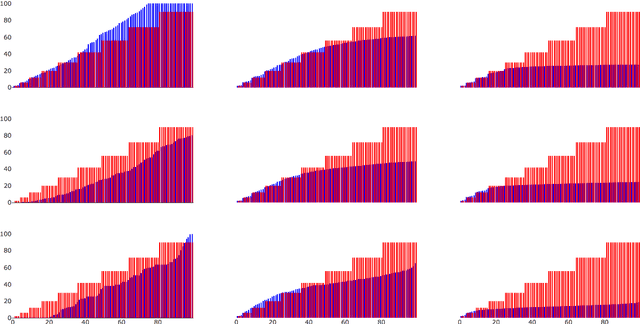
A popular approach to semi-supervised learning proceeds by endowing the input data with a graph structure in order to extract geometric information and incorporate it into a Bayesian framework. We introduce new theory that gives appropriate scalings of graph parameters that provably lead to a well-defined limiting posterior as the size of the unlabeled data set grows. Furthermore, we show that these consistency results have profound algorithmic implications. When consistency holds, carefully designed graph-based Markov chain Monte Carlo algorithms are proved to have a uniform spectral gap, independent of the number of unlabeled inputs. Several numerical experiments corroborate both the statistical consistency and the algorithmic scalability established by the theory.