 Add to Chrome
 Add to Firefox
 Add to Edge
Spatial Competition for Low-Complexity Learned Image Compression
May 13, 2026
Autoencoder-based image codecs achieve state-of-the-art compression performance but often incur high computational complexity, particularly at decoding time. This work introduces a low-complexity learned image compression framework based on spatial competition between multiple specialized neural codecs. For each image region, the encoder selects the codec that best matches the local content according to a rate-distortion cost. A mode map is transmitted as side information to indicate the per-region codec selection. At decoding time, this mode map-based selection guides reconstruction while preserving the complexity of a single codec. This design enables per-image adaptation with low decoding complexity and fast encoding. On the CLIC 2020 dataset, our method achieves up to -14.5% rate reduction compared to a single codec and reaches HEVC-level performance with a decoding complexity of 1433 MACs per pixel.

Cool-chic 5.0: Faster Encoding and Inter-Feature Entropy Modeling for Overfitted Image Compression
May 04, 2026Overfitted codecs compress an image by learning a decoder tailored to the content during the encoding. As such, they trade increased encoding complexity for strong compression performance and low decoding complexity. This work introduces Cool-chic 5.0, the latest version in the Cool-chic series of overfitted codecs, featuring an updated decoder architecture and an improved optimization process. Cool-chic 5.0 outperforms all overfitted codecs with 10 times less encoding iterations. It offers -11% rate reduction compared to the state-of-the-art conventional codec H.266/VVC. It is also competitive with modern autoencoders such as MLIC++ while featuring a decoding complexity 250 times lower. This work is made open-source at https://github.com/Orange-OpenSource/Cool-Chic.
Efficient Sub-pixel Motion Compensation in Learned Video Codecs
Jul 29, 2025Motion compensation is a key component of video codecs. Conventional codecs (HEVC and VVC) have carefully refined this coding step, with an important focus on sub-pixel motion compensation. On the other hand, learned codecs achieve sub-pixel motion compensation through simple bilinear filtering. This paper offers to improve learned codec motion compensation by drawing inspiration from conventional codecs. It is shown that the usage of more advanced interpolation filters, block-based motion information and finite motion accuracy lead to better compression performance and lower decoding complexity. Experimental results are provided on the Cool-chic video codec, where we demonstrate a rate decrease of more than 10% and a lowering of motion-related decoding complexity from 391 MAC per pixel to 214 MAC per pixel. All contributions are made open-source at https://github.com/Orange-OpenSource/Cool-Chic
BOGausS: Better Optimized Gaussian Splatting
Apr 02, 2025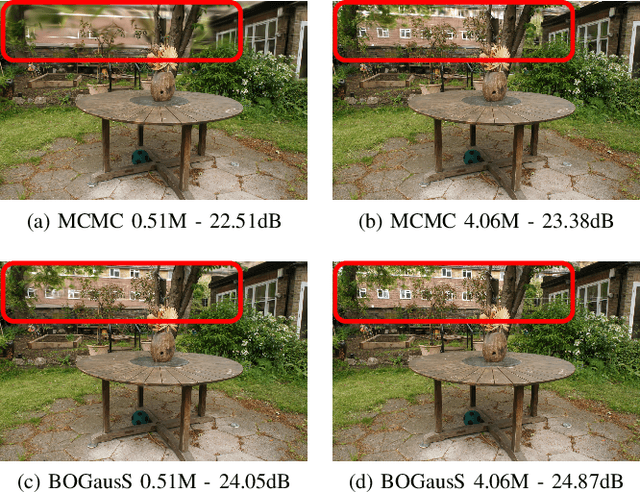
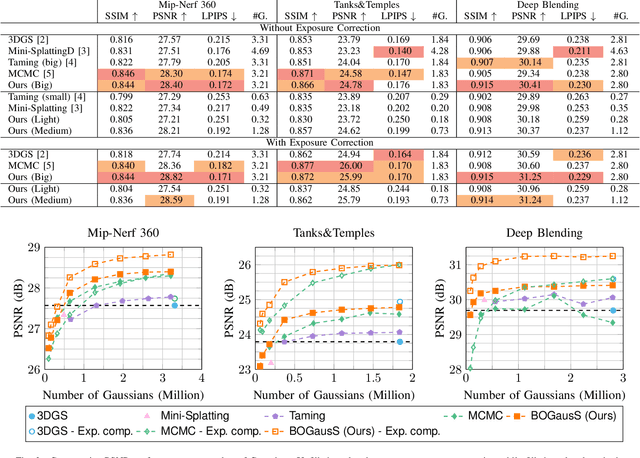
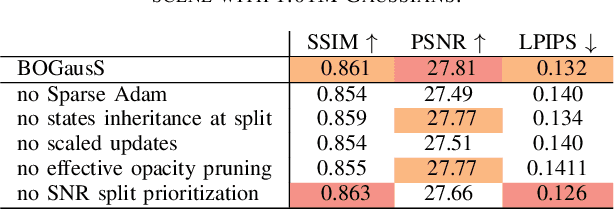
3D Gaussian Splatting (3DGS) proposes an efficient solution for novel view synthesis. Its framework provides fast and high-fidelity rendering. Although less complex than other solutions such as Neural Radiance Fields (NeRF), there are still some challenges building smaller models without sacrificing quality. In this study, we perform a careful analysis of 3DGS training process and propose a new optimization methodology. Our Better Optimized Gaussian Splatting (BOGausS) solution is able to generate models up to ten times lighter than the original 3DGS with no quality degradation, thus significantly boosting the performance of Gaussian Splatting compared to the state of the art.
Improved Encoding for Overfitted Video Codecs
Jan 28, 2025Overfitted neural video codecs offer a decoding complexity orders of magnitude smaller than their autoencoder counterparts. Yet, this low complexity comes at the cost of limited compression efficiency, in part due to their difficulty capturing accurate motion information. This paper proposes to guide motion information learning with an optical flow estimator. A joint rate-distortion optimization is also introduced to improve rate distribution across the different frames. These contributions maintain a low decoding complexity of 1300 multiplications per pixel while offering compression performance close to the conventional codec HEVC and outperforming other overfitted codecs. This work is made open-source at https://orange-opensource. github.io/Cool-Chic/
Upsampling Improvement for Overfitted Neural Coding
Nov 28, 2024Neural image compression, based on auto-encoders and overfitted representations, relies on a latent representation of the coded signal. This representation needs to be compact and uses low resolution feature maps. In the decoding process, those latents are upsampled and filtered using stacks of convolution filters and non linear elements to recover the decoded image. Therefore, the upsampling process is crucial in the design of a neural coding scheme and is of particular importance for overfitted codecs where the network parameters, including the upsampling filters, are part of the representation. This paper addresses the improvement of the upsampling process in order to reduce its complexity and limit the number of parameters. A new upsampling structure is presented whose improvements are illustrated within the Cool-Chic overfitted image coding framework. The proposed approach offers a rate reduction of 4.7%. The code is provided.
Overfitted image coding at reduced complexity
Mar 18, 2024Overfitted image codecs offer compelling compression performance and low decoder complexity, through the overfitting of a lightweight decoder for each image. Such codecs include Cool-chic, which presents image coding performance on par with VVC while requiring around 2000 multiplications per decoded pixel. This paper proposes to decrease Cool-chic encoding and decoding complexity. The encoding complexity is reduced by shortening Cool-chic training, up to the point where no overfitting is performed at all. It is also shown that a tiny neural decoder with 300 multiplications per pixel still outperforms HEVC. A near real-time CPU implementation of this decoder is made available at https://orange-opensource.github.io/Cool-Chic/.
Cool-chic video: Learned video coding with 800 parameters
Feb 06, 2024
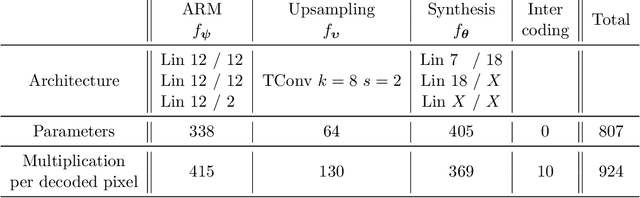
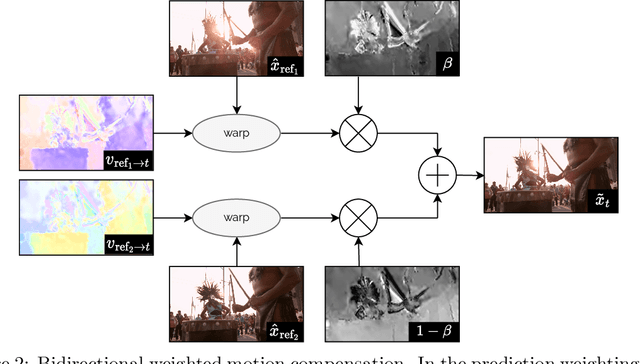
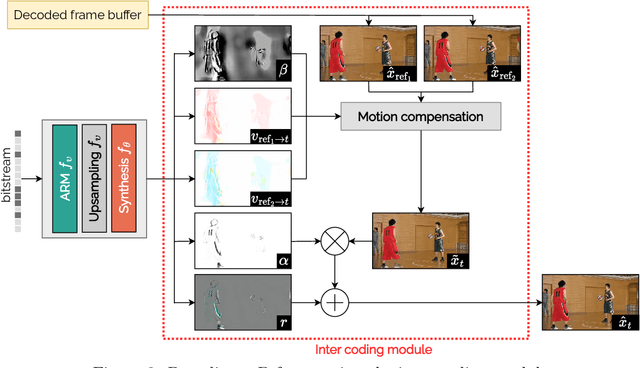
We propose a lightweight learned video codec with 900 multiplications per decoded pixel and 800 parameters overall. To the best of our knowledge, this is one of the neural video codecs with the lowest decoding complexity. It is built upon the overfitted image codec Cool-chic and supplements it with an inter coding module to leverage the video's temporal redundancies. The proposed model is able to compress videos using both low-delay and random access configurations and achieves rate-distortion close to AVC while out-performing other overfitted codecs such as FFNeRV. The system is made open-source: orange-opensource.github.io/Cool-Chic.
Cool-Chic: Perceptually Tuned Low Complexity Overfitted Image Coder
Jan 04, 2024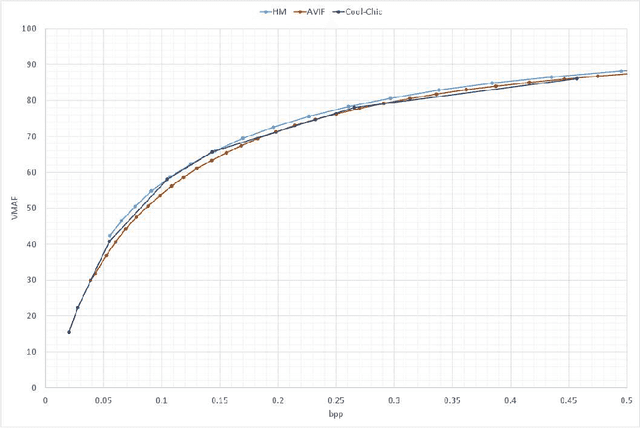

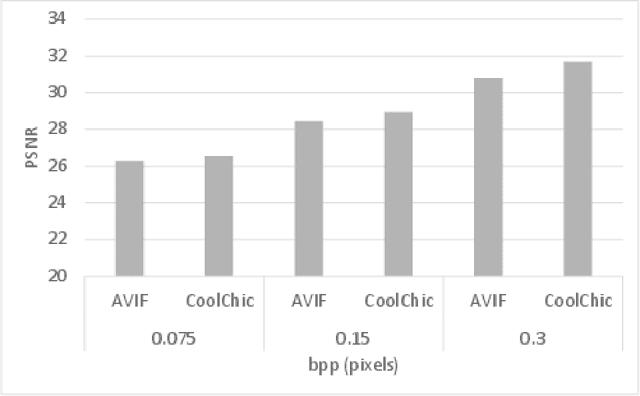
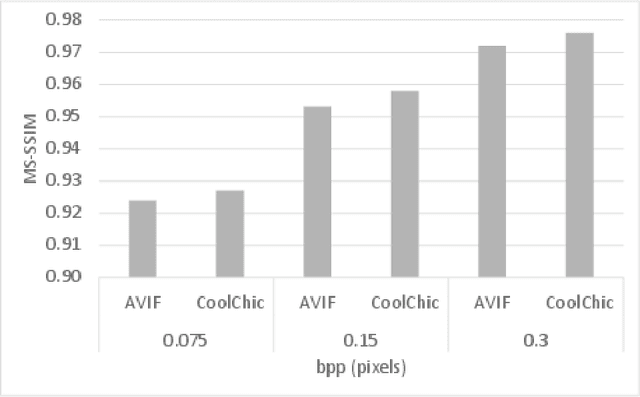
This paper summarises the design of the Cool-Chic candidate for the Challenge on Learned Image Compression. This candidate attempts to demonstrate that neural coding methods can lead to low complexity and lightweight image decoders while still offering competitive performance. The approach is based on the already published overfitted lightweight neural networks Cool-Chic, further adapted to the human subjective viewing targeted in this challenge.
ED: Perceptually tuned Enhanced Compression Model
Jan 04, 2024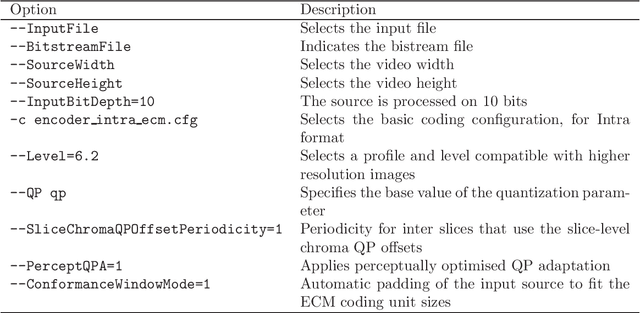


This paper summarises the design of the candidate ED for the Challenge on Learned Image Compression 2024. This candidate aims at providing an anchor based on conventional coding technologies to the learning-based approaches mostly targeted in the challenge. The proposed candidate is based on the Enhanced Compression Model (ECM) developed at JVET, the Joint Video Experts Team of ITU-T VCEG and ISO/IEC MPEG. Here, ECM is adapted to the challenge objective: to maximise the perceived quality, the encoding is performed according to a perceptual metric, also the sequence selection is performed in a perceptual manner to fit the target bit per pixel objectives. The primary objective of this candidate is to assess the recent developments in video coding standardisation and in parallel to evaluate the progress made by learning-based techniques. To this end, this paper explains how to generate coded images fulfilling the challenge requirements, in a reproducible way, targeting the maximum performance.