 Add to Chrome
 Add to Firefox
 Add to Edge
A Scaling Law for Bandwidth Under Quantization
Feb 26, 2026
We derive a scaling law relating ADC bit depth to effective bandwidth for signals with $1/f^α$ power spectra. Quantization introduces a flat noise floor whose intersection with the declining signal spectrum defines an effective cutoff frequency $f_c$. We show that each additional bit extends this cutoff by a factor of $2^{2/α}$, approximately doubling bandwidth per bit for $α= 2$. The law requires that quantization noise be approximately white, a condition whose minimum bit depth $N_{\min}$ we show to be $α$-dependent. Validation on synthetic $1/f^α$ signals for $α\in \{1.5, 2.0, 2.5\}$ yields prediction errors below 3\% using the theoretical noise floor $Δ^2/(6f_s)$, and approximately 14\% when the noise floor is estimated empirically from the quantized signal's spectrum. We illustrate practical implications on real EEG data.

Personalized identification, prediction, and stimulation of neural oscillations via data-driven models of epileptic network dynamics
Oct 20, 2023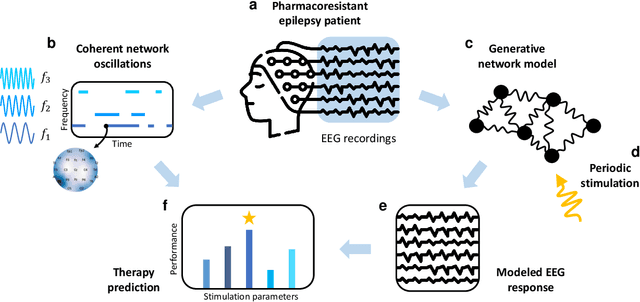
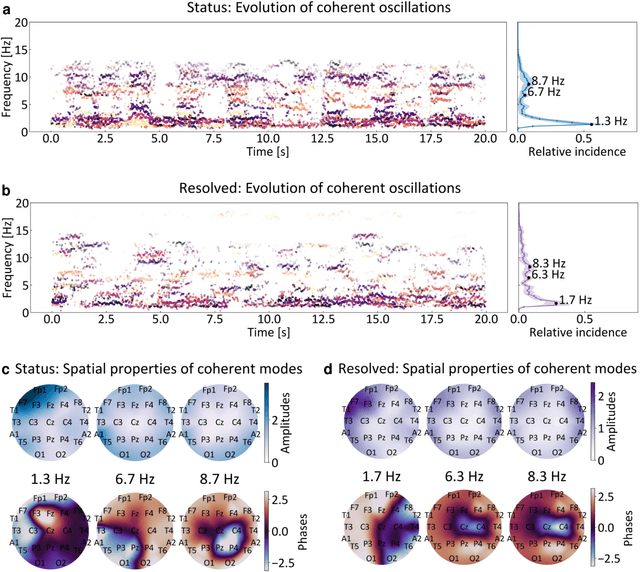
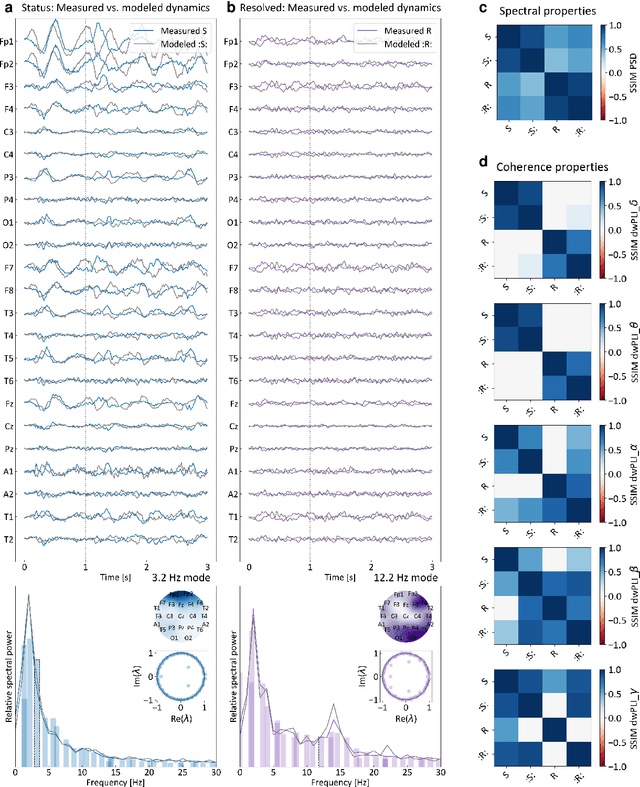
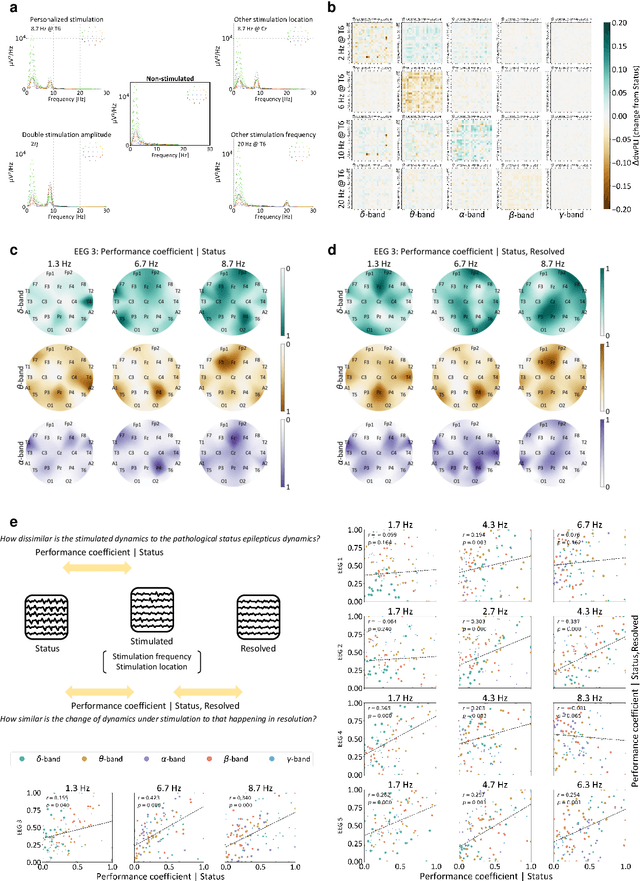
Neural oscillations are considered to be brain-specific signatures of information processing and communication in the brain. They also reflect pathological brain activity in neurological disorders, thus offering a basis for diagnoses and forecasting. Epilepsy is one of the most common neurological disorders, characterized by abnormal synchronization and desynchronization of the oscillations in the brain. About one third of epilepsy cases are pharmacoresistant, and as such emphasize the need for novel therapy approaches, where brain stimulation appears to be a promising therapeutic option. The development of brain stimulation paradigms, however, is often based on generalized assumptions about brain dynamics, although it is known that significant differences occur between patients and brain states. We developed a framework to extract individualized predictive models of epileptic network dynamics directly from EEG data. The models are based on the dominant coherent oscillations and their dynamical coupling, thus combining an established interpretation of dynamics through neural oscillations, with accurate patient-specific features. We show that it is possible to build a direct correspondence between the models of brain-network dynamics under periodic driving, and the mechanism of neural entrainment via periodic stimulation. When our framework is applied to EEG recordings of patients in status epilepticus (a brain state of perpetual seizure activity), it yields a model-driven predictive analysis of the therapeutic performance of periodic brain stimulation. This suggests that periodic brain stimulation can drive pathological states of epileptic network dynamics towards a healthy functional brain state.