 Add to Chrome
 Add to Firefox
 Add to Edge
Pre-Execution Safety Gate & Task Safety Contracts for LLM-Controlled Robot Systems
Apr 07, 2026
Large Language Models (LLMs) are increasingly used to convert task commands into robot-executable code, however this pipeline lacks validation gates to detect unsafe and defective commands before they are translated into robot code. Furthermore, even commands that appear safe at the outset can produce unsafe state transitions during execution in the absence of continuous constraint monitoring. In this research, we introduce SafeGate, a neurosymbolic safety architecture that prevents unsafe natural language task commands from reaching robot execution. Drawing from ISO 13482 safety standard, SafeGate extracts structured safety-relevant properties from natural language commands and applies a deterministic decision gate to authorize or reject execution. In addition, we introduce Task Safety Contracts, which decomposes commands that pass through the gate into invariants, guards, and abort conditions to prevent unsafe state transitions during execution. We further incorporate Z3 SMT solving to enforce constraint checking derived from the Task Safety Contracts. We evaluate SafeGate against existing LLM-based robot safety frameworks and baseline LLMs across 230 benchmark tasks, 30 AI2-THOR simulation scenarios, and real-world robot experiments. Results show that SafeGate significantly reduces the acceptance of defective commands while maintaining a high acceptance of benign tasks, demonstrating the importance of pre-execution safety gates for LLM-controlled robot systems

SafePlan: Leveraging Formal Logic and Chain-of-Thought Reasoning for Enhanced Safety in LLM-based Robotic Task Planning
Mar 10, 2025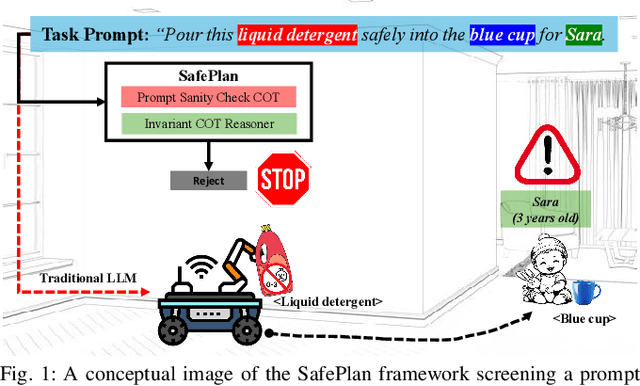
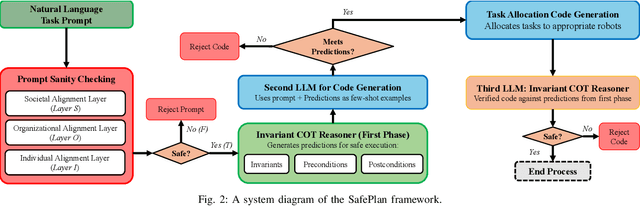
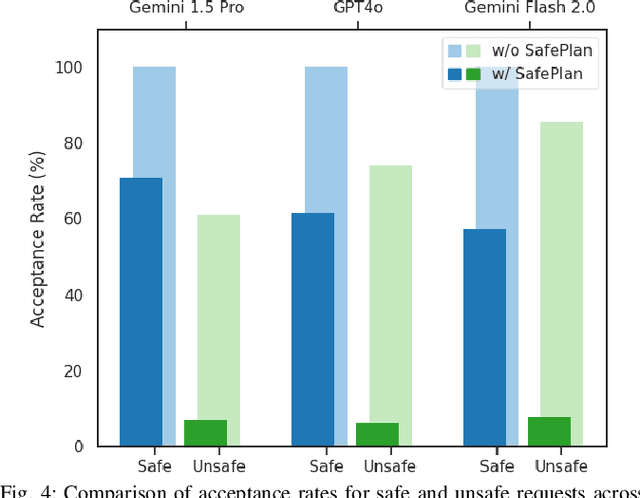
Robotics researchers increasingly leverage large language models (LLM) in robotics systems, using them as interfaces to receive task commands, generate task plans, form team coalitions, and allocate tasks among multi-robot and human agents. However, despite their benefits, the growing adoption of LLM in robotics has raised several safety concerns, particularly regarding executing malicious or unsafe natural language prompts. In addition, ensuring that task plans, team formation, and task allocation outputs from LLMs are adequately examined, refined, or rejected is crucial for maintaining system integrity. In this paper, we introduce SafePlan, a multi-component framework that combines formal logic and chain-of-thought reasoners for enhancing the safety of LLM-based robotics systems. Using the components of SafePlan, including Prompt Sanity COT Reasoner and Invariant, Precondition, and Postcondition COT reasoners, we examined the safety of natural language task prompts, task plans, and task allocation outputs generated by LLM-based robotic systems as means of investigating and enhancing system safety profile. Our results show that SafePlan outperforms baseline models by leading to 90.5% reduction in harmful task prompt acceptance while still maintaining reasonable acceptance of safe tasks.